


PASMA Training: The Ultimate Guide to Mobile Access Tower Safety in 2026
- Jun 11
- 10 min read
Updated: 2 days ago
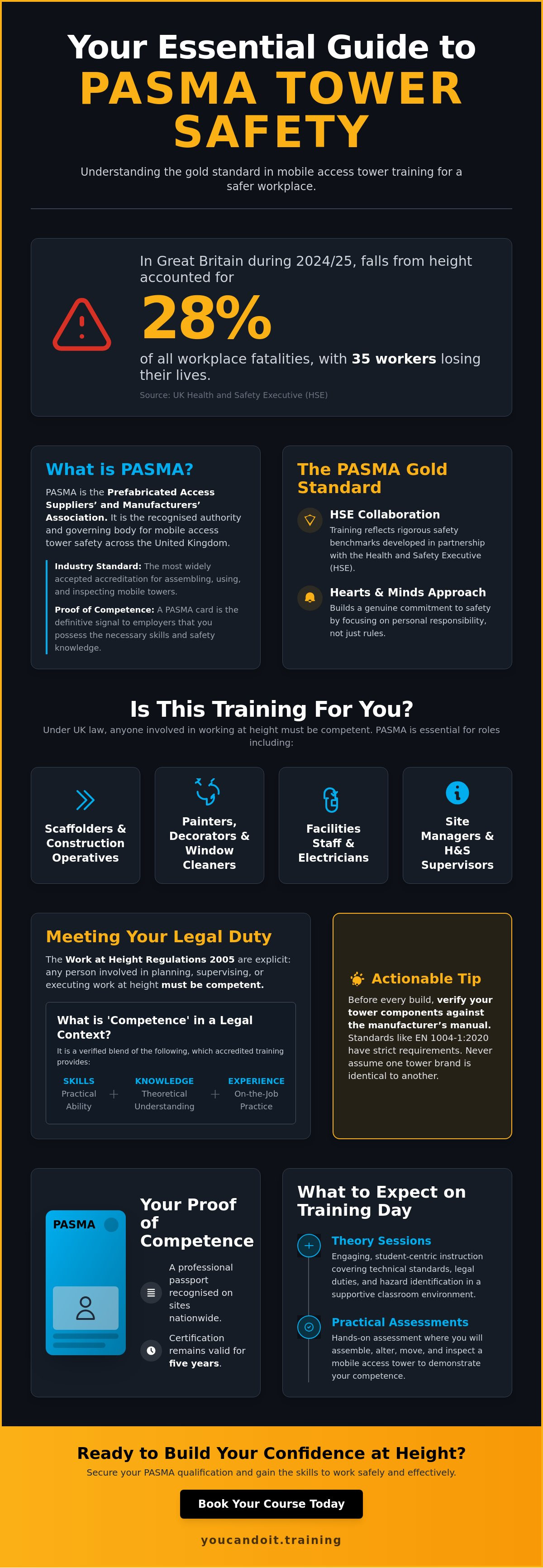
Did you know that 35 workers lost their lives to falls from height in Great Britain during the 2024/25 period, accounting for 28% of all workplace fatalities? It's a sobering statistic that highlights why securing your pasma qualification isn't just about ticking a box; it's about building the genuine confidence you need to stay safe when your feet leave the ground. We understand that staring at a list of technical health and safety standards can feel a bit like reading a foreign language, and the thought of a technical exam might even bring on a few pre-course jitters.
At You Can Do It Training Ltd, we believe in a "hearts and minds" approach, where we swap cold, clinical instruction for a warm, supportive environment filled with expert guidance and the occasional bourbon cream. This guide is designed to ignite a spark of confidence in your career by stripping away the jargon and providing a clear map to your qualification. You'll discover the essential legal requirements under the Work at Height Regulations 2005, learn how to choose the right training level for your specific role, and pick up actionable tips to ensure you pass your course with flying colours. Whether you're a site manager or a hands-on operative, we're here to ensure you have the right training, for the right job, at the right time.
Key Takeaways
Understand the legal definition of 'competence' under the Work at Height Regulations 2005 and how accredited training helps you meet these essential safety standards.
Identify the specific differences between the core Towers for Users course and combined options to ensure you choose the most relevant qualification for your daily tasks.
Discover why a pasma card is the industry-recognised gold standard, acting as a professional passport that proves your ability to safely handle mobile access towers.
Learn what to expect during your training day, from the technical theory sessions to the practical assessments conducted in a supportive, student-centric environment.
Gain practical advice on preparing for your assessment so you can approach your exam with confidence and secure a certification that remains valid for five years.
Table of Contents
Understanding PASMA: The Industry Standard for Mobile Access Towers
PASMA stands for the Prefabricated Access Suppliers’ and Manufacturers’ Association. It serves as the lead body for mobile access tower safety across the UK, acting as a guardian for those working at height. Essentially, PASMA is the industry-standard accreditation for anyone assembling or using mobile towers. When you hold a PASMA card, you aren't just carrying a piece of plastic; you're carrying the most widely recognised proof of competence in the country. It signals to employers and site managers that you have the skills, knowledge, and attitude to work safely and effectively.
Why PASMA is the Gold Standard
The association doesn't work in isolation. They collaborate closely with the Health and Safety Executive (HSE) to set the safety benchmarks that keep people safe on site. This partnership ensures that all training reflects the most rigorous Mobile Access Equipment Standards available today. At its heart, the pasma philosophy is about more than just technical rules. We focus on a "Hearts and Minds" approach, which aims to engage workers emotionally. We want you to value your own safety and the safety of your colleagues, transforming a mandatory qualification into a genuine commitment to workplace well-being. It's about igniting a spark of responsibility that stays with you long after the course finishes.
Who needs a PASMA qualification?
If your daily tasks involve leaving the ground to reach a work area, you likely need a formal qualification. This isn't just for those in high-risk sectors; it's for anyone who uses equipment to reach new heights. Key roles that benefit from our PASMA Towers for Users course include:
Scaffolders and construction operatives
Painters, decorators, and window cleaners
Facility maintenance staff and electricians
Site managers and health and safety supervisors
Even if you aren't the person physically building the tower, you still need to understand the principles of safe use. Site managers, for instance, must be able to identify an incorrectly assembled tower from the ground to protect their team. Whether you're assembling, moving, or simply supervising others, having this foundational knowledge is a legal necessity under the Work at Height Regulations 2005. It ensures that every person on site is competent and every tower is a stable, secure platform for success.
A safe site is about more than just tower stability; it also requires comprehensive protection against fire and security risks. To enhance your site's overall safety infrastructure, you can discover Scaitec Security Solutions Ltd, who provide specialist design and maintenance for electronic security and fire systems.
The Importance of Accredited Tower Training
Under the Work at Height Regulations 2005, the law is incredibly clear. Any person involved in the planning, supervision, or execution of work at height must be competent. In a legal context, competence isn't just a vague feeling of being "good at your job." It's a specific standard that requires a verified blend of skills, knowledge, and experience. Relying on "learning on the job" or watching a colleague might have felt sufficient in the past, but modern site safety demands more. Without a formal pasma qualification, you aren't just missing a card; you're potentially missing the critical safety nuances that prevent life-changing accidents.
Actionable Tip:
Before every build, verify your tower components against the specific manufacturer’s manual. Standards like EN 1004-1:2020 have introduced strict requirements for platform spacing and guardrail heights. Never assume one tower brand is identical to another.
Complying with HSE Guidelines
The Health and Safety Executive (HSE) views mobile towers as high-risk equipment if not managed correctly. They insist that towers are assembled according to the manufacturer's instructions and inspected at regular intervals, typically every seven days or after any event that could affect stability. Failing to meet these standards can lead to severe legal consequences for both the employer and the individual. You can find detailed guidance on these specific safety benchmarks on the PASMA official website.
The Human Element: Staying Safe at Height
Technical training can sometimes feel intimidating, especially when you're faced with complex tower configurations or heights that make your stomach flip. Our approach aims to dismantle that anxiety by focusing on the human connection. We foster a sense of camaraderie in our sessions, turning a dry compliance exercise into a shared learning journey. When you understand the "why" behind a safety check, the equipment becomes a tool for your success rather than a source of stress. We want to ignite a spark of confidence that makes you feel empowered every time you step onto a platform.
True site safety involves looking at the bigger picture beyond the tower itself. Knowing how to build a stable platform is vital, but being prepared for emergencies is equally important for a well-rounded safety profile. This is why many of our students also look into a first aid at work course to ensure they are fully equipped for any situation. If you're ready to build your skills in a supportive environment, checking out the range of options at You Can Do It Training Ltd is a brilliant way to start your journey toward a safer career.
Choosing the Right PASMA Course for Your Career
Selecting the right path for your professional development shouldn't feel like a guessing game. While the variety of options might seem overwhelming at first, your choice usually boils down to how you interact with equipment on a daily basis. The Towers for Users course is the essential starting point for anyone physically assembling mobile towers. If you're the person clicking the braces into place or checking the outriggers, this is your foundation. It provides the core skills needed to ensure every build is stable and secure.
For those who lead teams but never actually climb the rungs, the Towers for Managers course is a better fit. It focuses on the legal oversight and inspection duties required to keep a site compliant without the need for practical assembly. If your work involves a mix of tall towers and smaller indoor tasks, "Combi" options are brilliant. They provide the flexibility to work on both standard towers and low-level access units, ensuring you're prepared for any environment you encounter. This commitment to professional growth is mirrored by international training leaders like Trainetics Academy, who specialise in empowering individuals through comprehensive educational programmes.
Practical Tip:
Always check the back of your PASMA card. It lists the specific categories you're qualified for. If you're asked to build a tower on a staircase but your card only says "Towers for Users," stop and request the correct training to stay within the law and keep your team safe.
PASMA Towers for Users: What You Will Learn
This course is where theory meets the reality of the site. You'll spend time in a relaxed classroom setting before heading out for the practical assessment. The curriculum covers the full lifecycle of a tower: assembly, moving, dismantling, and thorough inspection. You'll learn the 3T (Through The Trapdoor) and AGR (Advance Guard Rail) methods, which are critical for staying safe whilst you build. It's a hands-on experience designed to build your confidence through practice and peer camaraderie.
Specialist Courses: Stairs and Low-Level Access
Sometimes, a standard tower isn't enough. If you're working in a tight stairwell, you'll need the specialist "Towers on Stairs" qualification to handle those unique configurations safely. These advanced skills often sit alongside broader site qualifications. For example, if you've already completed your SSSTS or SMSTS, adding a pasma certificate demonstrates a comprehensive commitment to safety. This alignment with HSE Tower Scaffold Guidance ensures that your site remains a beacon of best practice. Ready to take the next step in your career? You can book your PASMA Towers for Users course today and join the thousands of professionals who trust us to help them soar.
The Training Experience: What to Expect on the Day
Walking into a training centre shouldn't feel like walking into a courtroom. We've designed a learning environment that is relaxed yet professional, where genuine learning thrives through human connection. You'll be greeted with a warm welcome and, naturally, plenty of tea and coffee. We even make sure there’s a steady supply of bourbon creams to keep your energy up whilst you study. This hospitable British culture is a key part of our "Hearts and Minds" philosophy. It’s about making you feel comfortable so you can focus on the technical side of pasma training without the intimidation often found in health and safety compliance.
Practical Tip:
Download the PASMA app on your phone. It allows you to store a digital version of your card and provides instant access to assembly guides. This is a brilliant way to stay compliant with HSE guidelines whilst on the move.
A Personalised Approach to Safety
Our instructors aren't just here to read from a set of slides. They take a genuine interest in your background and the specific challenges you face on site. We make a point of explaining technical jargon in plain English, ensuring that no one feels left behind. This student-centric approach fosters a sense of camaraderie amongst the group, making the learning experience both productive and enjoyable.
Next Steps: Booking Your Training
Finding the right training, for the right people, at the right price is essential for your career growth. We're here to help you navigate the requirements and choose the path that best suits your needs. If you're ready to ignite a spark of confidence in your safety skills, we invite you to explore our range of accredited working at height training courses today. Let's get you qualified and back on site with the confidence you deserve.
Take Your Career to New Heights with Confidence
Mastering mobile access tower safety is about much more than just following a set of regulations; it's about making a personal commitment to your own well-being and that of your team. By choosing the right pasma course, you're not just securing a card for the next five years. You're gaining the practical expertise needed to handle complex builds and the legal knowledge to keep your site fully compliant with HSE standards. This guide has shown that whether you are assembling towers or managing them, the path to competence is clear and achievable when you have the right mentor by your side.
As a fully accredited provider and a Chartered member of IOSH, we take pride in our "Hearts and Minds" approach to safety training. We've helped thousands of professionals succeed, maintaining a 99% pass rate across all our safety courses by fostering a supportive, hospitable learning environment where every student is put at the heart of the experience. If you're ready to ignite that spark of achievement and advance your career, it's time to take the next step. Book your PASMA Towers for Users course with the experts today and experience the difference that personalised, professional guidance can make. You have the potential to lead the way in site safety, and we're here to help you soar. Remember, you can do it.
Frequently Asked Questions
How long does a PASMA card last before it expires?
A PASMA card is valid for five years from the date you successfully complete your training. Once this period ends, you'll need to attend a refresher course to renew your qualification and ensure your skills stay aligned with the latest safety standards. It is a brilliant way to stay current with any shifts in legislation or improvements in tower design that have occurred since your last assessment.
Can I use a mobile tower if I only have a CSCS card?
No, a CSCS card is not a substitute for specialised tower training. Whilst a CSCS card proves you have a basic level of health and safety awareness on a construction site, it doesn't demonstrate the specific competence required by the Work at Height Regulations 2005. Holding a pasma card is the industry-recognised gold standard that proves you can safely assemble, move, and dismantle mobile towers.
Is there a practical test involved in the PASMA Towers for Users course?
Yes, the course consists of both a theory session and a hands-on practical assessment. You'll work alongside your colleagues to physically build and dismantle a tower under the guidance of an expert instructor. This ensures you can apply the safety principles learned in the classroom to a real-world scenario, giving you the confidence to operate equipment safely when you return to your own site.
What is the difference between PASMA and IPAF training?
The difference is simply the type of equipment you are being trained to use. PASMA is the authority for mobile access towers, which are prefabricated scaffolding units assembled by hand. IPAF training covers Mobile Elevated Work Platforms (MEWPs), such as cherry pickers and scissor lifts. Many site professionals choose to hold both qualifications to ensure they are prepared for any task that requires working at height.
Do I need to bring my own safety equipment to the PASMA course?
You will generally need to bring your own standard Personal Protective Equipment (PPE), such as a hard hat, safety boots, and gloves. We provide the mobile towers and all necessary assembly components for the practical part of the day. If you are unsure about what to bring, just give us a ring; we're always happy to help you prepare so you can focus on enjoying the learning experience.


Comments