
Plant Machinery Training: CPCS, NPORS & PUWER Guide 2026
Table of Contents
- What Plant Machinery Training Actually Covers (And What It Doesn’t)
- CPCS Training Courses: What Each Category Involves
- Plant Machinery Operator Certification Duration: How Long Each Route Takes
- PUWER Regulations for Plant Operators: What Employers Must Evidence
- Choosing a Plant Machinery Training Provider: What to Check Before You Book
- On-Site vs Off-Site Delivery: Protecting Your Programme
- Frequently Asked Questions
Last Updated: September 29, 2026
What Plant Machinery Training Actually Covers (And What It Doesn’t)
Plant machinery training is the structured instruction that gives operators the knowledge and practical skill to run excavators, telehandlers, dumpers and similar equipment safely and legally. This guide from You Can Do It Training breaks down the three certification routes, the time each one takes, and what employers must evidence under PUWER.
Here’s what most course listings won’t tell you: training covers safe operation, pre-use checks, load handling and emergency procedures. It does not make someone competent on every machine in a category.
Most guides treat certification as the finish line. It isn’t. Certification proves someone was assessed as competent on a specific machine on a specific day. Competence is what they demonstrate on site, every shift, on equipment they may not have touched for months.
That gap between the certificate and the reality is where accidents live. Understanding it changes how you book training, how long you allow, and what you ask a provider before you commit.
The Three Routes: CPCS, NPORS and In-House Certification
Three recognised routes dominate: CPCS, NPORS and in-house certification. CPCS and NPORS are the schemes most major contractors and principal contractors accept at the gate. In-house certification works only where the employer controls access and accepts the risk.
The practical difference matters. A CPCS or NPORS card is portable and recognised across sites. An in-house certificate is not, and many principal contractors will turn an operator away at the gate without a scheme card.
CPCS Training Courses: What Each Category Involves
CPCS training courses are category-specific. You don’t get “a CPCS card”; you get a card for a named category, such as excavator above 10 tonnes, telehandler, or forward-tipping dumper. Each category has its own machine, its own hazards and its own assessment.
Categories broadly split into:
- Lifting and earthmoving: excavators, telehandlers, loading shovels
- Transporting: dumpers, dump trucks
- Access and specialist: MEWPs, compact cranes, agricultural plant
A common mistake is booking one category and assuming it covers a similar machine. It doesn’t. An operator certified on a 5-tonne excavator is not automatically certified on a 20-tonne machine.
Theory Test, Practical Test and the Red Card
The CPCS route runs through a theory test, then a practical test. Pass both and you receive the Red Card, formally the Trained Operator Card. It’s valid for two years and confirms you’ve been assessed but are still building experience.
After the Red Card period, operators typically progress to the Blue Competent Operator Card by completing an NVQ. What most people miss is that the Red Card is a starting point, not a destination. Employers who treat it as the end of the process are storing up problems.
Booking a practical test before the candidate has enough machine hours is the most common cause of failure. The consequence isn’t just the resit fee; it’s a lost day on site, a rebooked test slot, and a machine sitting idle.
Plant Machinery Operator Certification Duration: How Long Each Route Takes
Plant machinery operator certification duration depends on the route, the category and the candidate’s existing experience. There’s no single answer, and any provider quoting one fixed number for everyone is oversimplifying.
| Route | Typical Duration | Best For |
|---|---|---|
| Novice CPCS (per category) | Several days of training plus tests | New operators with no machine time |
| Experienced worker assessment | 1-2 days | Operators with years of seat time but no card |
| NPORS (per category) | Varies by category and experience | Teams needing flexible delivery |
| In-house induction | Hours to a day | Employer-controlled sites only |
The real variable is experience. A candidate who has run an excavator for years but never sat a test needs far less time than a complete novice. Matching the route to the person saves both money and downtime.
Ask candidates to log their machine hours before booking. An operator with 500 hours behind them doesn’t need the same course length as someone with none, and paying for novice training they don’t need is money burned.
PUWER Regulations for Plant Operators: What Employers Must Evidence
PUWER regulations for plant operators sit at the centre of employer duty. The Provision and Use of Work Equipment Regulations 1998 require that work equipment is suitable, maintained, inspected and used only by competent people (Provision and Use of Work Equipment Regulations 1998 (PUWER) – overview). That’s a legal duty, not a box to tick once.
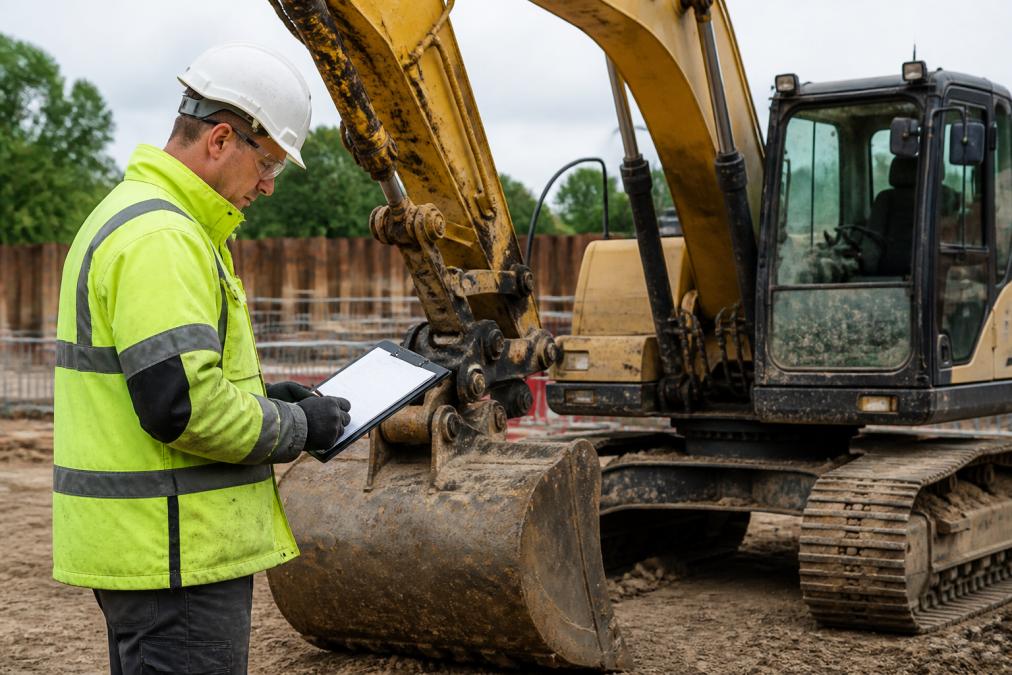
The employer must be able to evidence several things if an inspector or a principal contractor asks:
- That operators are trained and competent for the specific machine
- That pre-use checks and inspections are recorded
- That equipment is maintained and any defects are logged and fixed
- That refresher training happens at sensible intervals
The HSE guidance on PUWER is clear that competence is about more than a card. It’s about knowledge, training and experience combined.
Competence, Inspection Records and Refresher Intervals
Competence is the combination of training, experience and the judgement to know when to stop. A card is evidence of training; it says nothing about whether someone will refuse to operate a machine with a visible defect.
Inspection records are where many employers fall down. Daily pre-use checks, recorded and signed, are the simplest defence you have. Without them, an incident investigation starts from a weak position.
Refresher intervals aren’t fixed in law. A common approach is to refresh where there’s been a gap in operating, a change in machine, or an incident. Many employers also refresh on a set cycle as a matter of policy.
Choosing a Plant Machinery Training Provider: What to Check Before You Book
The right provider is the one that fits your sites, your schedule and your compliance needs, not the one with the glossiest brochure. Before you book, check these:
- Accreditation: Are they approved to deliver the scheme you need?
- Delivery options: Can they come to your site, or must your team travel?
- Instructor experience: Do trainers have real site experience, not just classroom time?
- Scheduling: Can they work around your programme so you don’t lose weeks?
- References: Can they show you other firms with similar needs?
You Can Do It Training delivers accredited plant machinery training with expert instructors and hands-on assessment, and courses are designed to avoid disrupting construction programmes. Pulling a whole team off site for a week costs far more than the course fee.
What most guides miss is that the cheapest quote often isn’t the cheapest outcome. A provider who can train on your site, around your schedule, and get your operators certified without a shutdown is usually worth more than the saving on the day rate.
On-Site vs Off-Site Delivery: Protecting Your Programme
On-site delivery keeps your team on the machines they actually use and removes travel time from the equation. Off-site delivery suits individuals, apprentices and anyone who needs access to a wider range of equipment than your yard holds.
For a team of operators, on-site usually wins on cost and disruption. For one or two people, or for a category you don’t own, off-site makes more sense. The decision comes down to numbers, machine availability and how much downtime you can absorb.
You Can Do It Training offers both approaches, which means the delivery method can be matched to the job rather than forced into a template. For teams spread across several sites, that flexibility is often the deciding factor.
CITB on plant operator competence sets out how the industry expects competence to be built and evidenced, and it’s worth reading before you finalise a training plan.
Plant machinery training only pays off when it’s matched to the machine, the person and the site. Get that wrong and you’re paying for cards that don’t cover the work and downtime you didn’t need to lose.
You Can Do It Training provides accredited, industry-recognised plant machinery training with expert instructors, hands-on assessment, and scheduling built around your programme. Whether you need one operator certified or a whole team, we’ll help you meet site requirements without grinding your project to a halt.
Get started with You Can Do It Training and put your operators on the machines with the certification and competence your sites demand.
Frequently Asked Questions
What is the difference between CPCS and NPORS plant machinery training?
CPCS issues a red card after the relevant theory and practical tests, then a blue competence card once you have logged on-site experience and completed the NVQ. NPORS works differently: it is delivered by accredited training providers who test and register you directly, and it is widely accepted on site. Both are recognised routes into plant machinery training, but some principal contractors specify one scheme over the other, so check the site requirements before booking.
How long does it take to get a plant operator ticket?
Plant machinery operator certification duration depends on the machine category and your existing experience. A novice course for a single category such as a 360 excavator usually runs several days, covering theory, practical training and assessment. Experienced operators who only need testing can often complete it in a day. Where you need multiple categories, expect the total to stretch across several weeks, and factor in the NVQ period if you are working towards a blue CPCS card.
Do I need a CSCS card to operate plant machinery?
A CSCS card alone does not entitle you to operate plant. CSCS cards evidence general health, safety and environment awareness, and many sites require one for access. Operating a specific machine needs a separate competence card, such as CPCS or NPORS, for that category. In practice most operators hold both: a CSCS card to get through the gate and a plant ticket to run the machine.
How often should plant machinery operator training be refreshed?
There is no single statutory refresh interval for plant operators. PUWER requires that anyone using work equipment is competent, and competence has to be maintained. Most schemes and principal contractors expect refresher training or reassessment on a cycle, commonly every three to five years, and many sites apply their own rule. Operators who have been off a machine for a long period should be reassessed before returning to it, regardless of card expiry.


Leave a Reply
Want to join the discussion?Feel free to contribute!