

HSA: The Essential Guide to the CITB Health and Safety Awareness Course 2026
Starting a career in the UK construction industry is an exciting prospect, but getting onto a site for the first time requires more than just a willingness to work hard. It requires a foundational understanding of how to keep yourself and your colleagues safe. This is where the HSA course comes in. Yet, search for “HSA” online, and you are met with a confusing mix of Irish government bodies and American health savings accounts. This guide cuts through the noise to give you the definitive, UK-focused explanation.
We will explore exactly what the CITB Health and Safety Awareness course is, why it is the essential first step towards your CSCS Green Card in 2026, and how to approach the training day with the confidence to succeed. This is not just about ticking a box; it is about building the knowledge that will protect you throughout your career. With the right guidance, you can navigate the process smoothly and start your journey on the right foot.
What is the CITB HSA Course and Why is it Essential in 2026?
First, let’s clear up a common point of confusion. In the context of UK construction, HSA stands for the CITB Health and Safety Awareness course. It is a one-day training programme designed to provide a practical introduction to health, safety, and environmental issues on a work site. Forget the Irish Health and Safety Authority or American financial products; for UK construction workers, HSA means this specific, foundational qualification.
The course is a core component of the Site Safety Plus suite, a series of courses created by the Construction Industry Training Board (CITB) to establish a standard for safety knowledge across the sector. Its primary role is to serve as the mandatory training prerequisite for anyone applying for a CSCS Labourer (Green) Card. Without a valid HSA certificate, you simply cannot get the card needed for site access. The content is carefully structured to align with the latest guidance from the UK’s Health and Safety Executive (HSE), ensuring that what you learn is current, relevant, and legally compliant.
Who should attend the HSA course?
The HSA course is specifically designed for two main groups of people. Firstly, it is for new entrants to the construction industry who need to grasp the basic hazards and safety protocols before they step foot on a building site. Secondly, it is for existing labourers who need to renew their qualification to maintain their CSCS Green Card, which must be done every five years. In essence, the HSA course is the foundation of site safety for the UK’s construction workforce in 2026, providing the essential knowledge everyone needs to work safely.
Beyond safety knowledge, the physical demands of construction require a high level of fitness. To prepare your body for the rigours of site work, you can discover Arete Gyms, which offers specialist strength and conditioning programmes in London.
Core topics covered in the training
The one-day course is packed with vital information, presented in an accessible and engaging way. You will not be bogged down with overly technical jargon. Instead, the focus is on practical understanding. Key topics include:
- Individual responsibilities: Understanding your personal duties for your own safety and that of others under the Health and Safety at Work Act 1974.
- Risk assessments and method statements (RAMS): Learning why RAMS are so important, how to understand them, and what your role is in following them on-site.
- Occupational health hazards: Gaining awareness of common site dangers such as working at height, manual handling, asbestos exposure, and the risks associated with excessive noise and vibration. You can learn more about safe lifting in our practical guide to manual handling.
HSA Course vs. the CSCS Touch-Screen Test: A Comparison
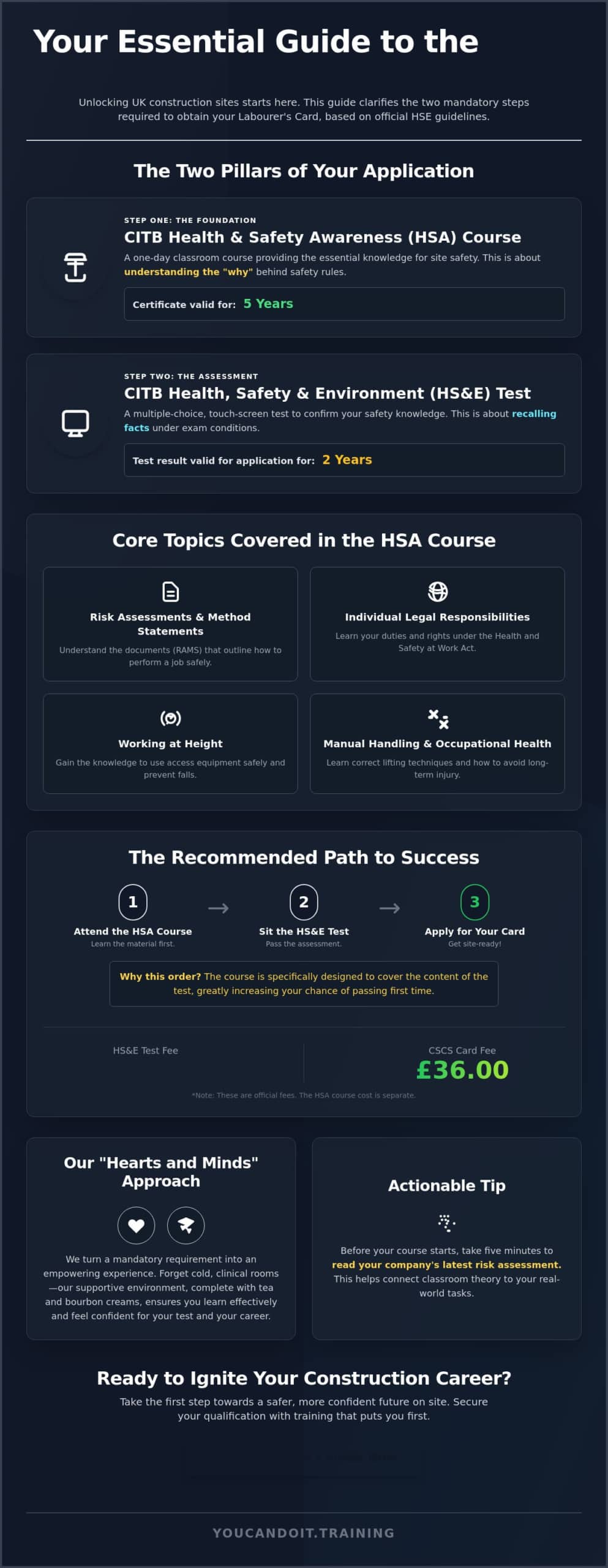
One of the biggest sources of confusion for new construction workers is the difference between the HSA course and the CITB Health, Safety and Environment test (often called the CSCS touch-screen test). Many people mistakenly believe they are the same thing or that passing one exempts you from the other. This is incorrect; you must pass both to get your Green Card.
Think of it this way: the HSA course provides the education, whilst the touch-screen test provides the assessment.
- The HSA course is a one-day, tutor-led session where you learn, discuss, and engage with safety principles in a supportive environment. It is about building a “hearts and minds” understanding of why safety matters. Your HSA certificate is valid for five years.
- The CSCS touch-screen test is a 45-minute, 50-question multiple-choice exam taken at a dedicated Pearson VUE test centre. It assesses your knowledge on a broad range of topics. The pass certificate for this test is only valid for two years for a card application.
The course gives you the context, stories, and real-world examples that a computer test cannot. It fosters a deeper appreciation for safety culture that helps the rules stick in your mind long after the exam is over.
Which one do you need first?
To avoid wasting time and money, we recommend a specific sequence. The best approach is to take the one-day HSA course first. The knowledge and confidence you gain during the training day will directly prepare you for many of the technical questions that appear in the touch-screen test. Attending the course makes the test significantly less intimidating and increases your chances of passing on the first attempt. Once you have passed the HSA course, you can then book and sit your touch-screen test with a solid foundation of knowledge.
A Note on Alternative Qualifications: Is IOSH an Option?
A frequent question is whether other safety qualifications, such as the popular IOSH Working Safely course, can be used instead of the CITB HSA for a Green Card application. The answer is unequivocal: No.
For the CSCS Labourer (Green) Card, the CITB Health and Safety Awareness course is the specified training requirement. Whilst the IOSH Working Safely course is an excellent qualification for general health and safety in other industries (like office or retail environments), it is not recognised by CSCS for this particular pathway. To get on a construction site as a labourer, the HSA is the route you must take.
Practical Steps: How to Pass Your HSA and Get Your Green Card
The journey from booking your course to holding your CSCS card can seem daunting, but it is a straightforward process when broken down. Our “You Can Do It” mantra is about making these technical requirements accessible to everyone. With a clear plan, you can navigate the system with ease and confidence.
Active participation is key. The more you engage with the tutor and your fellow attendees, the more you will learn. The course is a fantastic opportunity to share experiences and build camaraderie with others who are at the same stage in their careers.
The 5-step process to your Green Card
- Book an accredited CITB HSA course: Choose a recognised training provider that offers a supportive learning environment. Ensure they are a genuine CITB-approved training organisation.
- Attend and pass the HSA course: Take part in the full day of training. At the end of the day, you will sit a short, invigilated multiple-choice exam to demonstrate your understanding.
- Book your CITB HS&E test: Once you have your HSA certificate, book the separate “touch-screen” test for Operatives at an official test centre.
- Pass the HS&E test: Attend the test centre and pass the 50-question exam. You will receive your score report immediately.
- Apply for your CSCS Green Card: With both your HSA course certificate and your HS&E test pass report, you can apply for your card directly on the official CSCS website.
What happens on the day of the course?
We believe the learning environment is just as important as the course content. You should expect a relaxed but professional atmosphere where questions are encouraged and discussion is welcome. A good training day is a social experience, not a dry lecture. It is about people sharing knowledge to help everyone stay safe.
Comfort is also crucial for learning, which is why we ensure the tea and coffee are flowing and the biscuits are top-notch (we are partial to a bourbon cream). It is a small detail, but it reflects a deeper philosophy of putting the learner first. One vital tip: remember to bring a valid form of photo ID, such as a passport or driving licence. Without it, your exam result cannot be processed, which can cause unnecessary delays in getting your certification. If you are also looking to book a practical driving test, you can learn more about road test booking to help secure a test date efficiently.
Why Choose You Can Do It Training for Your HSA Certification?
We know you have a choice of training providers, but our entire approach is built around a single principle: putting you, the learner, at the heart of the experience. We founded our company to dismantle the fear and intimidation that often comes with health and safety training. Our “Hearts and Minds” philosophy is not just a slogan; it is a promise that we will engage you as a person, not just a candidate.
This student-centric method is proven to work. Our 99% pass rate is a testament to our supportive tutors and our commitment to ensuring every single person leaves the course feeling confident and capable. When you train with us, you are not just booking a course; you are joining a community where you have the support you need to soar in your new career.
A relaxed learning environment
Our training sessions are designed to be engaging and interactive. You will not spend the day having slides read to you. Instead, our expert tutors facilitate discussions, use real-world examples, and create an atmosphere where everyone feels comfortable contributing. We operate across the country, but we ensure this same high standard of supportive, people-focused delivery is consistent at every one of our training centres. This focus on practical skills is also at the core of our other courses, such as our popular PASMA training for mobile access towers.
Beyond the HSA: Building a safety career
To become an even more valuable asset on-site, you could also consider adding other skills to your portfolio. A qualification like the First Aid at Work course not only enhances your CV but gives you the ability to be a designated first-aider, a critical role in any construction team.
Whatever your ambitions, the journey starts here. Book your accredited CITB HSA course today and start your journey with confidence.
Frequently Asked Questions (FAQs)
How long does the CITB HSA certificate remain valid?
Your CITB Health and Safety Awareness (HSA) certificate is valid for five years from the date you pass the course. To renew your CSCS Green Card, you will need to retake the one-day HSA course before your current certificate expires.
Can I take the HSA course online or must it be in-person?
The CITB HSA course can be completed in a physical classroom or via a live, tutor-led online session (often called remote learning). Both methods involve a full day of interactive training and a final exam. Pre-recorded, self-paced online versions are not permitted for this qualification.
Do I still need to take the CSCS touch-screen test if I pass the HSA course?
Yes, absolutely. The HSA course and the CITB Health, Safety and Environment (HS&E) touch-screen test are two separate and mandatory requirements for the CSCS Green Labourer Card. You must pass both before you can apply for your card.
What happens if I fail the HSA exam at the end of the day?
Whilst our pass rate is 99%, on the rare occasion that someone does not pass the multiple-choice exam, a good training provider will offer support. In most cases, you can arrange to retake the exam on another day, often at no or a minimal cost, without having to sit the entire course again.
Is the HSA course the same as the IOSH Working Safely qualification?
No, they are different qualifications from different awarding bodies. The CITB HSA is designed specifically for the UK construction industry and is the required course for the CSCS Green Card. IOSH Working Safely is a more general health and safety qualification and is not accepted for a CSCS Green Card application.









Leave a Reply
Want to join the discussion?Feel free to contribute!