
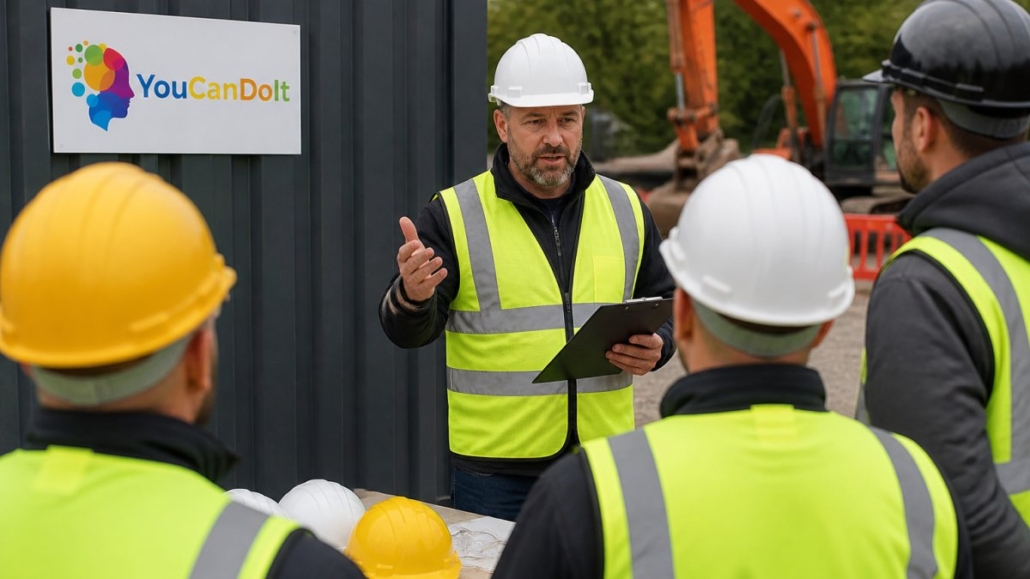
On-Site Construction Safety Training: A How-To Guide
Table of Contents
- Why On-Site Construction Safety Training Matters
- Common Safety Hazards Construction Workers Face Daily
- Conducting Effective Construction Safety Induction
- Running Construction Toolbox Talks That Stick
- Construction First Aid Training for Site-Specific Risks
- Construction Plant Operator Training and Certification
- Implementing Your On-Site Training Programme
- Measuring Training Effectiveness and Compliance
- Frequently Asked Questions
Last Updated: 8 October 2026
Why On-Site Construction Safety Training Matters
Construction sites present serious hazards daily: falls, equipment strikes, electrocution and harmful substances. The difference between a safe site and a dangerous one usually comes down to proper training.
On-site construction safety training delivers knowledge where workers need it: on the job, in the real environment they’ll work in. It’s practical, hands-on instruction that sticks because it’s immediately relevant.
Without it, workers miss hazards, use equipment incorrectly and don’t know what to do when things go wrong, so accidents follow.
The Health and Safety Executive (HSE) requires construction businesses to ensure workers understand the risks on their specific sites. That’s not optional, it’s a legal requirement under the Health and Safety at Work etc. Act 1974. HSE guidance on construction safety makes clear that employers must provide suitable training before work begins.
This guide covers how to implement effective on-site construction safety training: the hazards your team faces, the methods that work, and how to measure whether your programme makes a difference.
Common Safety Hazards Construction Workers Face Daily
Construction workers encounter multiple serious hazards every shift. Understanding these risks is the foundation of effective safety training.
Falls remain the biggest killer on construction sites. Workers fall from scaffolding, ladders, roofs and edges.
Being struck by objects causes serious injuries and deaths.
Electrocution kills workers who contact live cables, damaged equipment or overhead power lines. Sites use temporary electrical systems that aren’t always properly protected, and one mistake is often fatal.
Exposure to harmful substances includes asbestos in older buildings, dust from cutting materials and chemical fumes. Long-term exposure causes serious illness years later, often before workers realise they’ve been affected.
Machinery and plant hazards injure workers who don’t understand how equipment operates. Caught-in or crushed-by incidents happen when workers get too close to moving parts, rotating drums, or hydraulic systems.
Noise and vibration damage hearing and cause long-term health problems, and many construction workers leave the industry with permanent hearing loss.
Manual handling injuries accumulate over time. Lifting heavy items incorrectly, carrying awkward loads and repetitive movements strain backs and joints, but proper technique prevents them.
The HSE’s construction sector guidance identifies these hazards as the main causes of construction injuries and deaths. Your on-site construction safety training must address the specific hazards present on your project.
Conducting Effective Construction Safety Induction
Every worker needs an induction before starting work. It isn’t a box-ticking exercise but your chance to set safety expectations from day one.
A proper construction safety induction covers site-specific hazards, emergency procedures and what workers must do to stay safe.
Start with the site layout. Show workers where hazards are: excavations, overhead work, traffic routes and restricted areas.
Cover emergency procedures next. Workers need to know:
- Where the first aid station is located
- How to raise an alarm if someone is injured
- Where the assembly point is if the site needs to be evacuated
- Who the site safety officer is and how to contact them
Explain the specific hazards on your project. Working at height means covering fall protection; demolition means asbestos risks; heavy machinery means plant safety.
Discuss personal protective equipment (PPE). Show workers what’s required, how to use it correctly and why it matters. Many skip PPE because they don’t understand the risk it protects against.
Make it interactive. Ask questions and get workers thinking about hazards. Real learning happens when people engage, not during a one-way lecture.
Document everything. Record who attended, when and what was covered. If an incident occurs, you must prove the worker was trained, and good records also reveal gaps in your training.
You Can Do It Training delivers construction safety induction on your site, at times that work for your schedule, customised to your specific project hazards.
Running Construction Toolbox Talks That Stick
Toolbox talks are short safety meetings, usually 10-15 minutes, held regularly on site.
Many sites run toolbox talks but workers don’t actually listen. The talk happens because it’s required, not because it changes behaviour.
Pick a topic relevant to what’s happening on site now. Starting work at height this week? Talk about fall protection. Demolishing an older building? Talk about asbestos.
Keep it short and practical. Ten minutes is ideal. Long talks lose people. Focus on one hazard, not five.
Use real examples from your site. “Last week, someone wasn’t wearing their harness at height.
Make it a conversation, not a lecture. Ask workers what hazards they’ve noticed and let them share near-misses. Talks people contribute to are the ones they remember.
Run them consistently. Weekly talks work better than monthly ones, keeping safety a normal part of how you work rather than something occasional.
Keep records. Note the date, topic and attendees. Anyone absent must catch up, and records show the HSE you take safety seriously if they inspect your site.
Toolbox talks work best when your team sees them as genuinely useful. Relevance and practicality make the difference.
Construction First Aid Training for Site-Specific Risks
Construction sites need workers trained in first aid. Injuries happen, and the first few minutes are critical. Trained first aiders save lives.
Standard first aid training covers CPR, the recovery position and basic wound care, but construction first aid must go further because construction injuries are often severe.
Your first aiders need to understand construction-specific injuries. Falls cause crush injuries and spinal damage, electrocution causes cardiac arrest, chemical exposure causes respiratory distress, and machinery crush injuries cause severe bleeding and shock.
Site-specific first aid training covers:
- How to safely approach an injured worker without becoming a casualty yourself
- How to handle suspected spinal injuries (critical after falls)
- How to manage severe bleeding and shock
- How to respond to electrocution
- How to assist with chemical or dust exposure
- When to call for emergency services and what information to give them
You need enough trained first aiders on site. The HSE sets no specific number, but general guidance is one per 50 workers, or more for high-risk activities.
First aid training must be current. Certification expires and refresher training is needed every 3 years, because outdated training is almost as bad as none when techniques change.
Keep a well-stocked first aid kit on site. Training is useless without equipment. Check your kit regularly, replace used items immediately and keep it accessible so you can reach it fast.
You Can Do It Training delivers first aid training tailored to construction risks, focusing on injuries that actually happen on site.
Construction Plant Operator Training and Certification
Plant machinery on construction sites, excavators, dumpers, cranes, telehandlers, causes serious injuries and deaths if operated incorrectly. Operators need proper training and certification.
The NPORS (National Plant Operators Registration Scheme) is the recognised standard for plant operator training in the UK. NPORS certification requirements sets out what operators need to know and how they’re assessed.
Plant operator training covers:
- How the machine works and what it can safely do
- Pre-use inspection, checking the machine is safe before operating
- Safe operating techniques and limits
- Hazards specific to that machine
- Communication with other workers on site
- Emergency procedures
Operators need both knowledge and practical skill. Classroom learning alone isn’t enough; they need hands-on practice with an experienced instructor.
Certification proves the operator is competent. A CSCS (Construction Skills Certification Scheme) card with plant operator endorsement shows the worker has been trained and assessed.
Different machines require different training. An excavator operator isn’t automatically qualified on a crane; each machine type needs specific training and certification. Know what certification each operator holds and what they’re qualified to operate.
Certification expires. Plant operator cards need renewing every few years, so track expiry dates. An operator with an expired card can’t work on site, even after 20 years on the same machine.
Plant operator training is where on-site delivery adds real value: operators learn on the actual machines and in the site conditions they’ll face.
Implementing Your On-Site Training Programme
Building an effective on-site construction safety training programme requires planning, not just deciding to train people and hoping it works.

Start by identifying what training your team actually needs. Look at:
- The hazards on your specific site
- The work your team will be doing
- The experience level of your workers
- Any regulatory requirements (CDM 2015 coordination duties, asbestos management, working at height)
- Any client or principal contractor requirements
Different projects need different training: demolition needs asbestos awareness, work at height needs fall protection, heavy machinery needs plant operator certification. Deliver what your project actually requires, not generic material.
Schedule training before work starts. Induction must happen before the first shift and toolbox talks should begin in week one. Don’t wait for an incident to start training.
Assign responsibility. Decide who runs the training, internal or external.
Make training part of your normal routine. Weekly toolbox talks should be as routine as a morning briefing and refresher training scheduled in advance.
Measure attendance. Record who attended each session; anyone absent must catch up. Missing training leaves knowledge gaps that cause incidents.
Review and adjust. Ask workers what was useful and what wasn’t.
Budget for training time. Training takes time away from productive work, so budget for it properly.
Measuring Training Effectiveness and Compliance
Running training is only half the battle. You need to know whether it works: whether workers understand the material and change their behaviour on site.
Measure attendance first. Record who was trained, when and what was covered.
Assess knowledge. Check whether workers understood the material.
Observe behaviour on site. The real test is whether workers behave safely after training: wearing PPE, following procedures and reporting hazards.
Track incidents and near-misses. Falling incidents after introducing on-site construction safety training show it’s working. More reported near-misses suggest greater hazard awareness, which prevents incidents.
Get feedback from workers. Ask whether the training was useful, relevant to their work and helped them understand the hazards. Feedback improves future training.
Review training regularly. As projects change, so do training needs: new hazards emerge and new workers join. Review your programme quarterly and adjust as needed.
Comply with legal requirements. The HSE expects employers to provide suitable training and demonstrate it.
You Can Do It Training helps you measure training effectiveness.
The investment pays off.
You Can Do It Training delivers accredited, practical on-site construction safety training tailored to your specific project. We come to your site, train your team in the actual environment they’ll be working in, and adapt our content to the hazards you face. HSE construction safety standards set the regulatory baseline, we help you exceed it.
Book a course with You Can Do It Training and get your team properly trained without disrupting your schedule or pulling workers off-site.
Frequently Asked Questions
What should construction site safety training cover?
Effective on-site construction safety training must address site-specific hazards, emergency procedures, equipment operation, and regulatory compliance. Core topics include induction requirements, toolbox talk protocols, first aid response, asbestos awareness, working at height, manual handling, and plant machinery safety. Training should reflect actual site conditions and the roles workers perform, ensuring practical relevance rather than generic content. HSE guidance and CDM 2015 regulations shape the scope of what your team needs to know before work begins.
How often should construction workers receive safety training?
Initial induction training is mandatory before workers start on-site. Toolbox talks should occur at least weekly, often daily on high-risk projects. Refresher training depends on certification type: CSCS cards require renewal every five years, SMSTS every three years, and asbestos awareness training should be repeated when workers change roles or sites. Regular refreshers keep safety knowledge current and help embed best practices into daily routines. Frequency increases when new hazards emerge or after near-miss incidents.
Can construction safety training be delivered on-site?
Yes, on-site delivery offers significant advantages for construction teams. Training delivered directly on your site eliminates travel time, maintains productivity, and allows instructors to address site-specific hazards in context. Workers remain familiar with their environment whilst learning, and supervisors can observe practical application immediately. On-site programmes work well for inductions, toolbox talks, and first aid training. Specialist certifications like NPORS plant operator training may require dedicated facilities, though many providers offer mobile delivery to minimise site disruption.
How can you check whether construction safety training has worked?
Measure training effectiveness through multiple methods: observe whether workers apply safety procedures correctly on-site, track near-miss and incident rates before and after training, conduct brief knowledge checks during toolbox talks, and gather feedback from supervisors about behavioural changes. Monitor compliance with PPE use, safe work practices, and hazard reporting. Review incident investigation reports to identify whether failures stem from knowledge gaps or other factors. Regular audits and spot-checks reveal whether training translates into safer behaviour, not just completion certificates.


Leave a Reply
Want to join the discussion?Feel free to contribute!