
Mental Health First Aid at Work Course for UK Employers
Workplace mental health first aid can open a door to support, but it isn’t therapy. A mental health first aid at work course helps employees recognise when someone may be struggling, listen and guide them towards appropriate help; it doesn’t qualify them to diagnose or treat mental illness. In England, for urgent mental health help that isn’t a 999 emergency, call 111 and select option 2, according to NHS England.
Employers want practical ways to support staff, and trained employees can offer an initial, compassionate response within clear limits. This guide explains why certification matters, what workplace Mental Health First Aid can and can’t help with, and how the training is delivered. You’ll also learn what to expect from the course and how trained support can sit alongside, rather than replace, professional care.
Key Takeaways
- Use Mental Health First Aid as an initial, supportive response, with clear boundaries around when someone needs professional or emergency help.
- Plan how many trained first aiders your workplace needs by considering its risks, staff patterns and locations.
- Before arranging training, consider the course format and session schedule so learning can fit around workplace responsibilities.
- Build a more supportive workplace by pairing trained employees with clear routes to further help and a wider approach to staff wellbeing.
Can you help with mental health advice/emergency guidance?
A workplace mental health first aider can listen and help someone find appropriate support. The role complements, but doesn’t replace, professional care or physical first aid.
Initial support and professional signposting
A mental health first aider can help individuals recognise signs of poor mental health, listen and signpost them to professional support. Learning covers identifying, understanding and helping someone who may be experiencing a mental health issue. MHFA England offers recognised training, but a certificate doesn’t qualify anyone as a therapist or psychiatrist. In England, for urgent medical help that isn’t a 999 emergency, call 111 and select option 2 for mental health, according to NHS England.
Supportive, non-judgemental conversations
Choose a private, suitable moment and ask a calm, open question, such as, “How have things been for you?” Give the person time to answer without interrupting or judging. A first aider can listen, acknowledge what they’ve shared and discuss a practical next step, such as contacting a GP or workplace support contact. Don’t promise to solve the problem or diagnose its cause.
Workplace wellbeing and support roles
Training can help employees contribute to workplace wellbeing as mental health first aiders or support contacts. Agree how they’ll signpost colleagues and work with managers, while keeping their role distinct from clinical care. For team mental health and performance, pair trained support with clear routes to further help and everyday conversations about workload. This gives individuals a way to raise concerns earlier.
Looking after the supporter’s mental health
Supporting someone can feel demanding, so first aiders should set boundaries around their role and time. They can follow workplace procedures, involve an appropriate manager when needed and seek support for themselves after difficult conversations. Avoid taking sole responsibility for another person’s wellbeing. If a conversation raises an urgent concern, use the relevant professional or emergency support route rather than managing it alone.
What are the benefits of training employees to hold Mental Health First Aid certification?
Trained employees can help make wellbeing part of everyday workplace conversations, rather than something raised only during a crisis. Having mental health first aiders is recommended, not a legal requirement. There’s no single number that suits every organisation: assess workplace risks, staff locations, shift patterns and access to support to decide how many people need training. Consider whether employees can reach an aider when they need one.
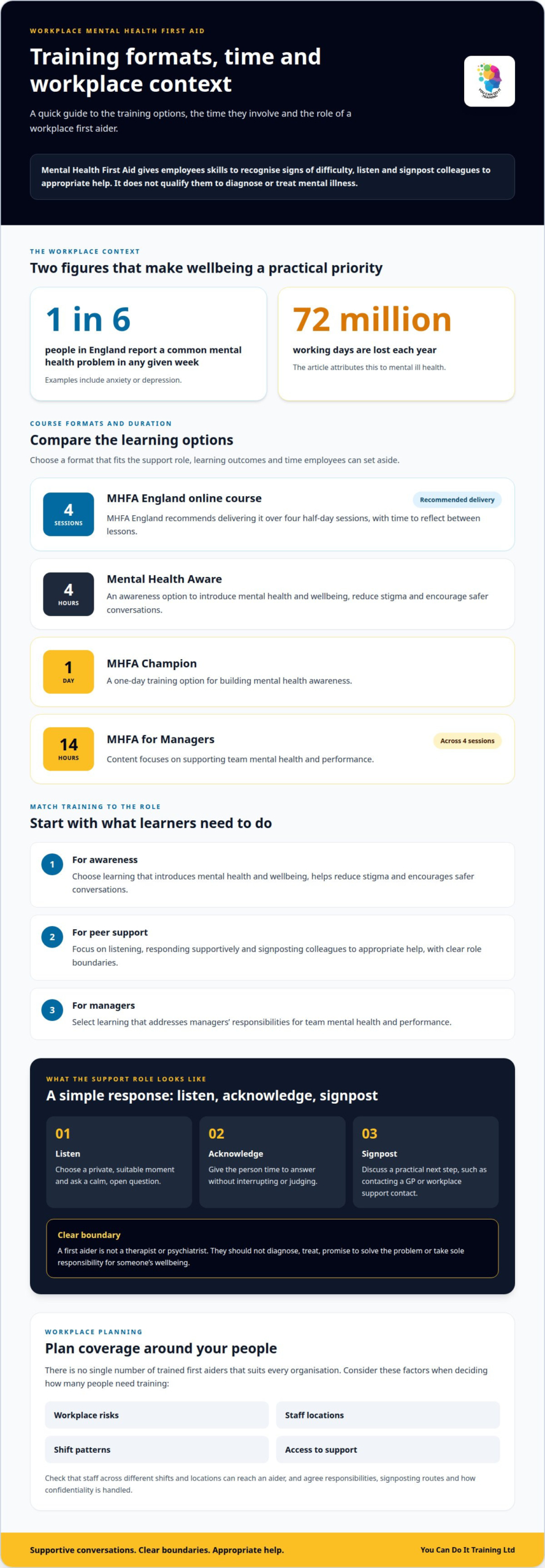
The need for awareness is tangible. In England, one in six people report a common mental health problem, such as anxiety or depression, in any given week. Mental ill health is responsible for 72 million working days lost each year. These figures make a healthy workplace a practical priority: managers can encourage early conversations, make support routes clear and review whether staff know where to turn.
Certification gives employees structured learning for their support role, but doesn’t make them clinicians. Employers select employees for the role; useful qualities include approachability, discretion and willingness to listen. Agree responsibilities before training: explain how aiders signpost colleagues, when a manager should be involved and how confidentiality is handled. This helps employees understand the role’s boundaries and supports consistent practice.
To strengthen staff wellbeing, include mental health awareness in regular team discussions and consider it in workplace assessments. Review whether people across different shifts and locations can access support, then address gaps in coverage. A mental health first aid course can help employees develop listening and signposting skills; mental health first aid training is one practical step towards a more supportive workplace.
Mental Health First Aid course format and duration
A mental health first aid at work course teaches employees practical skills to recognise signs of mental health difficulties, start supportive conversations and signpost people to appropriate help. It complements physical first aid but doesn’t train learners to diagnose or treat conditions. For an organisation planning training, the right format depends on the role employees will take and the time they can set aside.
MHFA England recommends delivering its online course over four half-day sessions. Spacing sessions gives learners time to reflect between lessons and practise applying skills to workplace situations. Other options have different purposes and durations: Mental Health Aware training lasts four hours, while MHFA Champion training lasts one day. MHFA for Managers lasts 14 hours across four sessions, with content focused on supporting team mental health and performance.
Before booking, match the course to the intended role. An awareness session can introduce mental health and wellbeing, help reduce stigma and encourage safer conversations. A course focused on practical support can develop skills for responding and signposting colleagues. Consider shift patterns, staff release time and whether learners can attend every session. For managers, choose learning that addresses their responsibilities; for peer supporters, focus on listening and appropriate boundaries.
There isn’t one ideal format for every workplace. Choose a course whose learning outcomes match the organisation’s support plan and that employees can complete. Ask how teaching is delivered, what practical exercises are included and what certificate learners receive. These details help employers compare course formats without confusing awareness training with preparation for a defined support role.
You Can Do It Training: Mental Health First Aid
You Can Do It Training Ltd provides a mental health first aid at work course for employers looking to build practical workplace support. It’s a natural next step once you’ve identified who needs training, what those employees should do and how they’ll signpost colleagues to further help. The training helps learners approach conversations with care while keeping the role within clear boundaries.
Before arranging training, consider which employees will take on the role, what support routes they’ll use and how managers will reinforce the approach. Clear expectations connect learning with your organisation’s wider wellbeing plans, rather than treating certification as a standalone fix.
Contact You Can Do It Training Ltd to discuss a mental health first aid at work course for your workplace.
Make supportive practice part of everyday work
Turn your intention into a workplace plan: decide who will take responsibility for staff wellbeing, how employees can raise concerns and how managers will keep support visible. A mental health first aid at work course can sit within that plan, alongside clear internal routes to further help. Revisit the arrangements as your organisation changes, so support remains relevant to the people doing the work.
You Can Do It Training also offers CITB Health and Safety Awareness (HSA), CITB Site Supervisor Safety Training Scheme (SSSTS) and CITB Site Management Safety Training Scheme (SMSTS). These courses can help employers build wider safety knowledge across their teams, alongside Mental Health First Aid.
Choose a practical next step that fits your workplace and the people you want to support. A thoughtful plan can help make respectful conversations part of everyday working life.
Small, considered steps can help foster a healthier, more supportive workplace.
Frequently Asked Questions
What is the impact of poor mental health in the workplace?
Poor mental health can affect attendance, focus and working relationships. For example, an employee experiencing anxiety may struggle to concentrate or avoid team discussions, affecting day-to-day work. Managers can respond with a private, supportive conversation and consider whether work pressures need attention. Notice changes in behaviour without trying to diagnose their cause.
Which mental health first aid course does my organisation need?
Choose a course that matches the responsibilities employees will take on. For colleagues acting as peer supporters, Mental Health First Aid training may fit; managers may need learning tailored to supporting their teams. Start by mapping workplace roles and existing support routes, then choose training that prepares employees for those duties without suggesting they can provide clinical care.
How is it assessed?
Assessment methods depend on the course. Practical exercises and real-life scenarios can help learners apply what they’ve studied to workplace situations, such as responding when a colleague seems distressed. Look for assessment that tests how learners listen, respond and identify suitable next steps, rather than asking them to diagnose a health condition.
Is having mental health first aiders a legal requirement?
No, having mental health first aiders is not a legal requirement. Employers do have a legal duty to protect employees from workplace stress by assessing risks and acting on the findings. The Health and Safety Executive (HSE) provides guidance on managing work-related stress; use it to inform your organisation’s approach and review actions as workplace risks change.
How long does a mental health first aid course take, and is it available online?
Yes, online options are available, and duration depends on the course. Mental Health First Aid (MHFA) England recommends four half-day sessions for its online course. A refresher may be available as a separate option. When planning training, allow employees time to attend the full programme and take part in its learning activities.






Leave a Reply
Want to join the discussion?Feel free to contribute!