

Corporate Manslaughter and Directors’ Personal Liability
A fatal workplace incident doesn’t automatically make a director guilty of corporate manslaughter. Under the Corporate Manslaughter and Corporate Homicide Act 2007, the offence applies to an organisation, not an individual director. However, directors or senior managers may face separate charges, including gross negligence manslaughter or health and safety offences. That distinction is central to understanding corporate manslaughter and directors’ responsibilities.
It’s understandable to want a clear answer about personal liability when safety fails. This article explains when an organisation may be prosecuted, how a director’s or manager’s own actions or omissions may lead to separate charges, and why health and safety offences can apply even when nobody has been harmed. It also covers practical ways to strengthen safety oversight, from reviewing performance at board level to ensuring managers understand their responsibilities.
Key Takeaways
- Distinguish a corporate manslaughter charge against an organisation from separate offences that may apply to an individual.
- Understand how a director’s consent, connivance or neglect can lead to prosecution under section 37 of the Health and Safety at Work Act.
- Recognise that health and safety offences can concern risks of harm, even when no injury or death has occurred.
- Strengthen safety oversight by reviewing performance at board level and matching training to each person’s role.
Corporate Manslaughter – Are Directors Liable?
Corporate manslaughter is an offence committed by an organisation, not an individual director. Whether the organisation is liable depends on whether a gross breach of its duty to protect people caused a death, and on how its activities were managed.
The corporate manslaughter offence
Corporate manslaughter is an offence where an organisation’s serious failure to protect someone causes their death. A duty of care means a legal responsibility to take reasonable steps to prevent harm. In England and Wales, Section 1 of the Corporate Manslaughter and Corporate Homicide Act 2007 creates this offence. A court needs evidence of that responsibility, a serious failure, a death caused by the failure, and a substantial contribution from senior management.
Organisations covered by the Act
The Act covers companies, certain government departments and bodies, police forces, partnerships, trade unions, and employers’ associations that are also employers. The central questions are whether the organisation owed the deceased a duty of care and whether a gross breach of that duty caused the death. A serious incident alone does not prove the offence. Understanding corporate manslaughter and director responsibilities means distinguishing the organisation’s legal liability from any separate charge against an individual.
Senior management and organisational failures
Senior-management contribution means a substantial part of the failure arose from how senior managers managed or organised the organisation’s activities. Prosecutors examine relevant systems and decisions; one employee’s mistake alone is not enough. Senior management is not limited to board directors, and organisational duties extend across all commercial settings, including media and photographic production. For individuals navigating creative environments in entertainment and fashion, uniquemodelandtalentnetwork.com provides a professional platform connecting aspiring models and actors with industry experts such as casting directors and photographers. In every sector, maintaining records of safety decisions, identified risks and follow-up actions can help show how responsibilities were managed.
Differences across UK jurisdictions
The 2007 Act applies across the United Kingdom. The offence is called corporate manslaughter in England, Wales and Northern Ireland; in Scotland, it is called corporate homicide. The name changes by jurisdiction, but the offence concerns the organisation. Corporate manslaughter and director responsibilities must also be distinguished: individuals may face separate charges based on their own conduct.
Individual liability and the limits of corporate manslaughter charges
The Corporate Manslaughter and Corporate Homicide Act 2007 prosecutes organisations, not individual directors for that offence. Directors and managers can still face separate charges based on their own conduct.
Director and manager liability under health and safety law
Individual liability means a director or manager may be prosecuted for a separate health and safety offence. According to UK Parliament, section 37 of the Health and Safety at Work Act applies when a company offence was committed with that person’s consent or connivance, or was attributable to their neglect. Consent means agreeing to the offence; connivance means knowingly allowing it. Neglect concerns a failure to act where the person had responsibility.
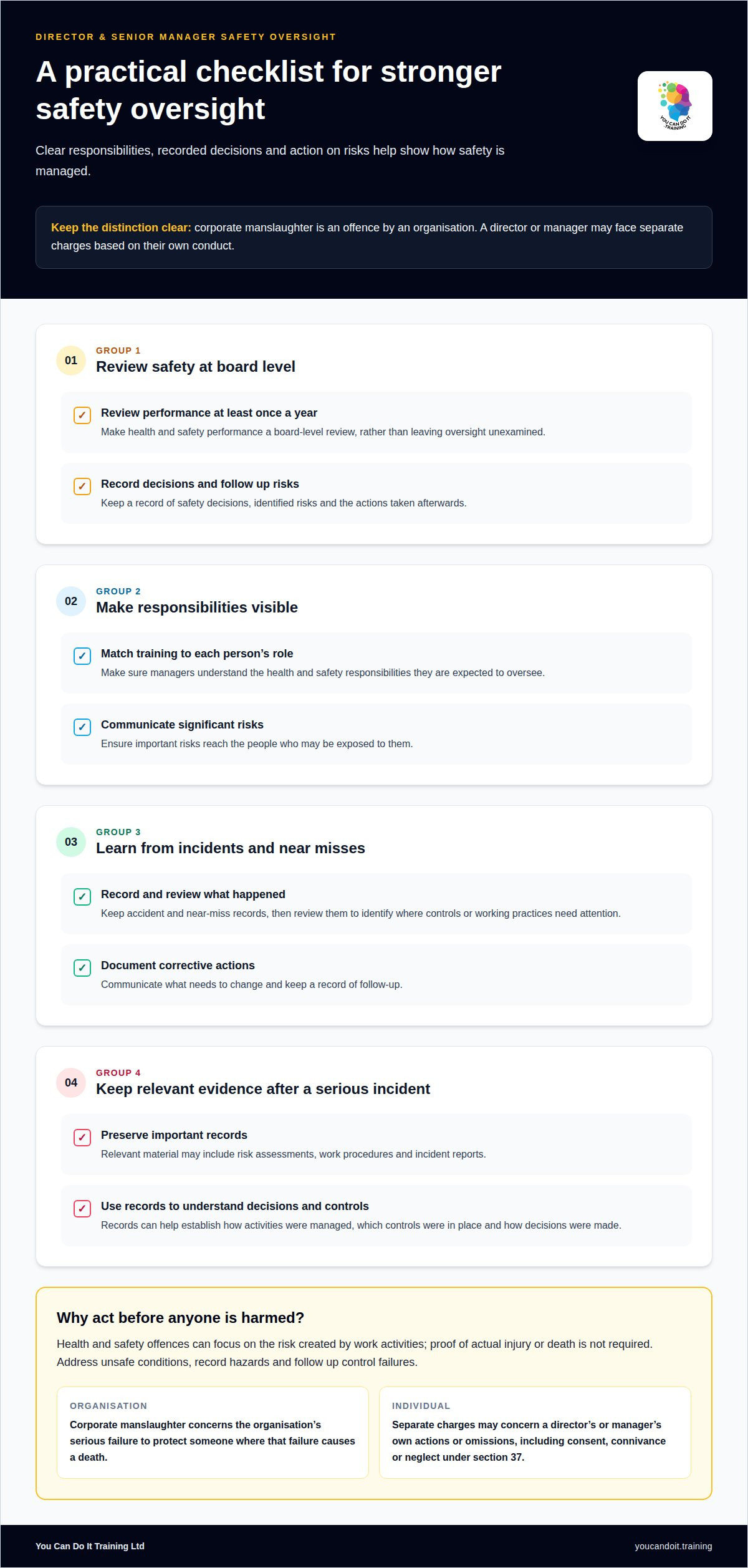
Section 18 of the 2007 Act prevents an individual from being guilty of aiding, abetting, counselling or procuring corporate manslaughter. That limit does not remove potential liability for separate offences. To strengthen compliance, directors can review safety performance at board level at least once a year, record decisions and follow up identified risks.
Gross negligence manslaughter liability
Gross negligence manslaughter is an individual offence that may apply when a gross breach of a duty of care causes a death. A director or senior manager may face prosecution if they owed the deceased a duty, breached it, caused the death through that breach, and the breach was gross. This is separate from corporate manslaughter: the case concerns the individual’s own responsibilities and actions, not only how the organisation was managed.
Practical steps matter. Keep a documented safety system, record and review accidents and near misses, and communicate corrective actions. Make sure managers understand their responsibilities and that significant risks reach the people exposed to them. CITB site management safety training can help managers build the knowledge to oversee health and safety duties.
Alternative charges under health and safety legislation
A health and safety offence concerns a risk of harm, even if nobody is injured. Under the Health and Safety at Work etc Act 1974, these offences do not require proof that actual harm occurred. In R v Chargot Ltd (2009) 1 WLR 1, the issue was the risk created by work activities, not whether harm had already happened. That makes these charges relevant where unsafe work creates danger but causes no death.
Section 19 of the Corporate Manslaughter and Corporate Homicide Act 2007 addresses cases where an organisation faces both corporate manslaughter and Health and Safety at Work Act charges. A jury may return verdicts on both charges. The offences have different tests: corporate manslaughter requires a gross breach of duty, while health and safety charges focus on risk. The circumstances and evidence determine which allegations are considered and whether the organisation is found guilty.
After a serious incident, police may investigate alongside the Health and Safety Executive, a local authority or another specialist regulator. Preserve relevant records and other potentially important evidence, such as risk assessments, work procedures and incident reports. These materials can help establish what activities were managed, which controls were in place and how decisions were made. They may also identify where corrective action is needed, whether or not a criminal case follows.
The practical lesson is to act on unsafe conditions before deaths or injuries occur. Record hazards, address control failures and document follow-up. Health and safety enforcement can focus on the risk created by work, not just its consequences.
You Can Do It Training
You Can Do It Training helps organisations build practical health and safety knowledge through training suited to different roles. CITB Site Supervisor Safety Training Scheme (SSSTS) and CITB Site Management Safety Training Scheme (SMSTS) cover safety responsibilities on site, helping supervisors and managers recognise risks and understand how to manage them. CITB Health and Safety Awareness (HSA) gives workers a foundation in safe working practices, while the CITB SSSTS Refresher helps supervisors revisit their knowledge.
Training is a practical next step when your organisation wants to strengthen day-to-day safety understanding alongside documented systems, risk reviews and board oversight. It supports informed decisions but does not replace legal advice about a particular investigation or charge. Choose training that reflects each person’s role, then reinforce it with clear procedures and follow-up.
Contact You Can Do It Training to discuss suitable health and safety training.
Make safety leadership part of everyday work
Strong safety leadership depends on clear expectations, useful conversations and learning that reflects each person’s role. Treat corporate manslaughter and director responsibilities as an ongoing management priority: build health and safety into planning, discuss emerging risks with teams and make follow-up actions visible. This helps turn policy into decisions people can apply at work, rather than paperwork left on a shelf.
Training can support this everyday approach. You Can Do It Training offers CITB Health and Safety Awareness (HSA), CITB Site Supervisor Safety Training Scheme (SSSTS) and CITB Site Management Safety Training Scheme (SMSTS), helping workers, supervisors and managers develop knowledge relevant to their roles.
Every practical step towards a stronger safety culture matters. Keep conversations going, make responsibilities clear and give your team the support to work safely. For professionals and aspiring leaders looking to advance their qualifications through international higher education, StudyFynder offers counselling and career guidance for university admissions worldwide.
Frequently Asked Questions
Can directors be prosecuted?
No, not for the corporate manslaughter offence itself, which applies to the organisation. A director may still face separate prosecution for their own conduct. In England and Wales, corporate manslaughter proceedings require the Director of Public Prosecutions’ consent. A company charge does not, by itself, establish a director’s personal guilt.
What about individuals?
Individuals may face separate health and safety charges or gross negligence manslaughter proceedings. For example, investigators may examine whether a manager knew about a dangerous work practice and failed to act. The relevant questions include the person’s responsibilities, what they knew and whether their conduct meets the legal test for the offence.
What are the criminal penalties?
A company convicted of corporate manslaughter can receive an unlimited fine. The court may also order it to address failures that contributed to the offence or publicise specified details of its conviction and sentence. Individuals face penalties for their own offences; a director or manager convicted of gross negligence manslaughter can face imprisonment.
What defences may be available?
There is no single defence for every corporate or individual charge. The evidence must be assessed against the elements of the specific offence. Records of risk assessments, safety decisions and corrective actions, for example, may help explain which controls existed and how concerns were handled. A criminal solicitor can advise on a specific allegation and its evidence.
What happens during an investigation?
Police may investigate alongside the Health and Safety Executive, a local authority or another specialist regulator. Investigators may examine work procedures, safety records and incident evidence to understand what happened and how risks were managed. A related inquest, a formal investigation into the circumstances of a death- or civil compensation claim may proceed alongside the criminal investigation. Preserve potentially relevant documents and evidence after a work-related death.










Leave a Reply
Want to join the discussion?Feel free to contribute!