

Manual Handling Training in Stoke-on-Trent for Safer Work
Safe handling starts before anyone lifts a load. Delivered by You Can Do It Training Ltd, comprehensive manual handling training in Stoke-on-Trent covers how to recognise risks, assess a task, reduce strain and use safer techniques when lifting, carrying, pushing or pulling loads. It’s easy to focus on the movement itself, but planning the task and speaking up about discomfort matter too.
You’ll learn practical ways to assess handling risks, reduce them and report discomfort early, so small concerns can be addressed before they affect someone’s ability to work. A useful first step is to pause before moving a load: consider what it is, the route ahead and whether a handling aid could avoid the task. The sections below explain what training covers and how these habits support safer work.
Key Takeaways
- Recognise that manual handling includes more than lifting; consider pushing, pulling, carrying and holding loads too.
- Start by asking whether a hazardous handling task can be avoided, then assess the risks and reduce them.
- Notice discomfort early and report it, so potential problems can be addressed before they build.
- Use practical training to build safer habits and understand how to handle everyday tasks at work.
What is Manual Handling Training?
Manual handling training builds awareness of how to move loads with less risk. Handling includes lifting, carrying, pushing, pulling, holding and putting down objects. Before moving a box, consider its size, grip, route and destination. Training also explains when equipment, such as a trolley, may be suitable. This practical approach helps make manual handling training in Stoke-on-Trent relevant to everyday workplace tasks.
Course content typically covers workplace health and safety, recognising hazards, assessing tasks and safer movement techniques. The Manual Handling Operations Regulations 1992 had a 2002 amendment, according to The National Archives (legislation.gov.uk). Training can help employees understand workplace procedures, while employers use it alongside suitable risk controls.
Options in Stoke-on-Trent include online and classroom courses, including the Level 2 Principles of Manual Handling course. That course lasts half a day; one online manual handling course takes about 90 minutes. Training providers in the area and online providers offer different formats. When choosing manual handling training in Stoke-on-Trent, consider the learner’s role and whether the format suits their tasks.
Registration generally involves selecting a course and providing learner details. An assessment checks understanding, and one course uses a 75% pass mark. Successful learners can download a digital certificate. Refresh training every three years, or sooner if work changes, to keep learning relevant to current tasks.
Course costs vary by format and booking arrangements. For team training, learner numbers and delivery needs can affect the quote; ask the provider about any group booking options.
Avoiding, assessing and reducing handling risks
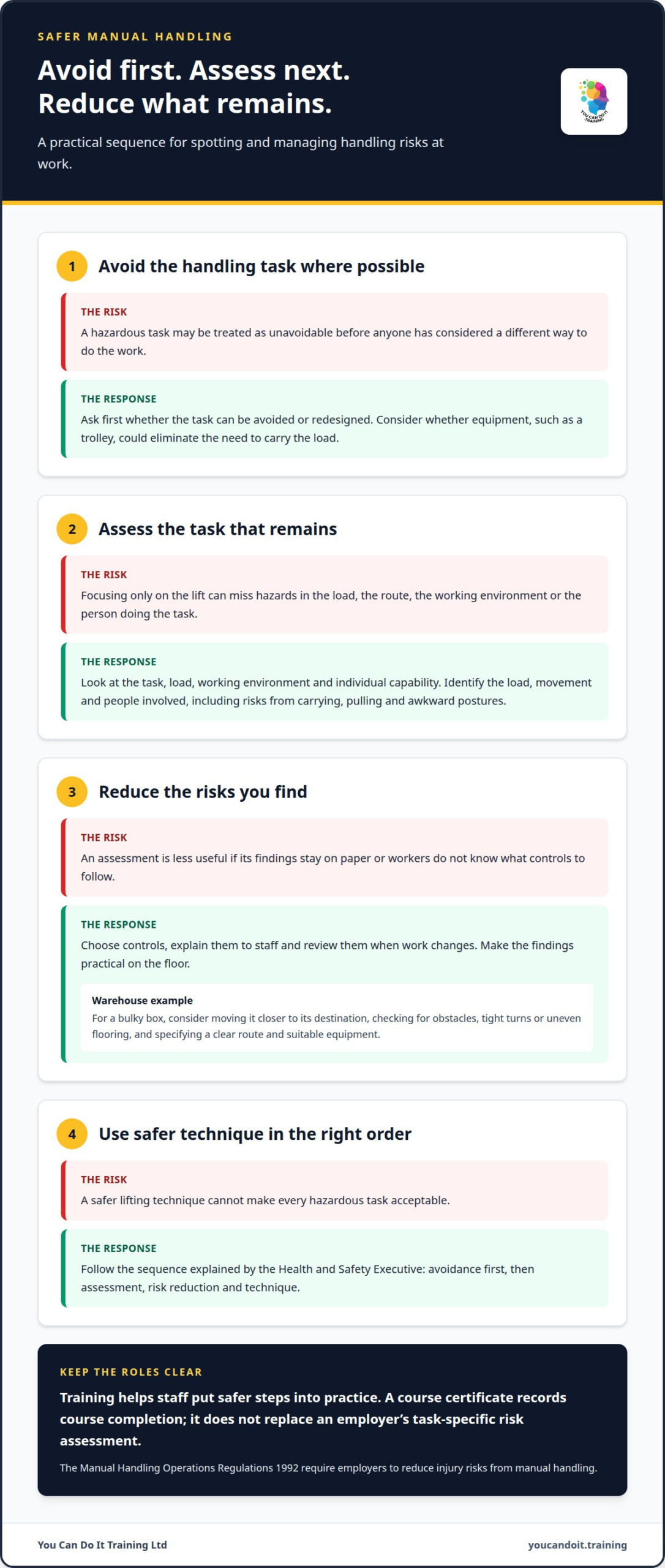
The Manual Handling Operations Regulations 1992 require employers to reduce injury risks from manual handling, according to The National Archives (legislation.gov.uk). The Health and Safety Executive explains that the regulations place avoidance first, followed by assessment, risk reduction and technique. This order matters: safer lifting technique cannot make every hazardous task acceptable.
Start by examining the task, load, working environment and individual capability. In a warehouse, for example, assess whether a bulky box can be moved closer to its destination before anyone lifts it. Check the route for obstacles, tight turns and uneven flooring. Consider whether a trolley or other equipment could eliminate the need to carry it.
A practical risk assessment can follow these steps:
- Identify the load, movement and people involved.
- Ask whether the task can be avoided or redesigned.
- Assess remaining risks, including pulling, carrying and awkward postures.
- Choose controls, explain them to staff and review them when work changes.
Employers should make assessment findings useful on the floor, rather than leaving them as paperwork. For example, a warehouse assessment might specify a clear route, suitable equipment and who should move a load. Staff can then follow the same control measures and report when conditions change.
Stoke-on-Trent courses include Level 2 Principles of Manual Handling and Level 2 Safe Moving and Handling. Course assessment checks understanding, and successful completion awards a digital certificate. The certificate records course completion; it doesn’t replace an employer’s task-specific risk assessment. A practical manual handling course can help staff put safer steps into practice.
Cumulative injuries and early reporting of discomfort
An estimated 909,000 working days were lost in 2013/14 due to handling-related injuries. This figure highlights the value of spotting workplace risks early, before discomfort becomes harder to manage. Repeated pushing, carrying and awkward movements can all contribute to strain during manual handling operations.
Report discomfort promptly to a supervisor, even if it seems minor. Describe the task, when symptoms arise and which movement brings them on. For example, explain whether discomfort starts while carrying stock or pushing a loaded cage. Clear details help identify which part of the task needs review.
- Note the activity and movement linked with discomfort.
- Report recurring symptoms early, rather than waiting for them to worsen.
- Tell a supervisor if a task or workplace condition changes.
Employers can use reports to revisit the task, layout and existing controls. A review might consider load position, work pace and whether mechanical aids could reduce repeated effort. Staff feedback also helps show whether a change works in practice. Under the Manual Handling Operations Regulations 1992, reducing handling risks remains an ongoing workplace responsibility.
You Can Do It Training: Manual Handling
You Can Do It Training delivers Manual Handling training to help staff recognise hazards, understand safer ways to move loads and apply good practice at work. It’s a practical next step for employees who need learning that supports workplace procedures and risk controls.
For team leaders and managers, the CITB Site Supervisor Safety Training Scheme (SSSTS) and CITB Site Management Safety Training Scheme (SMSTS) cover broader site safety responsibilities. CITB Health and Safety Awareness (HSA) gives learners a foundation in general workplace safety. The right course depends on each learner’s role and the knowledge they need on the job.
Bring the tasks your team handles into the conversation, such as moving stock, equipment or supplies. Connecting training to familiar workplace situations gives learners a clear starting point for safer habits.
Contact You Can Do It Training to discuss Manual Handling training for your team.
Build safer habits into everyday work
Make safer handling part of work planning, not just a topic covered during training. Managers can include a short task discussion in team briefings, giving staff space to raise concerns and identify changes before routines become fixed. Agreeing how reports are passed on also helps workers know what to do when discomfort or a new hazard arises.
For teams considering manual handling training in Stoke-on-Trent, the next step is to connect learning with the tasks people actually do. Consider which roles need training and how managers can reinforce safer decisions during everyday work. A consistent approach helps turn awareness into shared workplace habits.
Every thoughtful adjustment brings the workplace closer to one where people feel confident speaking up and working safely.
Frequently Asked Questions
Who should attend?
Employees whose roles involve moving loads should attend, including staff who regularly handle stock, deliveries or equipment. Training is particularly relevant when a job involves repeated or awkward movements, not just occasional heavy lifting. Employers can use role-specific examples: a delivery worker’s tasks differ from those of a colleague moving supplies between rooms.
How much does manual handling training cost?
The price depends on the delivery arrangement and learner requirements, and is provided after a quote request. Factors include whether learning is online or in person, whether the course is arranged for individuals or a team, and the number of learners. For a workplace booking, include expected attendance and preferred format when requesting a quote.
What topics are covered in a manual handling training course?
Courses cover hazard awareness, task assessment, risk reduction and safer movement techniques. Learners consider how a load’s size, grip and route affect a task, then identify whether equipment or a different process could help. Course content also explains relevant workplace responsibilities, helping staff understand how their actions fit the employer’s safety arrangements.
How long does manual handling training take, and is it available online or in person?
Manual handling training is available online and in person, and duration depends on the selected course. A listed online course takes about 90 minutes, while the Level 2 Principles of Manual Handling course lasts half a day. Choose a format based on how learners access training and whether discussing workplace scenarios together would be useful.
Who is required to complete manual handling training under UK health and safety rules?
Employers should provide training for employees who lift or move loads as part of their work. The appropriate training depends on the tasks, risks and worker’s role, rather than one course for every job. According to The National Archives (legislation.gov.uk), the Manual Handling Operations Regulations 1992 require employers to reduce injury risks from handling.









Leave a Reply
Want to join the discussion?Feel free to contribute!