

Avoiding HSE Fines: How Courts Set Penalties for Safety Breaches
A safety breach can expose a UK organisation to an unlimited fine. Avoiding HSE fines for safety breaches starts with understanding how courts set penalties. They consider the organisation’s culpability, the level of harm risked and its turnover, so similar offences can result in very different fines depending on the circumstances and the organisation’s size.
It’s understandable to focus on whether a fine can be appealed, but preventing breaches and understanding how sentencing works can help you make better-informed decisions. This guide explains UK health and safety rules, how courts assess culpability and harm, and how fine starting points vary by organisation size. It also shows why practical risk management and effective staff training matter, while keeping the human responsibility for safety at the centre.
Key Takeaways
- Build health and safety into everyday planning, staff consultation and workplace procedures to reduce the risk of preventable breaches.
- Understand how courts weigh an organisation’s culpability and the harm risked when setting a penalty.
- Use the sentencing bands for your organisation’s size to see why fines can differ sharply between businesses.
- Consider CITB Health and Safety Awareness (HSA) training to strengthen staff understanding of workplace safety responsibilities.
How is health and safety regulated in the UK?
UK health and safety rules set out employers’ duties and give regulators options ranging from notices to prosecution. Understanding these possible outcomes helps organisations respond to risks and manage compliance.
Understanding HSE enforcement outcomes
A notice requires an organisation to address a failing; a prosecution is a criminal case, and a fine is a penalty a court may impose after conviction. A notice is not itself a fine. The difference matters: identify the action required and respond within the stated timeframe. Northern Gas Networks Ltd received a £5 million penalty in 2022, while Transco was fined £15 million in 2005 after a fatal gas explosion.
Workplace breaches and director liability
Workplace breaches include failing to provide personal protective equipment, poorly maintained machinery, and housekeeping that causes slips, trips or falls. According to the Health and Safety Executive, UK organisations employing 5 or more people must have a written health and safety policy. UK legislation states that under section 37 of the Health and Safety at Work etc Act 1974, a director or similar officer may also face prosecution if an offence is attributable to their consent, connivance or neglect. This makes active oversight important.
Mitigating factors in enforcement
Effective procedures can demonstrate that an organisation took its safety duties seriously. A good health and safety record and effective procedures may reduce an offence’s seriousness or count as mitigation. Courts also treat cutting costs at the expense of safety as an aggravating factor. Keep procedures practical, communicate responsibilities and review whether controls work in the workplace, rather than relying on paperwork alone.
Proactive safety management
Proactive management identifies hazards before they cause injury, disruption or enforcement action. After an accident or near miss, make the area safe, support anyone affected, record what happened, investigate the causes and review risk controls. Use Health and Safety Executive guidance relevant to your work and seek competent health and safety advice where needed. These steps help turn an incident into a clear opportunity to improve compliance.
How courts assess culpability and harm risk
Courts assess how blameworthy a failure was, how serious the harm risked and the organisation’s turnover. These factors shape penalties after an organisation is found guilty, rather than the injury outcome alone. A breach that exposed people to a risk of death may be treated differently from one risking less serious harm, even if nobody was injured. This is why similar offences can result in different fines.
Culpability ranges from low to very high. A deliberate breach or flagrant disregard for safety regulations indicates very high culpability, while a serious or systemic failure to address known risks is an example of high culpability. Harm risk is also categorised: Level A involves death. These distinctions help courts place an offence within the sentencing framework and set a proportionate fine. Practical steps for avoiding HSE fines for safety breaches include acting on known hazards before they expose people to harm.
Employers should assess risks to employees, customers, partners and anyone else affected by their work. Consider the task, equipment, environment and people exposed, then record controls that reduce risk. For example, a workplace using hazardous substances should assess exposure and precautions under the Control of Substances Hazardous to Health Regulations 2002. Review assessments when working conditions, equipment or processes change, and explain revised controls to staff.
Keep usable records of risk assessments, safety procedures, staff training, equipment checks, employee consultation and incidents. They show which risks were identified, what action followed and whether controls were reviewed. After a failure, record corrective steps and who is responsible. Injury compensation is separate from a criminal fine, but a safety breach may give an injured person grounds to seek compensation. Keeping records current and accessible is part of a reliable approach to avoiding HSE fines for safety breaches.
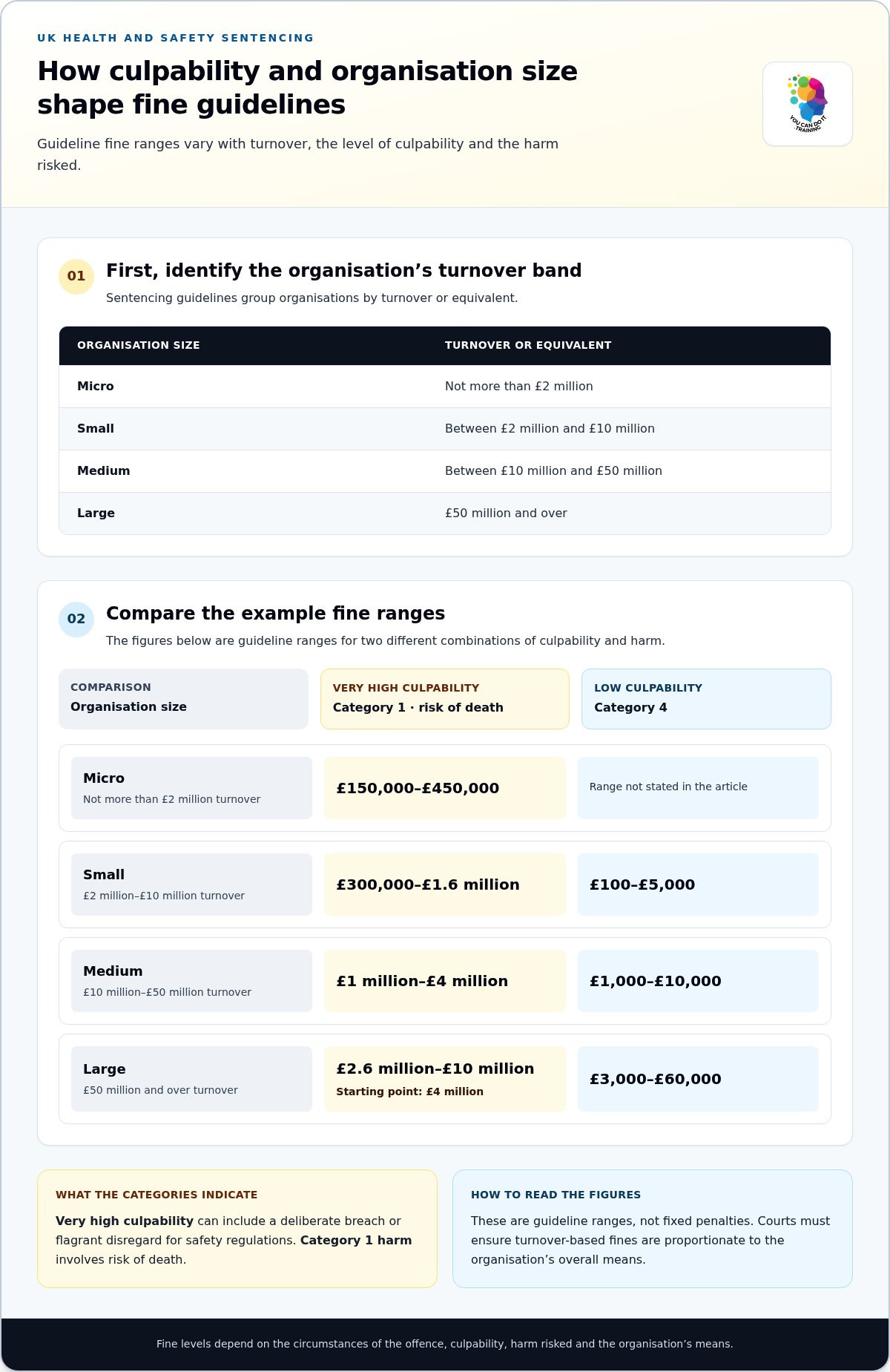
Fine starting points and ranges based on organisation size
Sentencing guidelines group organisations by turnover or equivalent, then consider culpability and harm category. A micro organisation has turnover not more than £2 million; a small organisation, between £2 million and £10 million; a medium organisation, between £10 million and £50 million; and a large organisation, £50 million and over. Knowing your organisation’s band helps put the potential fine range into context. Avoiding HSE fines for safety breaches starts with understanding the financial exposure, then focusing on prevention.
For a very-high-culpability, category 1 offence, the fine range is £150,000 to £450,000 for a micro organisation, £300,000 to £1.6 million for a small organisation, and £1 million to £4 million for a medium organisation. For a large organisation, the range is £2.6 million to £10 million, with a £4 million starting point. Category 1 harm involves risk of death.
For low-culpability, category 4 offences, a large organisation’s range is £3,000 to £60,000; a medium organisation’s is £1,000 to £10,000; and a small organisation’s is £100 to £5,000. These are guideline ranges, not fixed penalties. Avoiding HSE fines for safety breaches is better approached through sound safety decisions than by assuming a lower band will limit the outcome.
The Sentencing Council framework also requires courts to ensure that turnover-based fines are proportionate to the offender’s overall means. Executives and board members can make safety a practical priority by assigning responsibility, resourcing controls and acting on concerns. This gives teams a clearer approach to avoiding HSE fines for safety breaches while protecting employees and the public.
You Can Do It Training: CITB Health and Safety Awareness (HSA)
You Can Do It Training Ltd’s CITB Health and Safety Awareness (HSA) course helps workers build practical understanding of workplace hazards, safe working practices and individual responsibilities. It’s a useful step when employees need a stronger foundation for recognising risks and following site procedures. Training supports effective safety management, but it does not replace suitable risk assessments or workplace controls.
For people taking on supervisory or management responsibilities, the CITB Site Supervisor Safety Training Scheme (SSSTS) and CITB Site Management Safety Training Scheme (SMSTS) provide role-relevant learning. Choose training that reflects each person’s responsibilities, then apply the learning to everyday tasks, briefings and decisions on site.
Visit youcandoit.training to discuss which course fits your team’s needs.
Make safer working part of every decision
A lasting approach to avoiding HSE fines for safety breaches starts with making safe practice part of how work is planned, supervised and reviewed. Assign clear responsibility for turning identified risks into practical controls, then make sure employees understand what those controls mean on site. This keeps safety connected to daily decisions, rather than leaving it as a document brought out only after something goes wrong.
Choose a practical next step your organisation can take now: review how safety responsibilities are communicated, identify where workers need clearer guidance, or build learning into team discussions. Small, consistent actions can make good safety habits part of workplace culture and keep people engaged in protecting one another.
Keep learning, listen to your team and keep making safer work achievable for everyone.
Frequently Asked Questions
Can You Appeal HSE Fines?
Yes, a business can appeal an HSE fine, and appeals typically need to be submitted to the relevant court within 21 days of the fine being issued. Act promptly: note the date, keep the fine notice and related correspondence, and gather records that explain the circumstances. The appeal should address the decision and its basis, rather than simply stating that the penalty is unaffordable.
What Triggers an HSE Fine?
An HSE fine may follow a prosecution and court conviction for a health and safety offence. A breach alone does not automatically mean a fine. Enforcement can include a notice requiring action, and failure to address the stated problem within its timeframe may lead to further action. For example, an unresolved safety shortfall identified during an inspection can escalate if the organisation does not put it right.
What are Fees for Intervention?
Fees for Intervention are charges the Health and Safety Executive may recover when it finds a material breach, meaning a breach serious enough for the HSE to recover its investigation costs. These charges are separate from a court fine, so distinguish intervention costs from any prosecution or sentencing outcome.
What are the most common reasons the UK HSE issues fines for safety breaches?
Common reasons include inadequate risk assessments, insufficient safety training, missing personal protective equipment, poorly maintained machinery and unsafe housekeeping. Organisations can reduce exposure by matching controls to actual tasks. For example, check that workers understand equipment procedures and that maintenance issues are recorded and addressed. Ignoring the deadline in an improvement or prohibition notice can also lead to further enforcement.
What health and safety laws must UK employers comply with to avoid HSE penalties?
The laws that apply depend on the work and its hazards. Key examples include the Health and Safety at Work Act 1974, the Management of Health and Safety at Work Regulations 1999, and the Reporting of Injuries, Diseases and Dangerous Occurrences Regulations 1995. Construction work may also involve the Construction (Design and Management) Regulations. Identify rules relevant to your activities, then translate their duties into workplace controls.









Leave a Reply
Want to join the discussion?Feel free to contribute!