

Legal requirements for workplace safety training in the UK
There isn’t one safety course that every UK employer must provide. The legal requirements for workplace safety training in the UK depend on workplace risks and the tasks people do: according to The National Archives, Section 2 of the Health and Safety at Work Act 1974 requires employers to provide the information, instruction, training and supervision needed to protect health and safety.
It’s understandable to want a clear list of mandatory courses, especially when workplace responsibilities can feel complex. The key is to match training to identified risks, help people understand how to work safely, and review competence when tasks or conditions change.
This guide explains when training may be required, what can happen if employers fail to provide it, and how induction, supervision and refresher learning can help maintain competence. It also shows how risk assessments can guide practical training decisions.
Key Takeaways
- Match training to the risks and tasks in your workplace instead of relying on a generic course checklist.
- Plan adequate and appropriate first-aid provision, as required by the Health and Safety (First Aid) Regulations 1981, according to The National Archives.
- Use supervision and competence checks alongside refresher learning, especially when job duties or workplace risks change.
- For construction teams, align CITB training with responsibilities: HSA for general awareness, SSSTS for supervisors and SMSTS for site managers.
What happens if an employer does not provide mandatory training?
According to The National Archives, Section 2 of the Health and Safety at Work Act 1974 requires employers to provide necessary information, instruction, training and supervision. These duties support employees’ health and safety at work. If staff lack instruction for a task, they may not recognise its hazards or know the safe way to carry it out. For example, someone moving heavy items needs suitable guidance on the risks and safe handling practice.
Training needs differ across a workforce. Employers should identify risks through assessments, then match instruction to employees’ roles, workplace and equipment. The Health and Safety Executive reports that handling, lifting and carrying accounted for 17% of workplace injuries in the UK in 2024/25. Where manual handling cannot be avoided, relevant training helps workers understand safer methods. Fire safety instruction should also reflect the workplace’s risks and emergency procedures.
Employers should include new recruits, employees moving into different roles or taking on extra responsibilities, and contractors working for them. Keep records of training dates, attendees and topics covered, particularly for workplace fire safety. These records help managers identify who has received instruction and spot gaps when tasks or procedures change. They also make it easier to review whether training is still relevant.
Employees also have responsibilities. They should follow health and safety policies and instructions, apply what they have learnt, and report risks to the appropriate person. Supervisors can reinforce safe practice by observing work and addressing unsafe behaviour. This does not replace the employer’s duty to provide suitable training and supervision.
Must training be provided during working hours and free of charge? For employees who started on or after 6 April 2020, written particulars must set out mandatory training expectations, including training the employer does not pay for. The duties require employers to provide necessary training, but do not establish a universal schedule for when it takes place.
Refresher training, supervision and competence checks
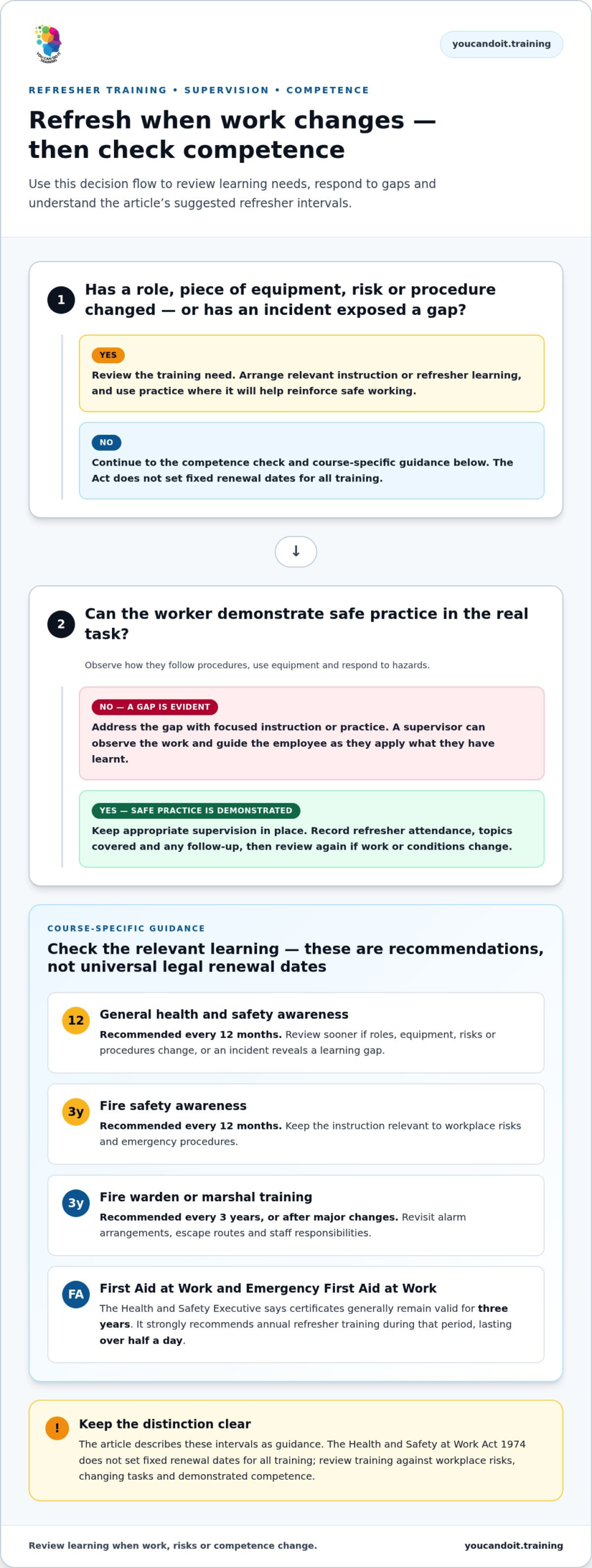
Refresher learning helps employees retain skills and respond to changed workplace risks. The Health and Safety at Work Act 1974 does not set fixed renewal dates for all training.
Reviewing refresher training needs
Refresher training revisits knowledge and skills so employees can apply them safely. Review needs when roles, equipment, risks or procedures change, and after an incident exposes a gap. General health and safety awareness and fire safety awareness are recommended every 12 months. Fire warden or marshal training is recommended every 3 years or after major changes. These intervals are guidance, not universal legal renewal dates.
Supervision and competence checks
Supervision means observing work and guiding employees as they apply training in real tasks. Check whether someone can follow procedures, use equipment correctly and respond to hazards, then address gaps with instruction or practice. The Health and Safety Executive says First Aid at Work and Emergency First Aid at Work certificates generally remain valid for three years. It strongly recommends annual refresher training during that period, lasting over half a day.
Continuous improvement through refreshers
Use refresher sessions to turn lessons from incidents, near misses and worker feedback into safer routines. Record attendance, topics covered and any follow-up, then review whether procedures have changed. For fire safety, revisit alarm arrangements, escape routes and staff responsibilities; practise the response so people understand their roles. A supervisor can note confusion during practice and arrange focused instruction. Practical refresher training can help reinforce learning when procedures or workplace risks change.
What Health and Safety Training Is Mandatory in the UK?
The legal requirements for workplace safety training in the UK depend on work tasks and identified hazards. Training should prepare people for the risks they may encounter at work.
Induction and changing risks
Induction introduces workers to safety procedures relevant to their role and workplace. According to The National Archives, the Management of Health and Safety at Work Regulations 1999 require training when staff start employment, periodically and when relevant workplace changes occur. The National Archives also says the Manual Handling Operations Regulations 1992 require training where manual handling cannot be avoided. The Health and Safety (First Aid) Regulations 1981 require adequate and appropriate first-aid provision, according to The National Archives.
Workers’ health and safety responsibilities
Workers should follow instructions, use safe procedures and report hazards to the appropriate person. For example, someone experiencing work-related stress can use the organisation’s reporting process, helping managers assess the issue and decide what action to take. Keep training records up to date, including attendance and topics covered, so the organisation can identify learning gaps and record follow-up.
Course accreditation
Accreditation shows that a course meets a recognised standard, but it does not make the course mandatory for every job. When mapping legal requirements for workplace safety training in the UK, employers should match course content to each role and its risks, then retain completion records. Relevant learning may include role-specific instruction, practical exercises or guidance on reporting hazards.
Training across UK nations
The core duty to provide suitable health and safety training applies across the UK, although legislation and arrangements can differ between its nations. Organisations operating in more than one nation should identify the rules that apply at each workplace and align training with local hazards. Record decisions and actions so managers can review whether training remains appropriate.
You Can Do It Training: CITB Health and Safety Awareness (HSA)
You Can Do It Training delivers CITB Health and Safety Awareness (HSA) for construction workers who need a grounding in site safety. Team leaders and managers can take the CITB Site Supervisor Safety Training Scheme (SSSTS) or CITB Site Management Safety Training Scheme (SMSTS), while the CITB SSSTS Refresher supports supervisors revisiting their learning.
Choose training according to each person’s responsibilities and the risks they face, rather than assuming one course suits every role. This connects course content with practical workplace needs and helps develop a capable, safety-aware team.
To discuss suitable CITB training for your workforce, contact You Can Do It Training Ltd or visit youcandoit.training.
Make safety learning part of everyday work
Turn your training plan into a routine: assign responsibility for each role, record completion and review learning when work changes. Understanding the legal requirements for workplace safety training in the UK is most useful when it informs everyday decisions, not just paperwork. Reviewing role assignments, induction notes, refresher needs and how staff apply procedures can show where further support is needed.
For construction teams, You Can Do It Training delivers CITB Health and Safety Awareness (HSA), the Site Supervisor Safety Training Scheme (SSSTS) and the Site Management Safety Training Scheme (SMSTS). Match each course to the learner’s responsibilities, then reinforce its lessons through regular conversations about safe working practices.
Each practical step helps create a workplace where people feel prepared to work safely and support one another.
Frequently Asked Questions
Can mandatory training be completed online in the UK?
Online training can suit knowledge-based topics when it provides the instruction workers need for their tasks. It may not be sufficient on its own when safe performance depends on practising equipment use or demonstrating a hands-on skill. For example, combine online learning about a site hazard with supervised practice when workers need to demonstrate how they apply a procedure.
Does manual handling training need to be renewed?
There’s no single statutory renewal interval for manual handling training across every role. Refresh manual handling training when role risks, equipment or working methods change, or when workers need further support. Revisit the training sooner if workers use new equipment or methods, report difficulty, or an incident shows that the original instruction needs reinforcing.
How often does mandatory workplace training need to be renewed in the UK?
UK law does not set one fixed renewal date for all workplace safety training. Review timing according to the course and level of risk, and bring reviews forward when duties, equipment or procedures change. The Health and Safety Executive says first-aid certificates generally remain valid for three years and recommends annual refresher training during that period. Keep a calendar of review dates and triggers.
What UK laws require employers to provide workplace health and safety training?
Several laws create training duties according to workplace risks and roles. According to The National Archives, Section 2 of the Health and Safety at Work Act 1974 covers necessary instruction and training, while the Management of Health and Safety at Work Regulations 1999 require training at relevant points. The National Archives also identifies first-aid and manual-handling regulations with specific training requirements.
What must workplace safety training cover under the Health and Safety at Work etc. Act 1974?
According to The National Archives, Section 2 requires the information, instruction, training and supervision necessary to protect health and safety. The Act doesn’t set one syllabus for every workplace. Tailor learning to the job: warehouse workers may need site-specific vehicle routes, while office staff may need guidance relevant to screen work. Explain emergency procedures and how to report hazards.










Leave a Reply
Want to join the discussion?Feel free to contribute!