

How to Get Team Buy-in for Safety Training in 2026
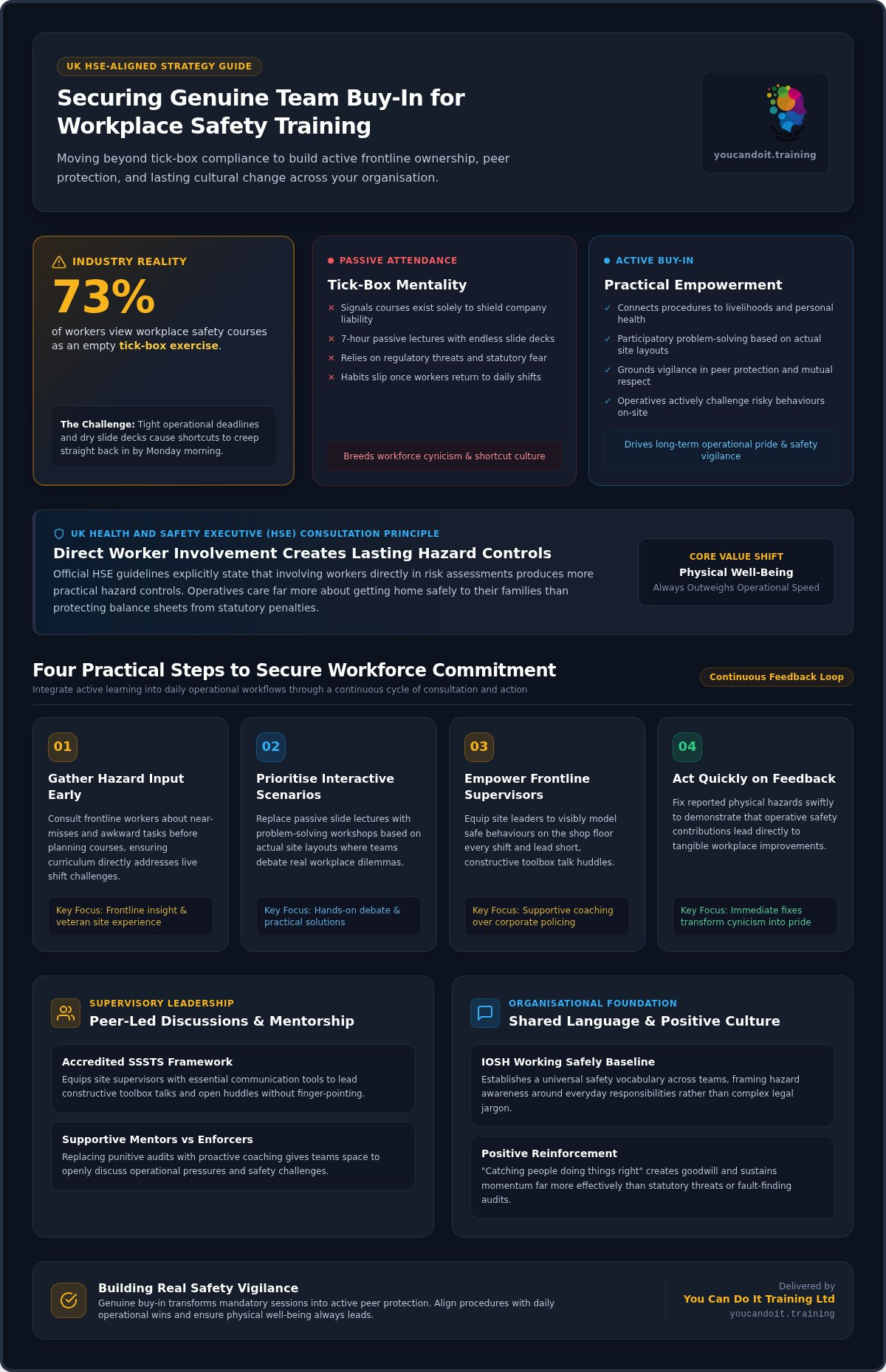
A recent industry survey revealed that 73% of workers view workplace safety courses as an empty tick-box exercise. When tight operational deadlines loom, pulling staff from their duties feels like an uphill struggle, particularly when familiar shortcuts creep straight back in by Monday morning. Figuring out how to get team buy-in for safety training isn’t about lecturing people or policing behaviour; it’s about connecting compliance with everyday protection and genuine pride.
You already know that real workplace vigilance can’t be forced through dry slide decks or statutory threats. In this guide, you’ll discover practical, HSE-aligned strategies to win hearts and minds, turning compulsory sessions into active, engaging discussions that protect livelihoods. We’ll explore actionable ways to boost participation, align safety with daily operational wins, and create lasting cultural change across your business.
Key Takeaways
- Discover how to get team buy-in for safety training by replacing passive compliance lectures with participatory, peer-led problem solving.
- Uncover why workforce cynicism develops and how aligning daily procedures with personal well-being breaks the cycle of post-course habits slipping.
- Learn four HSE-aligned implementation steps that involve workers directly in risk assessments to foster genuine ownership.
- Identify dynamic course delivery formats, from practical scenario workshops to foundational accredited programmes, that build long-term workplace engagement.
Why Teams Resist Safety Training and How to Shift Perceptions
Real buy-in isn’t about filling seats in a classroom; it’s active worker commitment. Passive attendance ticks legal boxes, but true engagement means operatives actively challenge risky behaviours on-site. Cynicism usually takes root when courses feel disconnected from daily operational reality. Bombarding teams with endless PowerPoint presentations signals that training exists solely to shield company liability rather than protect individuals.
Understanding how to get team buy-in for safety training starts with shifting this perception. Instead of presenting compliance as an administrative hurdle, position instruction as practical empowerment. When workers see that procedures directly safeguard their livelihoods, health, and colleagues, the tick-box attitude evaporates. Building a positive safety culture requires showing teams that their physical well-being always matters more than operational speed.
Winning Hearts and Minds over Regulatory Fear
Threatening staff with regulations rarely inspires vigilance. Operatives care far more about getting home safely to their families than protecting a balance sheet from HSE penalties. Practical steps to build this mindset include:
- Listen to frontline insight: Value the hard-earned experience of site veterans rather than talking down to them from a pedestal.
- Follow HSE consultation principles: Official Health and Safety Executive guidelines explicitly state that involving workers in risk assessments leads to more practical, lasting hazard controls.
- Ditch punitive rhetoric: Frame safe working practices as peer protection, proving that learning how to get team buy-in for safety training relies on mutual respect, not corporate policing.
Four Practical Steps to Secure Genuine Workforce Safety Buy-in
Securing genuine workforce commitment requires a structured, actionable framework. Rather than waiting for an annual refresher, organisations must actively integrate learning into daily operational workflows through four distinct steps:
- Gather hazard input early: Ask frontline workers about near-misses and awkward tasks before planning a course, making the curriculum directly relevant to their shift.
- Prioritise interactive scenarios: Replace passive lectures with problem-solving workshops based on actual site layouts.
- Empower frontline supervisors: Ensure team leaders visibly model correct safety habits on the shop floor every single day.
- Act quickly on feedback: Fix reported physical hazards swiftly to prove that safety contributions lead to tangible improvements.
Mastering how to get team buy-in for safety training depends entirely on this continuous loop of consultation and action. When operatives see their concerns resolved promptly, cynicism transforms into active operational pride.
Implementing Peer-Led Safety Discussions and Mentorship
Site supervisors play the most critical role in keeping training alive after classroom hours. Equipping leaders through an accredited SSSTS course gives them the communication tools needed to run constructive toolbox talks without finger-pointing. Short, informal huddles give teams space to discuss real operational pressures openly. When supervisors act as supportive mentors rather than strict enforcers, discovering how to get team buy-in for safety training becomes a natural part of daily teamwork.
If you’re looking to strengthen supervisory leadership on your sites, partnering with You Can Do It Training helps build practical coaching skills that stick.
Selecting Training Formats That Keep Teams Engaged Long-Term
Dry, slide-heavy lectures drain enthusiasm fast. When delegates spend seven hours staring at static diagrams, information rarely survives past the classroom door. Contrast that with interactive, discussion-led environments where candidates debate actual workplace dilemmas, test practical solutions, and share their own working knowledge. Real learning happens through conversation, not automated bullet points.
Establishing a common baseline across your entire organisation makes these discussions far more productive. Enrolling staff on an accredited IOSH Working Safely course provides everyone with a shared safety vocabulary. It frames hazard awareness around everyday individual responsibilities rather than complex legal jargon. Once your team speaks the same safety language, reinforcing good habits becomes second nature.
Sustaining this momentum requires regular positive reinforcement instead of punitive audits. Catching people doing things right builds genuine goodwill. Broadening the curriculum to cover wider threat awareness and emergency preparedness, like the specialised courses designed by FreeState Safety Training, also shows staff that their personal security is genuinely valued. That positive atmosphere is essential if you want to know how to get team buy-in for safety training over months and years, rather than just on assessment day.
Creating a Welcoming and Supportive Learning Environment
Intimidation kills engagement. Creating a relaxed, hospitable training environment, complete with fresh tea, coffee, and good biscuits, instantly lowers defensive barriers. When people feel comfortable, they ask candid questions and work through tricky operational scenarios collaboratively. Pairing this welcoming setting with advanced site qualifications like SMSTS training equips project managers to translate classroom principles into supportive site leadership. By consistently inviting feedback after every session, you can adapt ongoing refreshers to frontline realities, proving that learning how to get team buy-in for safety training is an evolving, team-centred journey.
Inspire Active Commitment Across Your Sites Today
Transforming your safety culture requires shifting away from compliance tick-boxes toward authentic peer protection. By listening to frontline insight, supporting supervisory coaching, and choosing interactive workshops, you dismantle old cynicism. Realising how to get team buy-in for safety training comes down to empowering workers to protect themselves and their colleagues every day.
With over three decades of industry experience and an established 99% pass rate across accredited CITB, IOSH, and UKATA certifications nationwide, our welcoming hearts-and-minds approach turns mandatory learning into positive workplace change.
Equip your people with practical skills in a supportive environment, because when it comes to keeping everyone safe, you can do it.
Frequently Asked Questions
How do you convince reluctant workers to participate in safety courses?
Convince reluctant staff by connecting course content directly to their personal well-being and daily challenges rather than corporate rules. Give them an active voice before training begins by asking what real hazards frustrate them on shift. Approaching sessions with genuine respect and open dialogue dispels scepticism, helping you understand how to get team buy-in for safety training that genuinely resonates.
What role do site supervisors play in driving safety training buy-in?
Site supervisors act as the crucial link between classroom theory and daily operational habits. If supervisors ignore protocol under pressure, frontline teams quickly follow suit. When leaders model safe working practices and lead constructive, peer-to-peer discussions during daily briefings, they reinforce learning continuously. Developing those influential leadership capabilities often benefits from executive coaching, such as that provided by Simon Lead LLC, helping managers engage and guide their workforce effectively. Their visible support proves that health and safety is an ongoing site value rather than an isolated exercise.
Can accredited courses like IOSH or CITB improve company safety culture?
Yes, accredited programmes like CITB and IOSH provide a structured framework and shared language that unite teams around safety expectations. Rather than relying on inconsistent internal rules, nationally recognised qualifications validate good practice and build mutual confidence. Delivering these courses in supportive, interactive environments encourages open collaboration, showing workers that understanding how to get team buy-in for safety training strengthens operational pride across all levels.
How often should safety training be refreshed to maintain engagement?
While statutory refresher intervals for major schemes typically range between three to five years, maintaining true engagement requires regular, informal touchpoints. Back up formal certifications with brief monthly toolbox talks, practical scenario reviews, and open feedback sessions. This continuous approach keeps safety concepts fresh in workers’ minds without overloading operational schedules or letting risky shortcuts turn into bad workplace habits.










Leave a Reply
Want to join the discussion?Feel free to contribute!