

Manual Handling Course: UK Workplace Safety Guide 2026
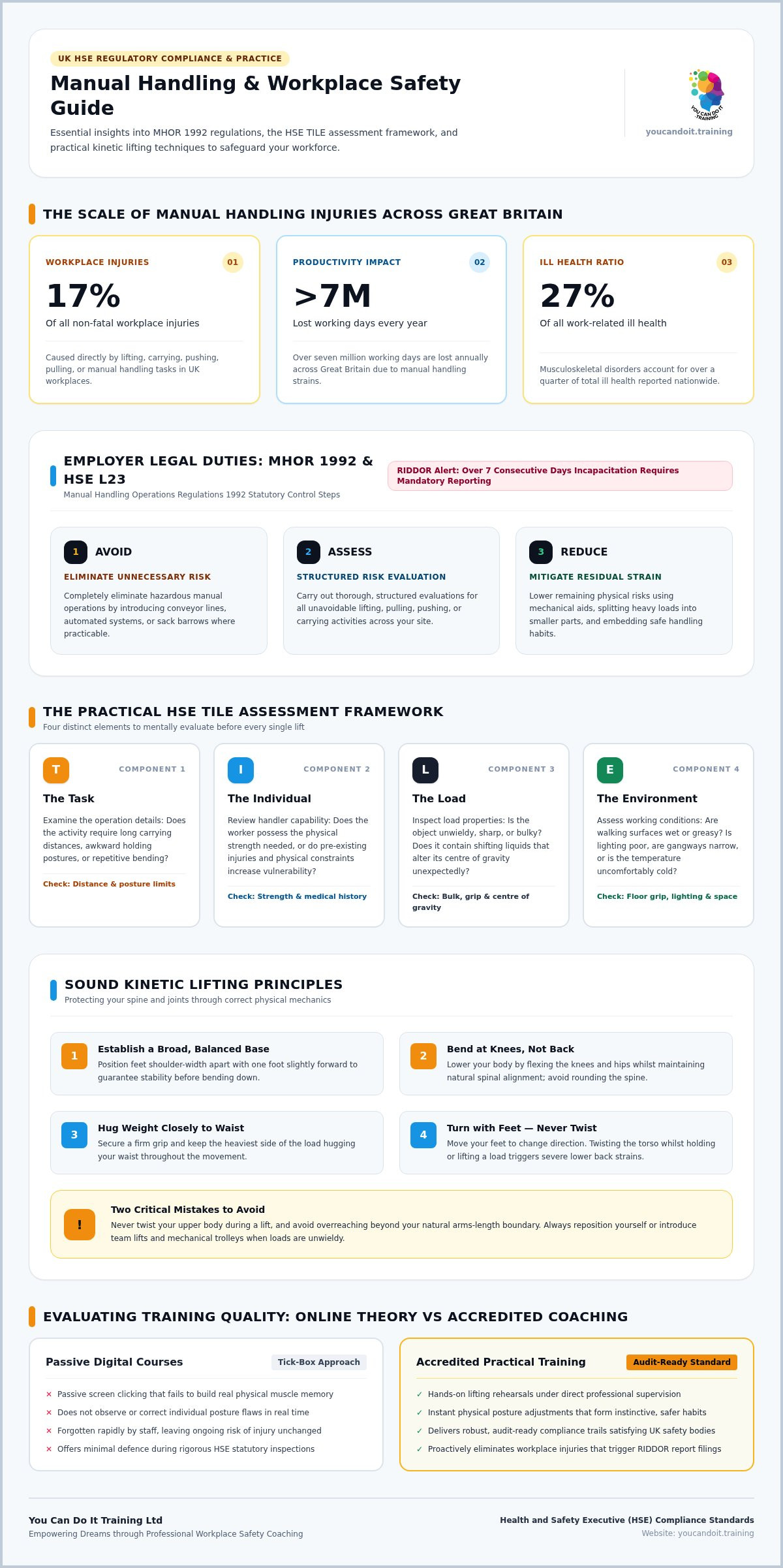
Handling, lifting, or carrying causes 17% of all non-fatal workplace injuries across Great Britain, resulting in over seven million lost working days each year. If you are searching for a reputable manual handling course stoke on trent or upskilling teams nationwide, you probably worry that safety training will simply become another dull, tick-box exercise forgotten by Monday morning. We understand that frustration completely. Real training shouldn’t feel like an administrative chore; it should empower your staff to look after themselves and each other.
Discover how an accredited course protects your workforce, satisfies Health and Safety Executive (HSE) legal standards, and actively prevents debilitating musculoskeletal strains. In this 2026 guide, we unpack official compliance duties, share practical handling techniques your team can implement straight away, and demonstrate how a positive learning environment builds long-term physical safety across all your daily operations.
Key Takeaways
- Learn how the Manual Handling Operations Regulations 1992 apply to your daily workplace tasks, demystifying statutory HSE duties without confusing legal jargon.
- Discover how to apply the HSE TILE assessment framework alongside practical kinetic lifting principles to protect your team against painful musculoskeletal injuries.
- Whether you need a manual handling course stoke on trent or seek nationwide workplace training, learn why accredited certification provides an essential, audit-ready inspection trail.
- Explore how hands-on, supportive coaching replaces forgettable tick-box theory with lasting physical lifting habits that keep staff safe every day.
Understanding Manual Handling Regulations and Workplace Injury Risks
Under the Manual Handling Operations Regulations 1992 (MHOR), manual handling encompasses transporting or supporting any load using physical effort, including lifting, putting down, pushing, pulling, or carrying. The official scope, established under foundational safety frameworks for the manual handling of loads, impacts every workplace from busy distribution hubs to quiet office stockrooms. Musculoskeletal disorders account for 27% of all work-related ill health in Great Britain. Damaged spinal discs, repetitive muscle strains, and chronic joint issues do not just disrupt operational productivity; they hurt individual lives and team morale.
The Employer Legal Duties Under UK Health and Safety Law
Health and Safety Executive (HSE) L23 guidance demands a clear three-step hierarchy of control to eliminate avoidable physical strain:
- Avoid: Eliminate hazardous manual operations by introducing conveyor systems, sack barrows, or process automation.
- Assess: Conduct structured risk evaluations for any unavoidable lifting or carrying movements.
- Reduce: Lower remaining injury risks through mechanical lifting aids, split loads, and task-specific physical handling habits.
When poor manual practices lead to employee incapacitation exceeding seven consecutive days, UK law triggers mandatory reporting under RIDDOR. Sourcing an accredited manual handling course stoke on trent, or pairing handling modules with a comprehensive IOSH Working Safely course, guarantees complete regulatory alignment while giving staff the practical confidence to protect their bodies every single shift.
Essential Lifting Techniques and the Practical TILE Assessment Framework
Safeguarding your spine relies on adopting sound kinetic lifting principles rather than relying on brute force. Before lifting any item, establish a broad, balanced base with your feet shoulder-width apart. Bend at the knees rather than curving your back, get a secure grip, and keep the weight hugging your waist throughout the movement. Two common mistakes trigger avoidable strains: twisting the upper torso whilst lifting, and overreaching beyond comfortable carrying boundaries. Always move your feet to change direction rather than rotating your lower back.
Applying the TILE Assessment to Daily Workplace Tasks
Before moving any load, staff should carry out a quick mental evaluation using the HSE-recommended TILE assessment framework, which breaks down risk into four practical areas:
- Task: Does the activity involve long carrying distances, awkward holding postures, or repetitive bending?
- Individual: Does the handler possess the required physical strength, or do pre-existing injuries increase risk?
- Load: Is the object bulky, sharp, uneven, or filled with shifting liquids that alter its centre of gravity?
- Environment: Are floor surfaces wet, lighting levels poor, walkways constrained, or temperatures uncomfortably cold?
When tasks present elevated risks, assign a clear leader to coordinate team lifts, or introduce mechanical aids like trolleys and barrows. Completing an empowering manual handling course stoke on trent gives your workforce the hands-on confidence to apply these assessment steps instinctively every single day.
Selecting an Accredited Manual Handling Course for Your Workforce
Passive digital tick-box courses rarely change physical behaviour on the shop floor. While clicking through online slides satisfies basic administration, it fails to correct posture flaws or teach true muscle memory. Choosing an interactive manual handling course stoke on trent gives your team hands-on practice under expert supervision. Delegates rehearse lifting techniques, receive instant posture adjustments, and build genuine body awareness. Accredited qualifications also create clear, audit-ready records for safety inspectors, proving your commitment to workforce welfare whilst cutting severe injuries that trigger mandatory RIDDOR reporting.
What to Expect from High-Quality Professional Safety Training
Top-tier training pairs technical rigour with genuine warmth, dismantling the intimidation often surrounding compliance. High-calibre instructors bring a hearts-and-minds philosophy to every session, putting nervous learners at ease with down-to-earth support, fresh tea, and proper biscuits. This reassuring approach helps teams achieve an industry-leading 99% pass rate.
Skilled tutors tailor lifting exercises to match individual mobility levels, ensuring everyone participates comfortably. Arranging nationwide on-site delivery allows your team to train together around active shift patterns, minimising operational downtime whilst establishing shared, lifelong safety habits across your entire operation.
Protect Your Workforce with Practical Lifting Confidence
Protecting your team against painful musculoskeletal injuries starts with moving beyond dry compliance theory. Applying the HSE TILE assessment framework and mastering sound kinetic lifting habits safeguards spinal health while ensuring your business satisfies statutory standards. Whether you are seeking a manual handling course stoke on trent or arranging flexible on-site delivery nationwide, accredited practical coaching creates real behavioural change on the shop floor. Our supportive tutors guide learners to an industry-leading 99% pass rate, proving that mastering workplace safety is well within your team’s reach.
Equipping your colleagues with proper technique today protects their long-term well-being and ensures everyone heads home safe, healthy, and injury-free after every shift.
Frequently Asked Questions
Is manual handling training a legal requirement for UK employers?
Yes, providing adequate instruction is a legal duty under UK workplace safety law. While the Manual Handling Operations Regulations 1992 don’t mandate a specific qualification name, employers must reduce lifting risks to the lowest reasonably practicable level. Professional training ensures your business satisfies statutory Health and Safety Executive obligations and protects personnel against painful, preventable injuries.
How often should employees complete manual handling refresher courses?
Most employers schedule refresher training every two to three years to maintain high compliance standards. However, you should refresh training sooner if operational duties change, new handling equipment arrives, or an injury occurs. Sourcing an accredited manual handling course stoke on trent or booking national on-site sessions ensures proper kinetic habits remain sharp, safe, and audit-ready.
What is the maximum legal weight an employee can lift at work?
Can manual handling training be completed entirely online?
While basic theory can sit online, digital modules can’t observe, coach, or correct physical lifting posture. Enrolling your workforce in a practical manual handling course stoke on trent provides supervised, hands-on kinetic training. Real coaching builds lasting muscle memory, puts nervous learners at ease, and dramatically cuts the risk of debilitating shop-floor strains.










Leave a Reply
Want to join the discussion?Feel free to contribute!