

RIDDOR Reporting: A Practical Guide to UK Compliance in 2026
Did you know that the HSE estimates that only about half of all reportable non-fatal workplace injuries are actually documented through official channels? It’s a startling figure that often stems from genuine confusion rather than neglect. We know that when an incident occurs, your first priority is the person involved, but the sudden pressure of riddor reporting can feel like an intimidating hurdle. Whether you’re worried about heavy fines or you’re simply stuck trying to tell the difference between “specified” and “over-seven-day” injuries, that feeling of anxiety is something many safety-conscious leaders share.
At You Can Do It Training Ltd, we believe in winning hearts and minds by making technical compliance feel achievable. Our goal is to provide the right knowledge and support so you can focus on what matters most: your people. This guide will help you master the essentials of the 2013 regulations, ensuring you stay ahead of the major 2026 consultation changes. We’ll break down the latest deadlines, simplify those complex forms, and give you a clear, practical roadmap to keep your site safe and your documentation flawless. You can do it.
Key Takeaways
- Understand your statutory obligations under the 2013 regulations to protect your workforce and keep your business compliant.
- Learn how to identify reportable incidents, from “specified injuries” to dangerous occurrences, to ensure your riddor reporting meets HSE standards.
- Get to grips with critical submission deadlines, including the 10-day limit for serious accidents and the 15-day window for over-seven-day injuries.
- Discover how accredited CITB training empowers your supervisors and managers to handle safety documentation and legal requirements with total confidence.
What is RIDDOR Reporting and Why Does it Matter?
Safety isn’t just a manual on a shelf; it’s a living commitment to every person on your team. The Reporting of Injuries, Diseases and Dangerous Occurrences Regulations 2013 is a statutory obligation that requires UK employers to notify the Health and Safety Executive (HSE) about specific workplace incidents. While the legal phrasing can feel heavy, the purpose is dual-fold. It helps the HSE identify where risks are rising across the country, and it gives your business the vital data needed to prevent future accidents. At its core, this is about winning hearts and minds by prioritising human life over paperwork.
Who is Responsible for Making the Report?
The duty to report rests with the “Responsible Person.” In most cases, this is the employer, but it also extends to the self-employed and those in control of work premises. If you’re managing a site, you are the mentor and guardian of that space. Your role is to ensure that any qualifying incident is documented accurately and submitted within the legal timeframe. This responsibility stays with you because you are best placed to understand what went wrong and how to fix it.
Managing riddor reporting for contractors whilst they are working on a third-party site requires clear communication. While the contractor’s own employer usually handles the report, the person in control of the premises must ensure the incident is captured. It’s about building a collaborative environment where safety is everyone’s business. Whether you are a small business owner or a site manager, having a clear process in place ensures that legal duties are met without the stress of confusion or last-minute panic.
What Incidents Must You Report Under RIDDOR?
Identifying what needs to be reported shouldn’t feel like a guessing game. To make things simpler, we can group reportable incidents into three main buckets: injuries, occupational diseases, and dangerous occurrences. It’s also vital to remember that your internal accident book is your first line of defence. Whilst riddor reporting is a legal requirement for the HSE, your accident book captures every minor slip and trip, helping you spot patterns before they become serious. For a full breakdown of every legal category, you should consult the official RIDDOR guidance to ensure nothing slips through the cracks.
Specified Injuries vs. the Over-Seven-Day Rule
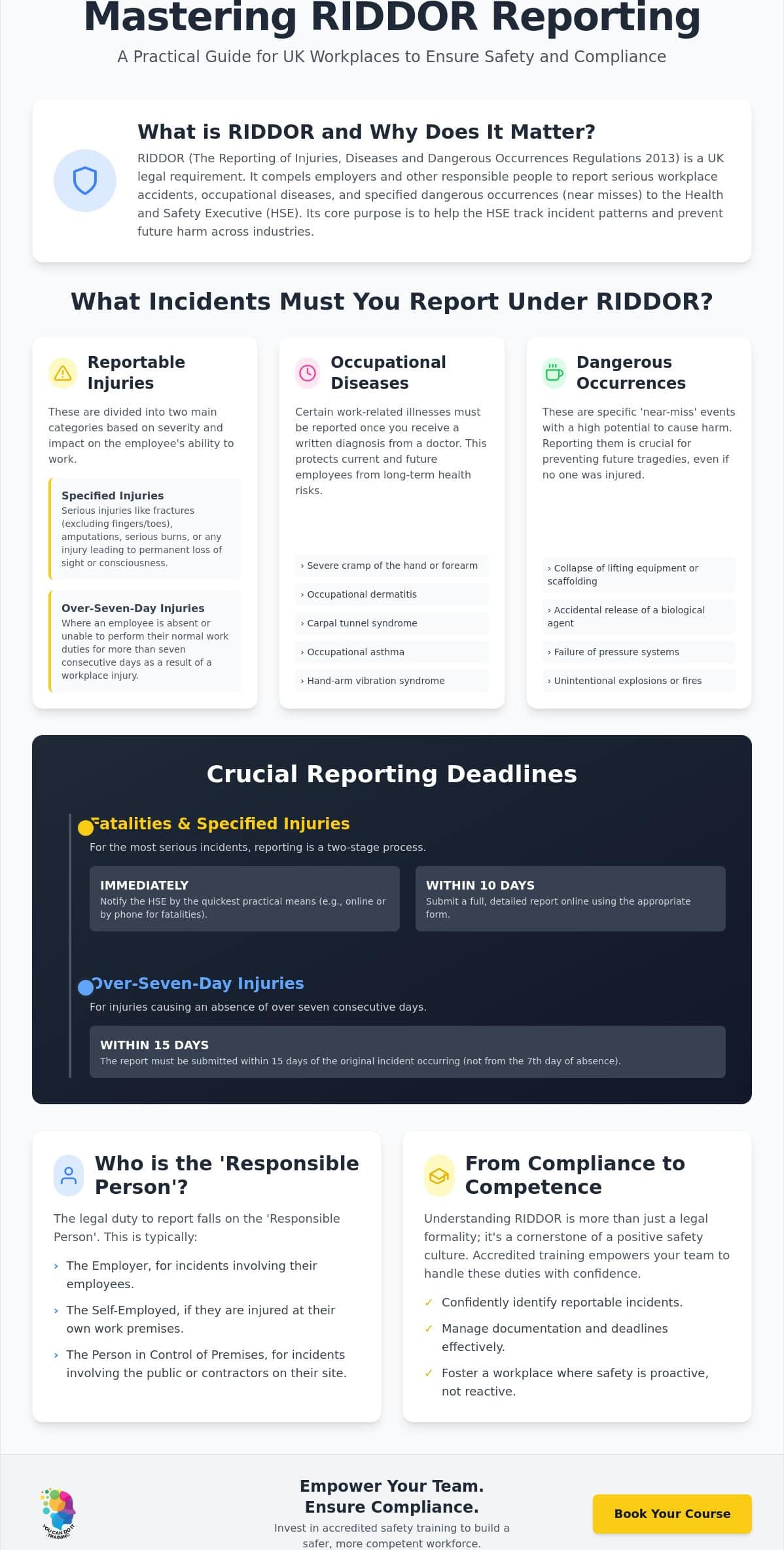
Some incidents are so serious they require immediate attention. These are called “specified injuries” and include things like certain bone fractures, serious burns, or any injury likely to lead to permanent loss of sight. You must report these without delay, with a full written record submitted within 10 days. On the other hand, the “over-seven-day” rule applies when a worker can’t perform their normal duties for more than seven consecutive days because of a workplace accident. While you have 15 days from the day of the incident to submit the report, the clock starts ticking the very moment the accident happens. It’s a lot to manage, but gaining a qualification like the SSSTS course can give you the practical tools to handle these situations with poise.
Occupational Diseases and Dangerous Occurrences
Not every reportable event involves a sudden crash or fall. Occupational diseases such as carpal tunnel syndrome, tendonitis, or occupational asthma must be reported once a doctor provides a written diagnosis. Then there are “dangerous occurrences.” Think of these as high-stakes near-misses. If a scaffold collapses or a forklift overturns, it’s reportable even if nobody was standing in the way. Managing riddor reporting for these lucky escapes is a proactive way to protect your team’s future, ensuring that a mistake today doesn’t become a tragedy tomorrow.
Reporting Deadlines and the Submission Process
Safety isn’t just about the rules; it’s about the people behind them. When an accident happens, the clock starts ticking immediately. Managing the pressure of a deadline whilst looking after an injured colleague is tough, but having a clear plan makes it manageable. For most reportable incidents, you have a 10-day window to submit your full report. However, if you’re dealing with an “over-seven-day” injury, you have a slightly longer period of 15 days from the date of the accident. For fatalities or specified injuries, the HSE requires an “immediate notification.” This usually means a quick phone call for fatal accidents followed by the formal online submission. To help manage these strict timelines and reduce the administrative burden, you can learn more about Be-Safe Technologies Ltd and their digital EHS platforms designed for efficient compliance tracking.
Preparation is the key to confidence. Before you open the portal, gather these essential details:
- The date, time, and specific location of the incident.
- Full personal details of the injured person, including their job role.
- A clear, factual description of what happened.
- Details of the injuries sustained or the dangerous occurrence.
Here’s a practical tip we share with all our learners: draft your description in a Word document before you start the online form. This allows you to proofread for clarity and ensures you don’t lose your progress if the website times out. Once you’re ready, you can find the specific forms and guidance on how to make a RIDDOR report on the HSE website.
How to Submit Your Report to the HSE
The primary way to handle riddor reporting is through the HSE’s online portal. It’s designed to be straightforward, walking you through each step of the process. Once you’ve hit submit, make sure you download and save the copy they provide. It’s a legal requirement to keep these records for at least three years. Keeping them organised shows you’re a professional who takes site safety seriously. If you want to master these administrative duties alongside site safety, our SMSTS course provides the comprehensive toolkit you need to lead with authority.
From Compliance to Competence: How Safety Training Helps
Safety isn’t just a tick-box exercise; it’s a skill that grows with the right mentorship. While we’ve discussed the technical deadlines and reportable categories, the real magic happens when your team feels truly equipped to handle these moments. At You Can Do It Training Ltd, we’ve spent 30 years igniting that confidence. Our SSSTS course is designed to give supervisors the sharp eye needed to spot a reportable incident before the situation escalates. For those leading the entire project, the SMSTS course dives deeper into the legal framework, ensuring you can manage the broader implications of site safety with poise.
We know that technical Health and Safety can feel cold and clinical. That’s why our learning environment is built on mutual respect and comfort. We provide a space that’s professional yet relaxed, complete with plenty of tea, coffee, and the finest bourbon creams to help those complex regulations go down smoothly. For the rest of your staff, the IOSH Working Safely course serves as a fantastic entry point. It helps every worker understand their personal role in the riddor reporting process, making safety a collaborative effort rather than a top-down instruction. Complementing this with dedicated fire warden training ensures your team is equally prepared to respond to fire-related emergencies with the same confidence and competence.
The “Hearts and Minds” Approach to Site Safety
Training shouldn’t just be about passing an exam; it’s about fostering a genuine interest in the people standing next to you on site. We call this our “hearts and minds” approach. It’s about building camaraderie where every team member feels responsible for their colleagues’ welfare. A truly holistic approach to workforce wellbeing also means looking beyond physical hazards — investing in mental health first aid at work ensures your team is supported in every dimension of their health. When you lead with this mindset, riddor reporting becomes more than just a statutory duty. It becomes a tool for transparency that protects the lifeblood of your business: your people. By investing in your team’s competence, you aren’t just following the law; you’re soaring toward a culture where safety is second nature.
Lead with Confidence: Your Path to a Safer Workplace
Mastering riddor reporting isn’t just about avoiding those heavy fines; it’s about building a site where every worker feels protected and valued. By integrating the deadlines and categories we’ve explored into your daily site management, you move from simply reacting to incidents to proactively safeguarding your team’s future. This journey from compliance to competence is what truly differentiates a leader who just follows the rules from one who fosters a culture of genuine care and mutual respect.
At You Can Do It Training Ltd, we’re proud to be your knowledgeable mentor in this process. Backed by 30 years of industry experience and a 99% pass rate, we offer training that is accredited by CITB, IOSH, and UKATA. We ensure that every course, from supervisor schemes to site management, is delivered in an environment that prioritises your comfort and success. It’s about providing the right training for the right people, ensuring you have the tools to soar in your career whilst keeping your colleagues safe.
Book your accredited safety training with You Can Do It Training Ltd today and take the first step towards a more transparent, safety-first workplace. We’re here to help you ignite that spark of achievement, because we know that with the right partner by your side, you can do it.
Frequently Asked Questions
What happens if I fail to report a RIDDOR incident?
Failing to report is a serious criminal offence that can lead to heavy legal penalties. In a Magistrates’ Court, you could face a fine of up to £20,000, whilst the Crown Court can issue unlimited fines. For the most severe cases, individuals can even face up to two years in prison. It’s much better to stay on top of your riddor reporting duties than to risk the future of your business and your freedom.
Do I need to report an accident if it was the employee’s own fault?
Yes, you must report the accident if it meets the criteria, regardless of who was at fault. RIDDOR focuses on whether the incident was “work-related” and caused a reportable injury. It isn’t about assigning blame; it’s about identifying risks so that similar accidents don’t happen again. If the work activity itself contributed to the injury, it needs to go in the books and to the HSE.
Does a “near-miss” always need to be reported to the HSE?
Not every near-miss requires a report to the HSE. Only specific “Dangerous Occurrences” listed in the regulations, such as a scaffold collapse or an exploding pressure vessel, must be officially reported. However, we always encourage you to record all near-misses in your internal safety logs. This proactive approach helps you spot dangerous patterns before someone actually gets hurt on your watch.
How long must I keep records of RIDDOR reports?
You are legally required to keep a copy of all riddor reporting records for a minimum of three years. These records should be stored safely and be easily accessible if an HSE inspector visits your site. Keeping organised files isn’t just about compliance; it shows that you lead a professional, safety-conscious team that takes the welfare of its people seriously.
Is a member of the public being injured a RIDDOR reportable event?
An injury to a member of the public is reportable if they are taken directly from the scene of the accident to a hospital for treatment. It doesn’t matter if the treatment is minor; the act of being taken to hospital is the trigger. This ensures that the HSE can monitor risks that work activities might pose to people outside of your immediate workforce.









Leave a Reply
Want to join the discussion?Feel free to contribute!