
PASMA Training Requirements UK: The 2026 Compliance Guide
Did you know that falls from height accounted for 40 workplace fatalities in Great Britain during 2022/23? This sobering statistic transforms safety from a mandatory chore into a vital mission. We know that unpicking the pasma training requirements uk often feels like wading through clinical jargon; you simply want your team safe, certified, and working without fearing an HSE intervention whilst on site.
We’re here to help you bridge the gap between “competence” and “legal requirement”. This 2026 guide provides a clear roadmap for staff certification and tower inspection protocols, ensuring you meet the Work at Height Regulations 2005 with total confidence. We’ll explore specific course levels and how to foster a “hearts and minds” culture that puts your people first. Mastering compliance is entirely achievable; especially when you have a supportive partner and a bourbon cream to help that knowledge sink in.
Key Takeaways
- Understand how the Work at Height Regulations 2005 define competence and why PASMA certification is the industry-recognised method for meeting these legal duties.
- Identify the specific pasma training requirements uk for your staff to ensure you invest in the correct training levels for their daily site responsibilities.
- Master the technical requirements for tower inspections, including the critical seven-day rule, to ensure your equipment remains safe and legally compliant at all times.
- Discover how a person-centred approach to training can dismantle the intimidation of safety exams and foster a proactive culture of site-wide safety.
The Legal Framework: Is PASMA Training a UK Requirement?
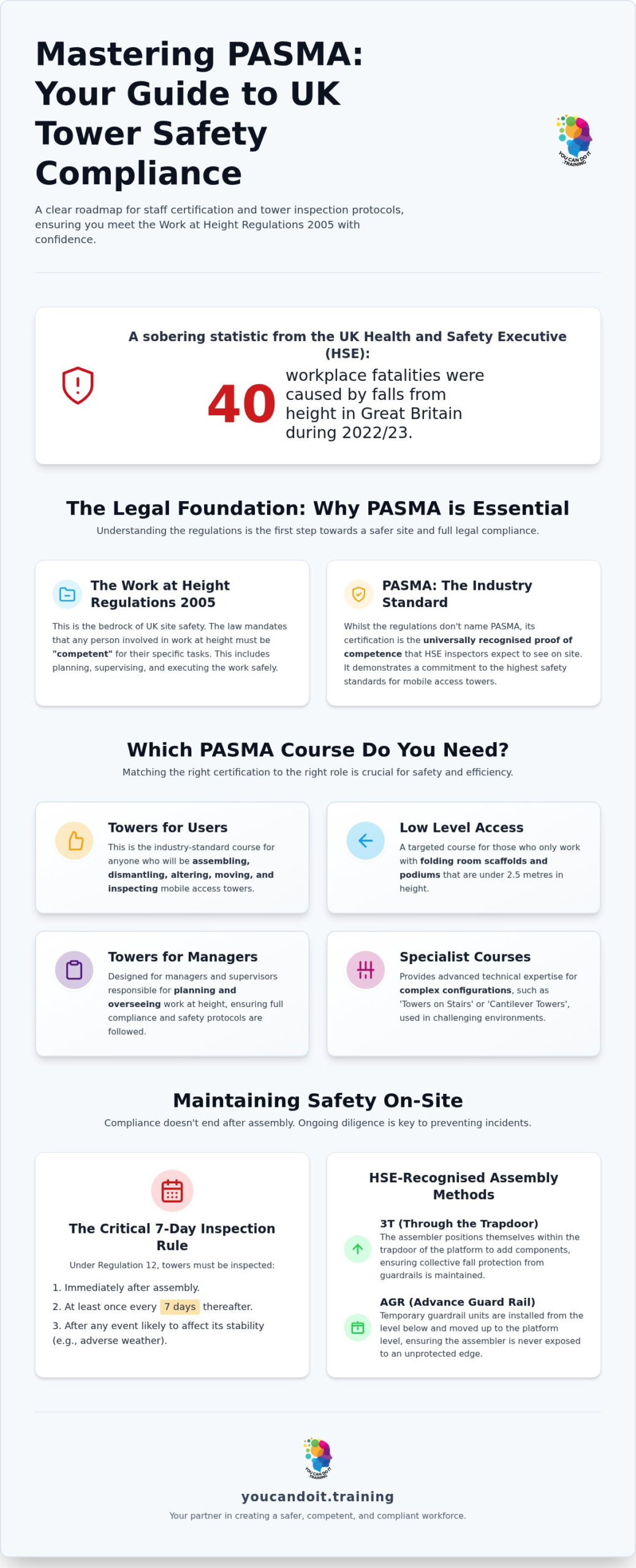
The Work at Height Regulations 2005 are the bedrock of site safety in the UK. Whilst they don’t explicitly name “PASMA”, they mandate that every person involved in work at height must be “competent” for their specific tasks. If an HSE inspector visits your site, they’ll look for industry-recognised proof of that competence. PASMA certification is the standard they expect to see.
Neglecting the pasma training requirements uk is a gamble with your team’s lives and your business’s future. Failure to provide adequate training often leads to RIDDOR reporting complications or substantial fines following an incident. The HSE L159 guidance specifically highlights that complex tower builds require specialised training to ensure stability and safety.
Navigating the Work at Height Regulations 2005
The regulations establish a clear hierarchy of control: avoid work at height where possible, prevent falls using existing safe places, and minimise risk through equipment. Actionable Tip: Use a detailed risk assessment to determine if a mobile tower is truly the safest option amongst alternatives like fixed scaffolding or podiums before starting work.
Our “Hearts and Minds” approach ensures workers respect these rules because they want to, not just because they have to. We dismantle the intimidation of technical compliance by fostering a relaxed, hospitable environment. Whether we’re discussing the pasma training requirements uk over a tea and a bourbon cream or during a practical assessment, we focus on human connection. When your team feels comfortable and respected, their safety behaviour improves, allowing everyone to soar.
Mapping PASMA Course Levels to Site Responsibilities
Identifying the right course, for the right person, at the right time ensures your team remains safe whilst avoiding wasted time on redundant training levels. The pasma training requirements uk are structured to match specific site roles, from hands-on assembly to high-level management. The Towers for Users course is the industry standard for anyone who needs to assemble, dismantle, or move mobile towers. For those working exclusively on folding room scaffolds or podiums under 2.5 metres, the Low Level Access course provides targeted, efficient certification.
If your role involves oversight rather than assembly, the Towers for Managers course aligns perfectly with SMSTS principles. It focuses on planning and supervising work to ensure compliance with the Work at Height Regulations 2005. For complex architectural challenges, specialist courses like Towers on Stairs or Cantilever Towers provide the technical expertise required for advanced configurations.
Choosing the Right Certification for Your Career Path
It’s vital to distinguish between the “User” who builds the tower and the “Inspector” who signs it off. Whilst Users must know the assembly process inside out, an Inspector focuses on the ongoing structural integrity and site-specific risks. You can explore these differences in our PASMA training guide. Once completed, you’ll receive a PASMA PhotoCard, the universal proof of tower safety competence in the UK. We’re here to help you achieve this in a relaxed environment with hot tea and bourbon creams. You can explore our full range of courses and join our 99% pass rate success story.
Implementing Safe Systems of Work and Tower Inspections
Compliance isn’t just about the initial build; it’s about the continued integrity of the equipment. Under Regulation 12, towers must be inspected immediately after assembly and then at least every seven days. This ensures that any structural shifts or site changes haven’t compromised safety. Following the official HSE guidance on working at height is the best way to stay on the right side of the law whilst protecting your team. Understanding these pasma training requirements uk is vital for maintaining a site that is both legal and safe.
A truly safe system of work includes a “Permit to Work” for complex or high-risk configurations. Our training dives deep into the “3T” (Through the Trapdoor) and “AGR” (Advance Guard Rail) methods, which are central to meeting the pasma training requirements uk. We use a person-centred approach, creating a space where no question is too small. If you’re unsure about a specific piece of safety kit, we’ll talk it through over a brew to ensure you feel empowered and ready.
Developing a Robust Mobile Tower Inspection Checklist
A thorough inspection should cover five non-negotiable areas to ensure total stability:
- Base Stability: Ensure castors are locked and base plates are level.
- Bracing: Check horizontal and diagonal braces are in the correct positions.
- Platform Integrity: Verify trapdoors function and platforms are clear.
- Toe Boards: Confirm they are securely fitted to stop falling tools.
- Guardrails: Ensure double guardrails are present at the required heights.
Actionable Tip: Organise a weekly “safety walk”. When supervisors and users inspect towers together, it builds camaraderie and shared responsibility. This holistic view of safety is why our working at height training is the perfect partner to your PASMA certification. It ensures every member of your team has the skills to spot a hazard before it becomes a headline.
Secure Your Site with Expert Tower Training
Mastering the legal necessity of competence and maintaining rigorous inspection schedules are the essential pillars of site safety. Keeping up with the pasma training requirements uk ensures your business remains compliant and your team stays safe whilst working at height. We’ve explored how the right certification, from Towers for Users to specialist configurations, empowers workers to perform with total confidence and precision.
At You Can Do It Training Ltd, we’re more than just an accredited PASMA, CITB, and IOSH provider. We offer a relaxed learning environment with expert mentors who focus on your success, helping us maintain a 99% pass rate. Whether it’s through technical mastery or a shared plate of bourbon creams, we’re committed to putting your people at the heart of everything we do.
Let’s ignite that spark of achievement together and ensure your team has the skills to soar safely on every project.
Frequently Asked Questions
Is PASMA training a legal requirement for construction workers in the UK?
PASMA training is not explicitly named as a legal requirement in the Work at Height Regulations 2005, but the law does mandate that all workers must be competent. Holding a PASMA card is the industry-recognised method for proving this competence to the HSE. It ensures your team meets the pasma training requirements uk whilst operating safely and legally on site.
How long does a PASMA training certificate remain valid before needing renewal?
A PASMA training certificate and the accompanying PhotoCard remain valid for five years. After this period, you’ll need to complete a refresher course to ensure your skills align with the latest safety standards. Keeping your certification current is a vital part of your career journey, ensuring you continue to work with total confidence and technical precision on every project.
What is the difference between PASMA and IPAF training for working at height?
The difference lies in the equipment you’re using. PASMA is specifically for mobile access towers, focusing on their safe assembly, movement, and inspection. IPAF training covers Mobile Elevating Work Platforms, such as scissor lifts or cherry pickers. Both are essential for site safety, but you must select the accreditation that matches the specific tools your team uses to get the job done.
Can I assemble a mobile tower if I only have an SSSTS or SMSTS certificate?
No, an SSSTS or SMSTS certificate does not qualify you to assemble a mobile tower. Whilst these CITB courses are excellent for management and supervision, they don’t provide the hands-on technical skills found in a PASMA Towers for Users course. To meet the pasma training requirements uk for assembly, you must hold the specific equipment-based accreditation alongside your management qualifications.







Leave a Reply
Want to join the discussion?Feel free to contribute!