

Manual Handling Regulations UK: The Essential 2026 Compliance Guide
Did you know that manual handling caused 17% of all non-fatal workplace injuries in Great Britain during 2024/25? It’s a sobering figure that accounts for 7.1 million lost working days and leaves many managers feeling stuck between the manual handling regulations uk and the fear of HSE fines. You probably find the constant debate over “maximum weights” confusing, especially with the HSE Fee for Intervention now costing £188 per hour. We believe that technical safety doesn’t have to be cold or clinical; it’s about mutual respect and human connection.
This guide empowers you to master the MHOR 1992 whilst fostering a genuine safety culture that puts your people at the heart of everything. We’ll explore the regulations through a “hearts and minds” lens, providing a practical risk assessment framework and actionable tips to boost staff morale. By the end, you’ll see that achieving total compliance is something you can definitely do.
Key Takeaways
- Master the fundamental ‘Avoid, Assess, Reduce’ hierarchy to ensure your business remains fully compliant with the core requirements of the Manual Handling Operations Regulations 1992.
- Learn how to apply the TILE framework to evaluate tasks and loads, moving away from the myth of a single ‘legal maximum weight’ within the manual handling regulations uk.
- Discover the ‘Hearts and Minds’ method for training, which transforms safety from a mandatory chore into a shared commitment amongst your entire workforce.
- Identify the critical role supervisors play in spotting risks early and fostering a supportive environment where safe lifting becomes second nature for everyone.
Navigating the Manual Handling Operations Regulations 1992 (MHOR)
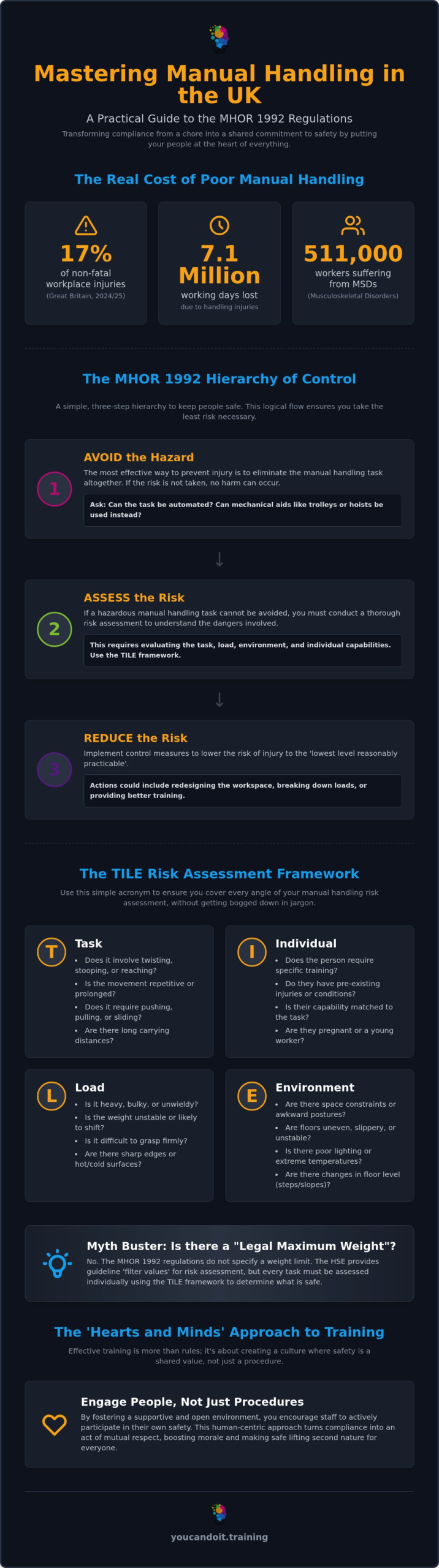
The Manual Handling Operations Regulations 1992 (MHOR) serve as the legal foundation for safety in the British workplace. Under this law, manual handling is defined as any transporting or supporting of a load by hand or bodily force, including lifting, putting down, pushing, pulling, carrying, or moving. This applies to every environment, from a bustling construction site where manual handling is taught as a core element of the SSSTS curriculum, to a quiet office where a staff member is moving a heavy crate of files. Employers have a clear duty of care to protect their teams from musculoskeletal disorders (MSDs); a vital task considering that 511,000 workers were suffering from these conditions in 2024/25. Understanding the Manual handling of loads is the first step toward building a culture of care.
The Hierarchy of Control: Avoid, Assess, Reduce
The manual handling regulations uk are built upon a simple, three-step hierarchy designed to keep people safe and healthy. It’s a logical flow that ensures you aren’t taking unnecessary risks with your team’s wellbeing.
- Avoid: The most effective way to prevent injury is to stop the manual task entirely. Can the task be automated or handled by mechanical aids like trolleys or hoists? If you can avoid the lift, you eliminate the risk.
- Assess: If it cannot be avoided, you must evaluate the remaining tasks. This involves looking at the specific movements, the weight of the load, and the capabilities of the person doing the work.
- Reduce: Finally, you must implement controls to lower the risk of injury to the lowest level reasonably practicable. This could mean redesigning the workspace or providing better training.
Compliance doesn’t have to be a clinical, box-ticking exercise. When you approach these steps with a genuine interest in your staff’s comfort, you ignite a spark of trust that makes safety second nature. It’s about the right approach, for the right reasons, with the right support. You’ll find that once you master the manual handling regulations uk, the intimidation fades away, leaving a safer, more productive environment for everyone.
Conducting a Robust Manual Handling Risk Assessment
Conducting a risk assessment shouldn’t feel like a clinical chore. It’s actually a fantastic opportunity to foster camaraderie and show your team that their health is your priority. When you sit down with a brew and a bourbon cream, you can turn a compliance task into a meaningful conversation about the manual handling regulations uk. The Manual Handling Operations Regulations 1992 don’t actually set a “legal maximum weight” for lifting. Instead, the HSE provides “filter values” as guidelines. This means you need a robust process to evaluate each unique situation. Consulting with your staff whilst carrying out these checks provides practical insights you might miss from behind a desk. It’s about getting the right training for the right people, and our Manual Handling course can help you navigate these nuances with confidence.
The TILE Framework: A Practical Checklist
To keep your assessments simple and effective, use the TILE acronym. This ensures you cover every angle of the manual handling regulations uk without getting bogged down in jargon.
- Task: Does the movement involve twisting, stooping, or excessive reaching? Repetitive movements often hide the biggest risks.
- Individual: Does the worker have a pre-existing injury or require specific training? Everyone’s capability is different.
- Load: Is the object heavy, bulky, or unstable? Consider if it’s difficult to grasp safely.
- Environment: Are there floor level changes, poor lighting, or restrictive spaces? A cramped room or a slippery floor can turn a simple lift into a hazard.
Remember to document your findings and review them whenever work conditions change. This proactive approach proves that safety is achievable for everyone. With the right mindset, you can transform these requirements into a soaring success for your business.
Implementing Training: The ‘Hearts and Minds’ Approach
Effective training goes far beyond a set of slides or a dry textbook; it’s about engaging the ‘hearts and minds’ of your workforce. When we talk about the manual handling regulations uk, we aren’t just discussing legal compliance, but the genuine wellbeing of every person on your team. Creating a relaxed learning environment, complete with plenty of tea, coffee, and leagues-ahead bourbon creams, helps dismantle the intimidation often felt towards health and safety. This human approach fosters camaraderie and ensures that safety becomes a shared value rather than a mandatory burden. It’s a philosophy we weave into our broader leadership training, including the SMSTS course, where manual handling oversight is positioned as a fundamental management duty.
Empowering Supervisors and Managers
Supervisors are the knowledgeable mentors who bridge the gap between policy and practice. An SSSTS certification equips these leaders to model safe behaviour and spot poor lifting techniques before they lead to an injury. They play a pivotal role in keeping safety at the forefront of the team’s mind through regular, engaging tool-box talks.
- Lead by Example: When staff see supervisors prioritising their own posture, it creates a ripple effect of safe behaviour across the site.
- Open Communication: Encourage a culture where reporting ‘near misses’ is seen as a proactive success, not a reason for disciplinary action.
- Personalised Approach: Recognise that every worker has a different background and may need a slight adjustment to their technique to stay safe.
By fostering this supportive atmosphere, you ensure that compliance is achievable for everyone. It’s about the right training, for the right people, provided in a way that truly resonates. This focus on practical, hands-on mastery is a principle that extends to many rewarding team-building activities; for example, you can discover Knolita Cooks to learn traditional culinary techniques in a similarly engaging environment. The goal is to ignite a spark of interest that transforms your safety culture, proving that with You Can Do It Training Ltd as your partner, you really can do it.
Building a Legacy of Safety and Care
Mastering the manual handling regulations uk is about much more than avoiding HSE fines; it’s about protecting the people who make your business soar every day. By applying the TILE framework and embracing the hierarchy of control, you transform technical compliance into a practical, life-saving skill that becomes part of your team’s DNA. We’ve spent 30 years fostering this “hearts and minds” approach, maintaining a 99% student pass rate as an accredited CITB and IOSH partner. Whether you’re a supervisor leading by example or a manager overseeing a busy site, the right training provides the clarity you need to succeed. You have the tools to create a supportive environment where everyone feels valued and safe. No matter how complex the regulations may appear at first, you can do it.
Frequently Asked Questions
Is manual handling training a legal requirement in the UK?
Yes, providing adequate training is a legal obligation under the manual handling regulations uk whenever risks cannot be avoided. It’s about empowering your team with the knowledge to protect their own health. Effective training ensures staff understand specific risks and how to use mechanical aids properly. This proactive approach builds a safety culture where everyone feels confident and supported.
What is the maximum weight a person is allowed to lift at work in the UK?
There is no single legal maximum weight limit defined in the manual handling regulations uk. Instead, the HSE provides guideline filter values, such as 25kg for men and 16kg for women under ideal conditions. These figures are not “safe” limits but starting points for your assessment. If a task involves twisting or stretching, these acceptable weights drop significantly to prevent injury.
Does the Manual Handling Operations Regulations 1992 apply to office workers?
You should review your assessments whenever there’s a reason to suspect they’re no longer valid or if significant changes occur in the workplace. This includes new equipment, different staff capabilities, or a change in the load itself. While there’s no fixed expiry date, an annual check-up over a coffee and some bourbon creams helps ensure your safety culture stays fresh and effective.









Leave a Reply
Want to join the discussion?Feel free to contribute!