

SSSTS Course Syllabus and Exam Format: What Supervisors Need to Know
Preparing for an SSSTS course can feel difficult when online sources give conflicting details about the assessment. The SSSTS course syllabus and exam format are best understood by separating the learning topics from claims made about mock tests. Focus on the current course materials and on applying safety principles to the situations supervisors face on site, rather than memorising predictions about assessment questions.
This guide covers key syllabus areas, including legal responsibilities, risk assessment, hazard awareness and communication. It also explains how to use practice questions effectively and gives you a practical revision plan. You Can Do It Training delivers CITB SSSTS training with supportive, expert-led teaching that connects course learning to supervisory responsibilities.
Key Takeaways
- Understand how the SSSTS course syllabus and exam format connect to the practical responsibilities of supervising a construction site.
- Explore the SSSTS scheme guide for more context on the course and its purpose.
- Use current CITB course information as your reference for assessment requirements. Treat third-party mock tests as practice, not proof of the official format.
- Make revision focused by linking course topics to site situations, noting unfamiliar terms and revisiting areas you find challenging.
SSSTS course syllabus: what supervisors learn and why it matters
The Site Supervisor Safety Training Scheme (SSSTS) is CITB’s course for people with, or preparing for, supervisory responsibilities on construction sites. The SSSTS scheme guide explains the course’s purpose. You can also learn more about the organisation behind the scheme through the Construction Industry Training Board (CITB).
The syllabus links supervisors’ responsibilities with health and safety requirements, risk assessment and suitable control measures. A risk assessment identifies what could cause harm and considers how to reduce the risk. Control measures are practical steps for managing hazards, such as organising a task differently or explaining precautions before work begins. For a supervisor, the key is knowing how to recognise concerns, communicate them and support safer decisions.
Clear communication and steady leadership help teams work safely and build a positive site culture.
How the SSSTS syllabus applies to day-to-day site supervision
Use the learning when briefing a team, checking that instructions are understood and monitoring whether agreed precautions are being followed. Before a task starts, for example, explain the relevant controls, invite questions and pay attention to changes that could affect safe working. If the conditions or task change, consider whether the team needs updated instructions before continuing.
Course themes include health, safety and welfare, identifying hazards, preventing accidents, communicating effectively and delivering toolbox talks: short, focused discussions about safety at work. Welfare refers to workers’ basic facilities and wellbeing on site. To make these topics useful in practice, connect each one to a task you supervise: what could go wrong, what precautions apply, and how will you make sure the team understands them?
The syllabus supports supervisors in understanding these subjects and applying them to their role. It does not replace site-specific procedures or guidance from the Health and Safety Executive (HSE). Use the course to strengthen your judgement, ask informed questions and encourage everyone to raise concerns. For professionals looking to further develop their supervisory communication and leadership skills, organisations such as Intact Academy specialise in team coaching and organisational change.
SSSTS exam format: what is confirmed and what mock tests cannot prove
Online descriptions of the SSSTS assessment can differ, particularly when they come from third-party practice-test pages. A mock test can help you practise applying course knowledge, but it cannot establish the official assessment requirements. Use the current CITB course materials and the instructions provided for your course as your reference. For construction safety context, the Health and Safety Executive (HSE) Construction Guidance is useful, but it does not set out the SSSTS assessment format.
Take assessment details from current CITB course materials, not from third-party mock-test claims.
| Source | What it tells you | How to use it |
|---|---|---|
| Official CITB course materials | The course requirements and assessment instructions provided for the current course. | Use these as your reference for the assessment. |
| Third-party mock-test pages | Examples of practice formats and claims, which differ between pages. | Use questions to practise, not to infer official requirements. |
| Details needing current verification | Question numbers, pass marks, assessment components and any presentation requirements. | Rely on current CITB information and your course instructions. |
How to interpret SSSTS mock tests and assessment claims
Third-party pages may describe different question types, scoring thresholds or assessment activities. These descriptions refer to those pages’ practice materials, not necessarily to CITB requirements. Use mock questions to identify gaps in your understanding. If a question about risk controls leaves you unsure, revisit the principle behind the answer and think through how it applies to a task you supervise.
Revise the syllabus themes, keep a note of topics that need more attention, then follow the assessment instructions provided for your course. SSSTS is for supervisors; the separate management-level scheme is SMSTS, covered in this SMSTS course guide. You Can Do It Training delivers CITB SSSTS training with supportive teaching focused on practical understanding.
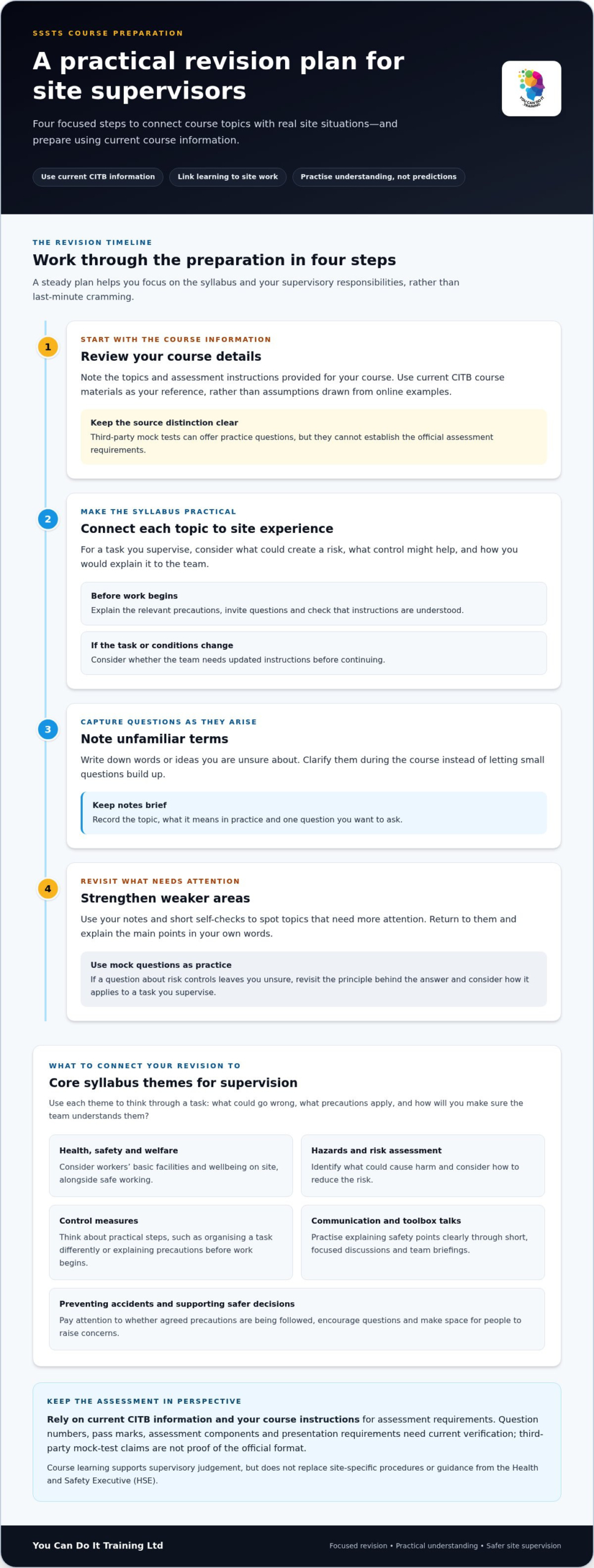
How to prepare for the SSSTS course and assessment with confidence
A steady plan is more useful than last-minute cramming. Work through the topics in manageable steps, and use your own supervisory experience to make the learning relevant. Preparation supports your understanding, but it does not replace taking part in the course or completing its assessment.
- Review your course information. Note the topics and assessment instructions provided for your course. This keeps your preparation focused on current guidance rather than assumptions from online examples.
- Connect topics to site experience. For each subject, consider a real supervisory situation: what could create a risk, what control might help, and how would you explain it to the team?
- Note unfamiliar terms. Write down words or ideas you are unsure about. Clarify them during the course rather than letting small questions build up.
- Revisit weaker areas. Use your notes and short self-checks to identify topics that need more attention. Return to them and explain the main points in your own words.
Simple revision habits for site supervisors
Keep notes brief: write down the topic, what it means in practice and one question you want to ask. Bring examples from your work context and think about how risk controls are communicated and understood. This helps you connect the syllabus to real supervisory decisions, while recognising that different tasks and conditions may call for different responses.
Third-party mock questions can help you check your understanding, but treat them as practice rather than a guide to the official assessment. The SSSTS course syllabus and exam format are best approached through current course information, active participation and focused revision. You Can Do It Training’s SSSTS training is led by trainers who are Chartered Members of IOSH (CMIOSH) with 30+ years of experience. You Can Do It Training has a 99%+ pass rate, which is not a guarantee of an individual result.
Build your understanding with SSSTS training from You Can Do It Training Ltd.
Take your next step towards confident site leadership
Use your understanding of the SSSTS course syllabus and exam format as a starting point for how you lead, not simply as preparation for an assessment. Take one practical idea into your next team briefing: invite questions, check that instructions are understood and make it easier for people to raise concerns. Consistent conversations can help make safe working part of everyday practice.
You Can Do It Training delivers CITB-accredited SSSTS training led by Chartered Members of IOSH (CMIOSH) with 30+ years of experience. Supportive, expert-led sessions connect learning to supervisory responsibilities and give you space to develop your approach.
You can take the next step at your own pace. You Can Do It.
Frequently Asked Questions
Who should take an SSSTS course?
SSSTS is intended for people who supervise construction workers or are preparing to take on that responsibility. This can include team leaders and forepersons who organise tasks, guide colleagues or monitor work on site. If you are moving from a hands-on role into supervision, the course can help you understand the safety responsibilities involved in leading others.
Are SSSTS mock tests the same as the official CITB assessment?
No. Mock tests are independently produced practice materials, so their questions and scoring should not be treated as the official assessment. Use them to spot subjects you may need to revisit, not to predict the exact test. If a question about a work method leaves you unsure, review the underlying safety principle and follow the instructions provided for your course.
Is SSSTS the same as SMSTS?
No. SSSTS is aimed at people with site supervisory responsibilities, while SMSTS is designed for site managers and people taking on management-level duties. The courses relate to different roles, so consider the scope of your current or upcoming responsibilities when deciding which is relevant. Supervising a team’s daily work and managing site-wide safety arrangements involve distinct levels of responsibility.
How can I prepare if I am worried about the SSSTS assessment?
Turn your worry into a short list of questions. Choose one topic at a time, explain its practical meaning in your own words, then note anything you cannot yet explain clearly. Bring those questions to the course and take part in discussions. The SSSTS course syllabus and exam format make more sense when you focus on understanding rather than memorising uncertain predictions.










Leave a Reply
Want to join the discussion?Feel free to contribute!