
Fire Marshal Responsibilities in a School: A Practical UK Guide
What if the alarm sounds and the person leading an evacuation is unsure where their role ends? Clear boundaries matter as much as calm action. Fire marshal responsibilities in a school include supporting fire prevention and helping people move towards safety, but marshals aren’t expected to take unsafe risks or replace the school’s wider fire-safety arrangements.
Staff may worry about what they’re accountable for if procedures fail, especially when children or colleagues need help. This guide explains what a marshal can do before and during an evacuation, what remains the school’s responsibility, and how training and clear procedures work together. It also sets out practical steps for supporting an orderly evacuation without delaying your own escape or putting anyone at added risk.
Key Takeaways
- Understand how fire marshal responsibilities in a school support its evacuation plan, and where the role’s limits lie.
- Use the school’s agreed procedures to guide your actions before and during an evacuation.
- Know how to raise concerns about evacuation arrangements through the school’s reporting process.
- Clear role assignments, practice and Fire Marshal Training can help staff prepare for site-specific procedures.
Fire marshal responsibilities in a school: understand the role and its limits
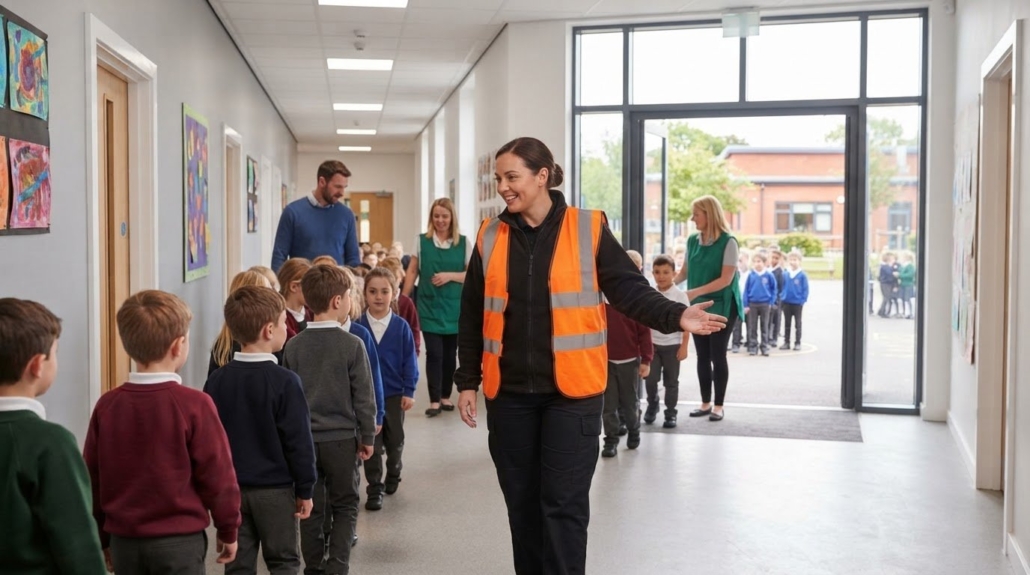
A school fire marshal supports the school’s fire procedures and evacuation arrangements. The school’s plan should set out each marshal’s tasks, such as directing people or checking an assigned area. Any check should only be carried out if it is safe and does not delay the marshal’s own escape. The role is practical support, not permission to take risks or act beyond training and instructions.
The fire marshal role can vary across jurisdictions, so a general description cannot replace a school’s own arrangements. In practice, the fire marshal responsibilities in a school should be written down, explained to the staff member and matched to the site. If a task is unclear or appears unsafe, follow the evacuation plan and raise the concern through the school’s reporting process.
Who is responsible for fire safety in a school?
In England and Wales, fire-safety law uses the term “responsible person” for the person or organisation with control of the premises. They hold wider responsibility for organising fire-safety measures. A marshal may be given specific tasks but does not automatically become the responsible person. School leaders can delegate practical work, such as explaining procedures or checking an assigned area, without transferring that wider accountability.
The legal framework differs across England, Wales, Scotland and Northern Ireland. Schools should consult current official guidance for their nation, including the HSE’s workplace fire safety risk assessment guidance where applicable, alongside their own fire risk assessment and site procedures. Staff briefings can clarify who holds overall responsibility, which tasks are delegated and who receives reports about hazards or gaps. This helps everyone understand their part without confusing practical support with wider accountability.
What a school fire marshal does before and during an evacuation
Preparation makes a calm response easier. Before an alarm, a marshal should know their assigned area, the designated escape routes and assembly point, and how to report a blocked route or other concern. They should also understand the school’s arrangements for anyone who may need assistance. These practical fire marshal responsibilities in a school should follow the agreed plan, not assumptions or improvised instructions. GOV.UK explains the wider context in its guidance on workplace fire safety responsibilities.
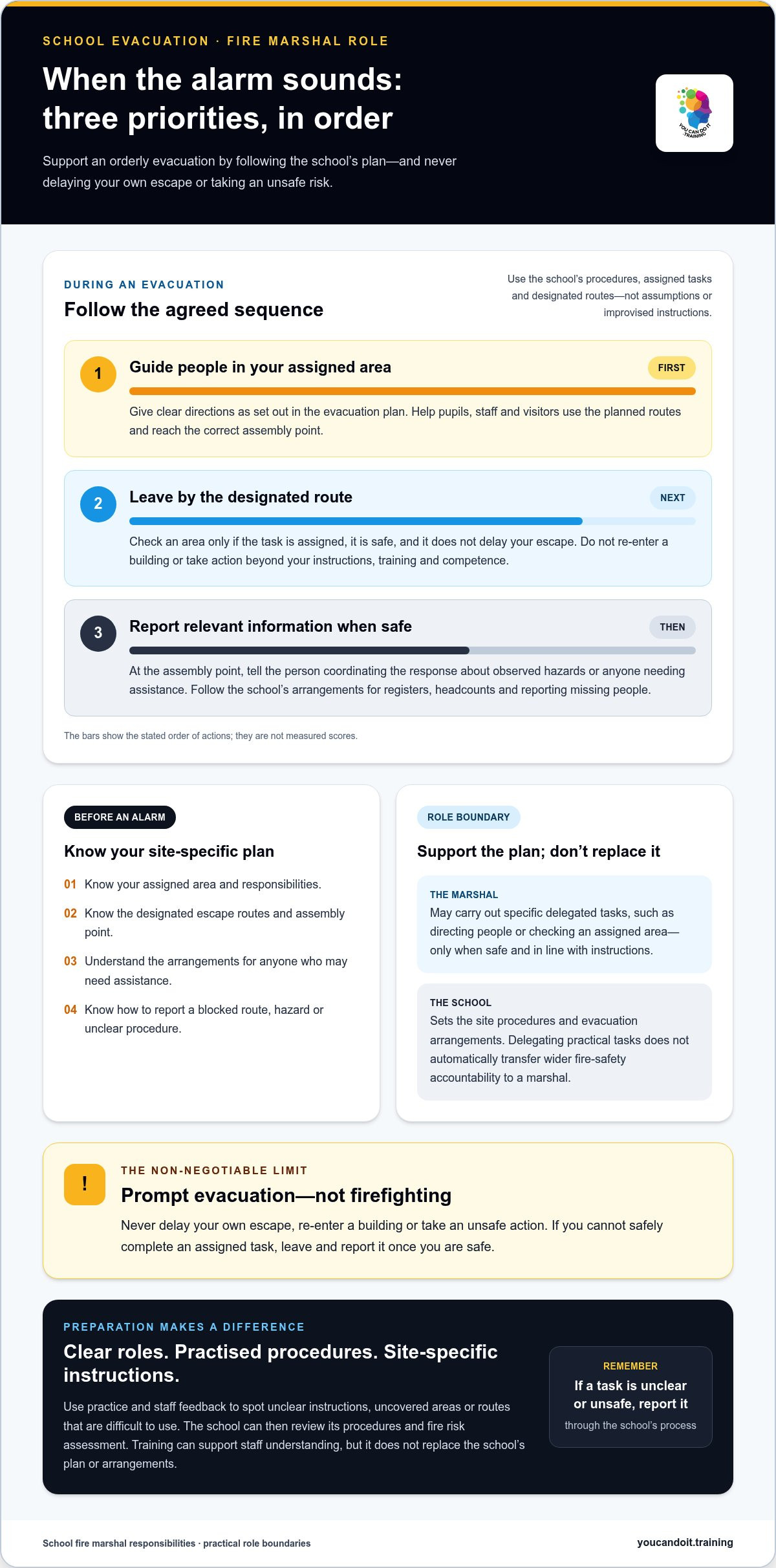
When the alarm sounds, follow the school’s procedures. The usual priorities are to:
- Give clear directions to people in your assigned area, as set out in the evacuation plan.
- Leave by the designated route. Carry out an area check only if it is assigned and safe, and does not delay your escape.
- Go to the assembly point and report relevant information, such as an observed hazard or someone needing assistance, to the person coordinating the response.
How should a marshal support pupils, staff and visitors?
Help people use the planned routes and reach the correct assembly point. Follow the school’s arrangements for registers or headcounts, and report missing or unaccounted-for people through the agreed channel. Support pupils or visitors who need assistance in line with the individual arrangements set out by the school, rather than improvising during an emergency.
A marshal’s priority is prompt evacuation, not firefighting. Never delay your own escape, re-enter a building or take action beyond your instructions, training and competence. If you cannot safely complete an assigned task, leave and report this once you are safe. Suitable Fire Marshal Training can help staff understand how their role fits the school’s procedures.
How schools prepare fire marshals with procedures, practice and training
Confidence comes from knowing the plan before an alarm sounds. Schools can make preparation practical by assigning each marshal a clear area and responsibility, keeping evacuation procedures accessible, and explaining who coordinates the response and receives reports. Staff should know the designated routes and assembly point, along with the arrangements for anyone who may need assistance.
Use practice to identify confusion while there is time to improve the arrangements. After an exercise, staff can report problems such as unclear instructions, uncertainty about who covers an area or a route that is difficult to use. The school can then review its procedures and risk assessment, which identifies fire hazards and how to manage them. The fire marshal responsibilities in a school should reflect these site-specific arrangements, not replace them.
- Make each marshal’s assigned area and tasks clear, including what to do if they cannot safely complete a task.
- Keep current procedures accessible to the staff who need them.
- Use practice and staff feedback to identify areas that need clarification.
When can fire marshal training help school staff?
Training can help staff build a practical understanding of their role, communicate clearly and follow assigned procedures. It should sit alongside the school’s risk assessment and evacuation plan, since general learning cannot account for every building layout or individual arrangement. The Fire Industry Association (FIA) also provides fire-sector information that can support wider learning.
Fire Marshal Training forms part of You Can Do It Training Ltd’s workplace safety training. It can help staff develop practical understanding to complement their school’s arrangements, without replacing site-specific instructions. Other emergency roles may work alongside marshals. For example, staff with first-aid responsibilities can support people within their training and assigned role.
With clear preparation and suitable support, staff can approach their role with greater confidence. Make sure each marshal knows their assigned duties and where to find the school’s current evacuation procedures. If a procedure or responsibility is unclear, raise it through the school’s usual reporting process so it can be addressed before an emergency.
Frequently Asked Questions
What are a school fire marshal’s main responsibilities?
A school fire marshal helps staff and pupils follow the school’s fire procedures and completes tasks assigned for their area. For example, if a planned route is blocked, they should follow the school’s instructions and report the problem through the agreed process rather than inventing a new route. Exact duties depend on the school’s arrangements, and the role does not automatically include wider fire-safety management.
Is a fire marshal legally responsible for a school’s fire safety?
No. Being appointed as a marshal does not automatically make someone responsible for managing all of a school’s fire safety. The responsible person has wider duties under the applicable arrangements, while marshals support agreed procedures. Responsibilities and legal frameworks can differ across UK nations. Schools should use current official guidance and make clear in writing which tasks each staff member is expected to carry out.
Does every school need a trained fire marshal?
There is no single number of marshals that suits every school. The school needs suitable fire-safety and evacuation arrangements, with roles matched to its circumstances. When planning, consider whether assigned areas can be covered across the site and what happens if a designated staff member is absent. Make sure staff know their responsibilities and how to raise gaps in cover.
What should a school fire marshal do when the fire alarm sounds?
Follow the school’s evacuation procedure and carry out only the actions assigned to you. Direct people towards the agreed exit and assembly arrangements where instructed, but do not investigate a suspected fire or delay leaving to complete a task. Once safe, report concerns or missing people using the school’s process. Never use fire equipment unless your instructions, training and the school’s procedures allow it.










Leave a Reply
Want to join the discussion?Feel free to contribute!