

Fire Marshal Training: The Essential Guide to Workplace Safety and Compliance
Workplace safety is far more than an exercise in regulatory compliance or ticking boxes on an inspection sheet. When an emergency strikes, clear thinking, rapid response, and practical competence make the difference between a minor incident and a catastrophic failure. Central to any robust emergency plan is the fire marshal—a dedicated, well-trained individual capable of taking charge when alarms sound and seconds count.
Whether you are an operations director managing a sprawling production facility, an office manager overseeing a multi-storey commercial complex, or an employer dedicated to safeguarding your workforce, ensuring you have competent personnel on site is a primary duty of care. This comprehensive guide details everything you need to understand regarding statutory responsibilities, essential skills, course selection, and why cultivating a genuine culture of safety protects both lives and livelihoods.
Understanding the Legal Framework and Fire Marshal Duties
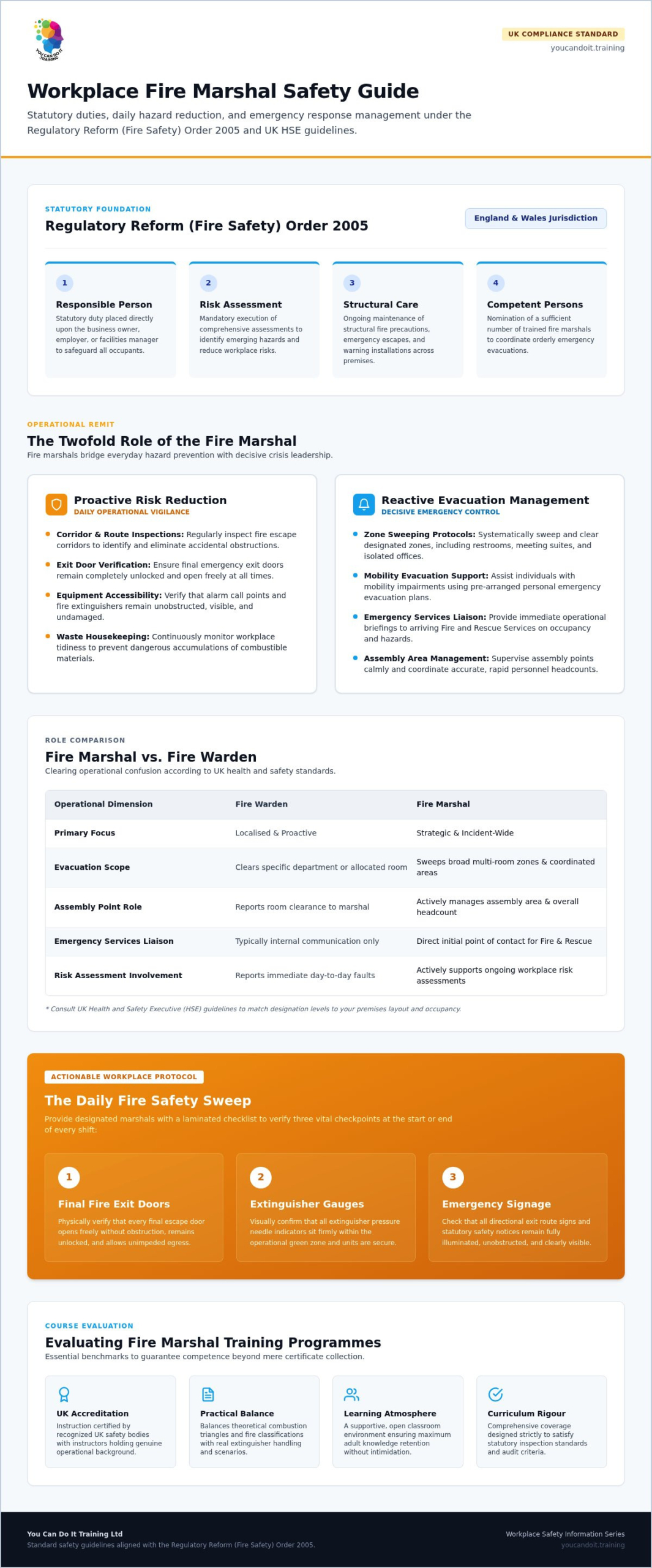
Every commercial organisation operating within England and Wales falls under the jurisdiction of the Regulatory Reform (Fire Safety) Order 2005, often referred to simply as the Fire Safety Order. This primary legislation places a clear statutory obligation on the designated “Responsible Person”—typically the business owner, employer, or facilities manager—to take all reasonable steps to reduce the risk of fire and guarantee that occupants can evacuate safely in the event of an emergency.
Under the Fire Safety Order, the Responsible Person must carry out a comprehensive fire risk assessment, identify emerging hazards, maintain structural fire precautions, and nominate a sufficient number of competent persons to implement emergency evacuation arrangements. These nominated individuals are your fire marshals.
The role of a fire marshal is inherently twofold, bridging everyday prevention with decisive crisis management:
- Proactive Risk Reduction: Fire marshals act as the eyes and ears of workplace safety on a daily basis. They inspect fire escape corridors to prevent obstructions, ensure emergency exit doors open freely, check that fire alarm call points and fire extinguishers remain accessible and undamaged, and monitor general housekeeping standards to prevent the accumulation of combustible waste.
- Reactive Evacuation Management: When an alarm sounds, fire marshals calmly take control of designated zones. They execute sweeping protocols to ensure restrooms, meeting rooms, and isolated offices are cleared, assist individuals with mobility impairments via pre-arranged evacuation plans, liaise directly with emergency services upon arrival, and manage designated assembly points to conduct accurate headcounts.
Understanding these obligations in plain terms removes anxiety surrounding safety compliance. For a thorough review of overarching workplace standards, reviewing your workplace health and safety policy will help clarify how emergency procedures align across every tier of your organisation.
Fire Marshal vs. Fire Warden: Clearing the Confusion
In everyday conversation, many employers use the titles “fire marshal” and “fire warden” interchangeably. While both roles share the overarching objective of preserving life, industry standards draw a practical operational distinction between their regular responsibilities.
A fire warden generally operates with a proactive focus within an allocated zone. They conduct routine checks, monitor basic housekeeping, and report faults to management. During an evacuation, their remit is often strictly localised, ensuring that their specific department or room is empty before exiting the building.
A fire marshal, by comparison, assumes broader operational and strategic duties. Beyond sweeping designated zones during an evacuation, fire marshals routinely support the ongoing workplace risk assessment process. They actively manage assembly areas, coordinate communications across multiple floors or industrial buildings, and serve as the initial point of contact for the fire and rescue services to deliver critical briefings on building occupancy and hazard locations.
Employers should consult official HSE guidelines to evaluate the unique risks, structural layout, and occupancy levels of their operational premises to determine appropriate designation and staffing levels.
Provide your designated marshals with a simple, laminated checklist to review at the start or end of each shift. This checklist should verify three vital points: ensure all final fire exit doors are unlocked and unobstructed, confirm that extinguisher pressure gauges indicate adequate charge within the green zone, and verify that emergency signage remains fully illuminated and visible.
Selecting the Best Fire Marshal Training Programme
Choosing the right training provider is a significant decision. When an emergency occurs, theoretical knowledge locked in a neglected handbook offers zero protection. Your team members must possess the muscle memory, presence of mind, and practical confidence to take charge immediately.
When assessing prospective training organisations, avoid providers that treat health and safety as a dry, clinical exercise designed merely to issue attendance certificates. High-quality instruction balances regulatory rigour with an engaging delivery style that guarantees information retention. Key criteria to evaluate include:
- Accreditation and Industry Standing: Ensure your chosen provider is accredited by recognized UK safety bodies and employs qualified instructors who possess genuine on-site and operational experience.
- Practical vs. Classroom Balance: Theoretical instruction on the combustion triangle and fire classifications is essential, but it must be reinforced with realistic evacuation decision-making scenarios and practical extinguisher operation.
- Learning Environment: High-pressure, intimidating classroom atmospheres stifle engagement. Adult learners retain complex regulatory frameworks far more effectively when taught in a relaxed, open, and supportive setting where questions are actively encouraged.
- Curriculum Scope: Verify that the syllabus covers everything needed to satisfy statutory inspections, from the mechanics of smoke travel and human behaviour in emergencies to statutory record-keeping and post-drill reporting.
For organisations aiming to establish an all-inclusive safety management framework, it is sensible to partner with an established provider capable of aligning fire safety with broader occupational health requirements. Reviewing a vetted guide on the best health and safety training providers in the UK can simplify this vendor selection process.
Key Features of a High-Quality Training Course
A comprehensive course should transform an apprehensive employee into an authoritative, capable safety leader. When reviewing syllabuses, ensure the following core elements are covered thoroughly:
- Fire Science and Behaviour: Learners must understand the chemistry of fire—fuel, heat, oxygen, and chemical chain reactions—alongside how fire spreads through conduction, convection, radiation, and direct burning. Understanding smoke travel is particularly vital, as toxic gases represent the primary cause of fire-related fatalities.
- Extinguisher Identification and Practical Application: Trainees must be taught the specific colour coding and operational profiles of water, foam, carbon dioxide (CO2), dry powder, and wet chemical extinguishers. Understanding when it is safe to fight a fire and when evacuation must take absolute precedence is fundamental.
- Human Behaviour and Evacuation Dynamics: In real emergencies, individuals often freeze, deny alarm cues, or attempt to return to workstations for personal belongings. Marshals must learn assertive, empathetic communication strategies to direct personnel safely and effectively.
- Emergency Evacuation Planning (PEEPs): Courses must address how to formulate and execute Personal Emergency Evacuation Plans for individuals who may require additional assistance due to visual, auditory, cognitive, or physical impairments.
- Statutory Record-Keeping and Drills: Instruction should outline how to structure unannounced fire drills, evaluate evacuation times, log corrective actions, and document records in line with local fire authority inspection standards.
You can learn more about specific curriculum requirements by exploring the fire marshal training requirements to verify that your chosen course meets the rigorous standards mandated by current UK regulations.
Before booking your cohort, inquire directly about the provider’s pass rate and their strategy for supporting participants who experience test anxiety or learning difficulties. A training provider dedicated to candidate success will offer structured support, ensuring every employee feels empowered rather than intimidated by assessments.
The You Can Do It .Training Experience: Hearts and Minds
At You Can Do It .Training, vocational safety training is approached from a distinctive perspective. Compliance should never feel like a dull, punitive chore; it should serve as a genuine catalyst for personal development and team cohesion. With three decades of industry experience, led by Chartered members of IOSH and accredited by premier bodies such as CITB and UKATA, You Can Do It .Training combines unimpeachable technical authority with a warm, grassroots methodology.
Central to this ethos is our proven “Hearts and Minds” philosophy. True safety compliance is achieved not by forcing individuals to memorise regulations by rote, but by winning their emotional commitment to preserving life and looking out for their colleagues. When learners connect with the human importance of safety protocols, safe practices cease to be external rules and become second nature.
The classroom experience at You Can Do It .Training is deliberately designed to foster confidence from the moment students arrive. The atmosphere is relaxed yet thoroughly professional. Delegates are greeted with warm British hospitality, featuring plenty of fresh tea, premium coffee, and our famous, leagues-ahead bourbon creams that immediately break the ice and put candidates at ease. By replacing clinical corporate coldness with genuine camaraderie, barriers dissolve, discussions flourish, and complex safety material becomes instantly accessible.
The foundational mantra of You Can Do It .Training is simple: technical compliance is within everyone’s reach. Regardless of educational background, previous experience, or anxieties surrounding examinations, our instructors guide learners step-by-step, nurturing competence until confidence soars.
A Student-Centric Approach to Workplace Safety
Putting the learner at the heart of everything we do delivers tangible results. You Can Do It .Training maintains an outstanding 99% pass rate across our comprehensive training suite. More importantly, our graduates return to their workplaces genuinely site-ready, equipped with practical skills that keep teams safe.
Workplace hazards rarely exist in isolation. A warehouse or manufacturing environment that presents fire risks will often involve operations governed by other safety disciplines. By partnering with You Can Do It .Training, employers gain access to a cohesive educational pathway that connects fire preparedness with broader competencies, including manual handling, working at height, and emergency first aid.
When booking your safety course with You Can Do It .Training, brief the instructors on the specific layout, operational bottlenecks, or risk profiles unique to your premises. This allows our trainers to tailor practical discussions directly to your operational environment, maximising the immediate value delivered to your team.
Frequently Asked Questions
How many fire marshals do I need for my business?
UK legislation does not specify a single universal number. The appropriate provision depends directly upon your building’s fire risk assessment. Key variables include building size, number of floors, occupancy levels, shift patterns, holiday coverage, and whether you operate high-risk activities (such as hot works or chemical handling). As a baseline rule of thumb, low-risk office environments generally require at least one trained marshal for every 50 employees per floor, whereas high-risk manufacturing sites often necessitate one marshal for every 15 to 20 workers, ensuring full coverage at all times.
What is the difference between a fire warden and a fire marshal?
While frequently used to describe similar duties, fire wardens typically concentrate on proactive safety maintenance within a designated departmental zone. Fire marshals carry wider strategic authority, overseeing full building evacuations, managing the assembly area, communicating directly with emergency responders, and reviewing continuous fire risk reduction measures.
How often should fire marshal training be refreshed in the UK?
In accordance with HSE guidance and industry best practice, fire marshal certification should be refreshed at least once every three years. However, refresher training should be conducted sooner if substantial changes occur within your workplace layout, if high-risk machinery is introduced, or if an actual incident or drill highlights gaps in evacuation performance.
Is fire marshal training a legal requirement for all employees?
No, not every employee requires full fire marshal certification. Under the Regulatory Reform (Fire Safety) Order 2005, employers are legally required to provide all staff with general fire safety awareness upon induction and periodically thereafter. Only a nominated cohort of employees must undertake formal, accredited fire marshal training to carry out dedicated evacuation duties and ongoing safety checks.
Equipping Your Team for Real-World Safety
A resilient safety culture is built upon decisive leadership, thorough preparation, and continuous professional development. When emergencies occur, there is no time to ponder protocols; your team requires the knowledge to respond rapidly, the confidence to lead effectively, and the practical skills to preserve life. Beyond immediate evacuation, complete emergency planning also extends to property recovery, where professional teams like Fire Industry Restoration Experts assist organisations in safely mitigating fire and smoke damage.
You Can Do It .Training is dedicated to delivering the right training, for the right people, at the right price. Through our supportive environment, our proven Hearts and Minds approach, and our 99% pass rate, we empower your workforce to conquer compliance with total confidence. Connect with our specialist team today to book your accredited training and safeguard your workplace for the future.










Leave a Reply
Want to join the discussion?Feel free to contribute!