

IOSH Managing Safely: Complete UK Manager’s Guide for 2026
If you are searching for IOSH Managing Safely training, you may be looking for more than just a qualification. You want practical ways to spot hazards, assess risks and protect your team without getting lost in complex legal jargon. IOSH Managing Safely is designed to help managers apply essential health and safety principles to everyday work.
This guide explains what the course covers, how the risk assessment project and final assessment work, and what to consider when choosing a training provider and learning format. It also shows how the course can help you make more informed safety decisions across different types of workplaces. You Can Do It Training Ltd offers IOSH Managing Safely alongside other professional health and safety training, so you can explore a course that fits your role and responsibilities.
Key Takeaways
- Learn how IOSH Managing Safely helps managers identify hazards, assess risks and decide on practical controls.
- Review the course topics and assessments, then compare delivery formats against your role and workload.
- When comparing providers, check that the course is IOSH-approved and ask what support is available for the assessment.
- Look for relevant course experience, clear learner support and opportunities to apply the learning to your own workplace.
Understanding IOSH Managing Safely: Practical Leadership Without the Compliance Dread
Health and safety can seem like a long list of rules that have little connection to day-to-day work. IOSH Managing Safely focuses on applying safety principles in practice: recognising hazards, considering who could be harmed and choosing appropriate controls. The Institution of Occupational Safety and Health (IOSH) is a chartered professional body, and its course is intended to help managers put what they learn into action rather than simply memorise regulations.
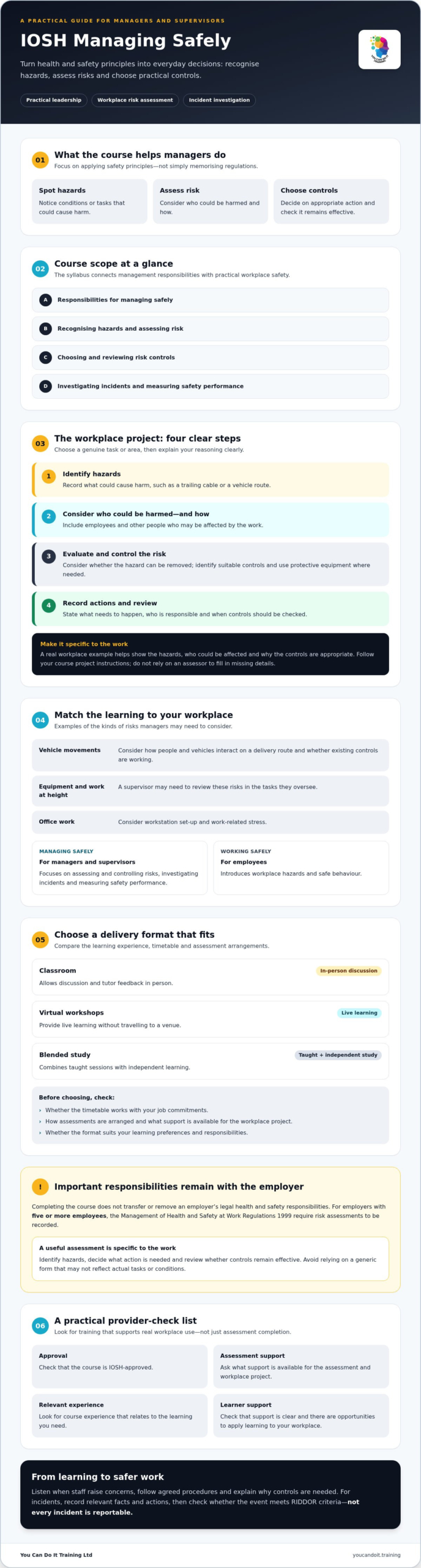
For employers with five or more employees, the Management of Health and Safety at Work Regulations 1999 require risk assessments to be recorded. A suitable assessment helps managers identify hazards, decide what action is needed and review whether controls remain effective. Make it specific to the work being done, rather than relying on a generic form that may not reflect actual tasks or conditions.
Managing Safely and Working Safely: different responsibilities
IOSH Working Safely introduces employees to workplace hazards and safe behaviour. Managing Safely is aimed at managers and supervisors, with a focus on assessing and controlling risks, investigating incidents and measuring safety performance. Managers can support safer work by listening when staff raise concerns, following agreed procedures and explaining why controls are needed.
When comparing training, check that the course content relates to your responsibilities. Think about the tasks you oversee, the people affected by them and the kinds of decisions you need to make. That makes it easier to judge whether the learning will be useful beyond the assessment.
Navigating the IOSH Managing Safely Syllabus: Modules, Assessments, and Delivery Formats
The syllabus covers responsibilities, hazards, risk assessment and control, incident investigation and safety performance. To make those topics relevant, connect them to real tasks. For example, when reviewing a delivery route, consider how people and vehicles interact, who could be exposed to harm and whether the current controls are working. The IOSH official website is a useful place to check current course information.
Training formats vary by provider. Classroom learning allows in-person discussion and tutor feedback. Virtual workshops provide live learning without travelling to a venue, while blended study combines taught sessions with independent learning. Before booking, compare the timetable with your work commitments and ask how assessments are arranged, what support is available for the workplace project and whether the format suits your learning preferences.
Mastering the step-by-step risk assessment and workplace project
Choose a genuine task or area of your workplace for the project. A specific example makes it easier to describe the hazards, explain who could be affected and show why particular controls are appropriate. Use this sequence:
- Identify hazards: record what could cause harm, such as a trailing cable or a vehicle route.
- Consider who could be harmed and how: include employees and other people who may be affected by the work.
- Evaluate and control the risk: consider whether the hazard can be removed, then identify suitable controls. Use protective equipment where needed.
- Record actions and review: state what needs to happen, who is responsible and when the controls should be checked.
Follow your course’s project instructions and explain your reasoning clearly. Don’t assume the assessor knows the workplace or can fill in missing details. Incident investigation is another syllabus skill: record relevant facts and actions, then check whether the event meets the criteria for Reporting of Injuries, Diseases and Dangerous Occurrences Regulations (RIDDOR). Not every incident is reportable. You can also review IOSH Managing Safely training when comparing course options and formats.
Choosing an Accredited Training Provider to Maximise Success and Career Impact
Choose a course that prepares you to use the learning at work, not just complete an assessment. When comparing providers, check that the course is IOSH-approved and ask how assessment support works. Find out whether you will have opportunities to ask questions, discuss practical examples and relate the learning to your own responsibilities. Clear explanations and useful feedback can help you understand how to apply the course principles.
You Can Do It Training Ltd provides IOSH Managing Safely training as part of its health and safety course offering. When contacting a provider, ask what the course covers, how the assessment is handled and what support learners can access if they need clarification. Comparing these details can help you choose a course that fits your experience and learning needs.
For construction supervisors, IOSH Managing Safely may complement role-specific training such as the SSSTS course. Consider the responsibilities you hold now and the skills your next role may require, then compare course content against those needs. Different qualifications serve different purposes, so choose according to the work you are expected to manage. For learners interested in expanding their professional qualifications through certified online courses and educational materials, platforms like NAVO offer accessible study options.
Turn learning into everyday safety habits
Keep team briefings focused on real tasks. Ask workers what could go wrong, listen to their experience and agree clear actions. Build routine hazard checks into normal work, record concerns and follow up to see whether controls remain effective. Make it straightforward for staff to raise wellbeing concerns as well as physical hazards, and take those concerns seriously.
When choosing a provider, weigh course approval, relevant learning support and the practical fit of the timetable. To find out more about IOSH Managing Safely training from You Can Do It Training Ltd, visit You Can Do It Training Ltd.
Turn Safety Knowledge into Confident Leadership
IOSH Managing Safely helps managers apply health and safety principles to everyday work: identifying hazards, assessing risks, choosing controls and learning from incidents. The workplace project gives you a chance to use those steps in context. Comparing delivery formats and learner support can help you find a course that fits your responsibilities and workload.
You Can Do It Training Ltd offers IOSH Managing Safely alongside other health and safety training, including CITB courses, IOSH courses and workplace safety courses. Review the course details and consider how the learning relates to the risks and decisions you manage at work.
Use what you learn to make safety discussions more practical: check hazards, involve your team and follow up on agreed actions. These everyday habits can help managers apply course principles consistently.
Book your accredited IOSH Managing Safely course
Take the next step and explore the course with You Can Do It Training Ltd.
Frequently Asked Questions
Who should take the IOSH Managing Safely course in the UK?
IOSH Managing Safely is designed for managers, supervisors and team leaders who have responsibility for other people or workplace activities. It can be relevant across sectors because the principles apply to a wide range of hazards, from equipment and vehicle movements to office-based risks. Consider whether your role involves managing risks or guiding a team’s safety.
What does the IOSH Managing Safely assessment involve, and is it difficult to pass?
The assessment includes a multiple-choice question paper and a workplace-based risk assessment task. The project asks you to apply course learning to hazards and controls in a real work setting. Preparation helps, but you still need to think through the example and explain your decisions clearly. Review the course material, follow the project instructions and ask your trainer to clarify anything you do not understand.
How long is the IOSH Managing Safely certificate valid, and do I need a refresher?
The IOSH Managing Safely certificate has no expiry date. IOSH recommends a one-day refresher to help keep knowledge current, and some employers may require one within a three-year period. Check your organisation’s policy and consider whether your responsibilities or workplace risks have changed. A refresher can help you revisit key principles, but it does not replace regular reviews of risk assessments and safety practices.
What is the difference between IOSH Managing Safely and the NEBOSH General Certificate?
IOSH Managing Safely is aimed at managers and supervisors who need practical skills to manage everyday workplace risks. The NEBOSH General Certificate, awarded by the National Examination Board in Occupational Safety and Health (NEBOSH), provides broader, more detailed health and safety study and may suit people developing a dedicated safety career. They serve different learning needs, so compare the syllabus, assessment and expectations of your role or employer before choosing. Neither qualification removes an employer’s legal responsibilities.










Leave a Reply
Want to join the discussion?Feel free to contribute!