

First Aid at Work Requirements for Offices: A 2026 Guide
What if the right first-aid provision for your office can’t be worked out from headcount alone? You may be wondering whether you need a trained first-aider, how many kits to provide or how to cover different floors and working patterns. The first aid at work requirements for offices depend on the risks and circumstances of your workplace.
UK employers must provide adequate and appropriate first-aid equipment, facilities and personnel under the Health and Safety (First-Aid) Regulations 1981. A needs assessment helps you decide what that means in practice by considering hazards, staffing, shifts and how quickly help can reach people. This guide explains the legal duty, the office-specific factors to consider and how to make arrangements clear to staff. It also compares Emergency First Aid at Work with broader First Aid at Work training to help you choose a suitable option for your team.
Key Takeaways
- Use a first-aid needs assessment to decide what provision is suitable for your office, rather than relying on a fixed headcount rule.
- Review hazards, attendance patterns, floors, lone working and visitors to identify gaps in how quickly someone can get help.
- Make sure staff know where first-aid equipment is and how to reach the people responsible for first aid.
- Match appointed-person duties, Emergency First Aid at Work or broader First Aid at Work training to your assessment. The first aid at work requirements for offices don’t mean every workplace needs the same course.
What first-aid requirements apply to UK offices?
The Health and Safety (First-Aid) Regulations 1981 require employers to provide adequate and appropriate first-aid equipment, facilities and personnel. In practice, your organisation needs arrangements suited to its workplace so employees can get help if they’re injured or become ill. The duty applies to small offices too. Having few staff or working in a low-risk setting doesn’t remove it.
“Adequate and appropriate” doesn’t mean every office needs the same number of trained first-aiders or kits. It means making a considered decision based on your workplace. A small office on one floor may need different arrangements from a larger office spread over several floors. HSE guidance and a first-aid needs assessment can help you decide what’s suitable. For background on first aid principles and practices, see this general overview.
Does every office need a trained first-aider?
There’s no universal headcount that automatically determines whether a trained first-aider is needed. The first aid at work requirements for offices depend on your assessment, including how many people are present and how quickly help could reach them.
How should an office assess its first-aid needs?
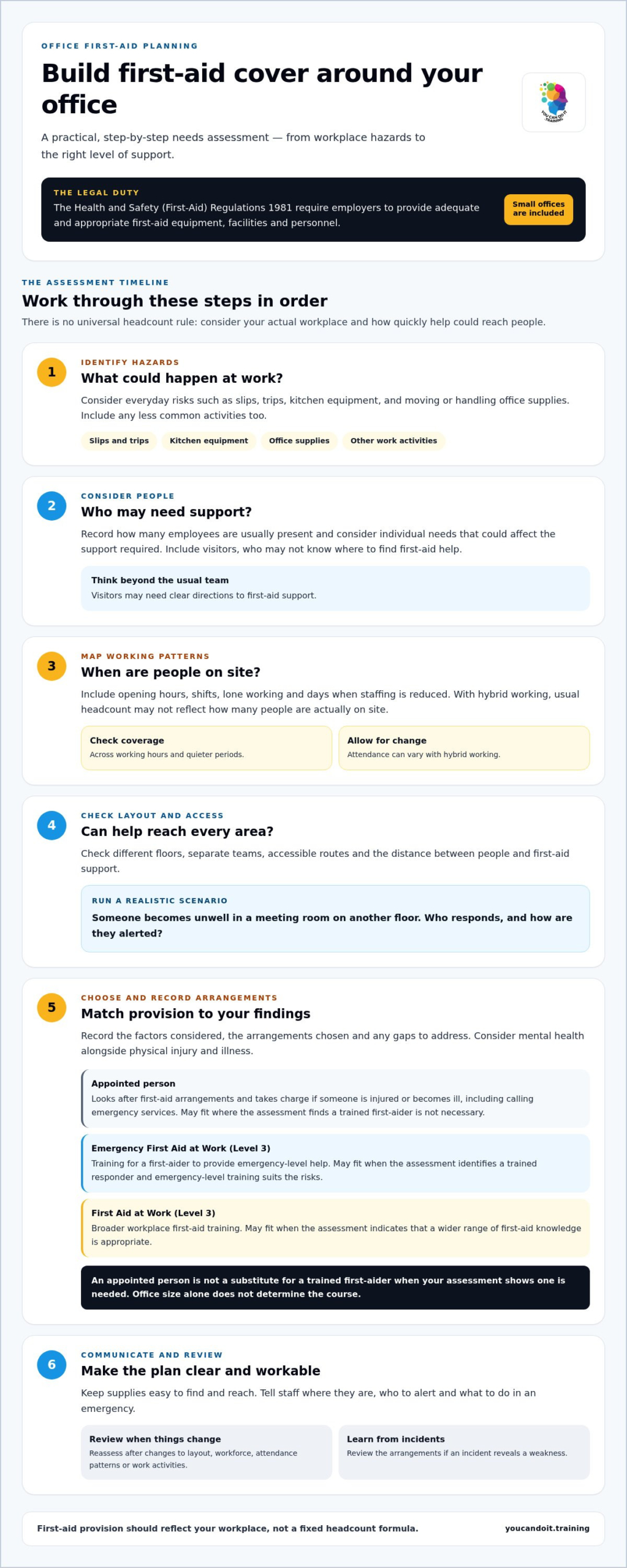
Make the assessment a practical review of who might need help, what could happen and how quickly assistance can reach them. The HSE’s first-aid guidance sets out the official framework. For an office, work through these prompts:
- Hazards: Consider everyday risks such as slips, trips, kitchen equipment and moving or handling office supplies, as well as any less common activities.
- People: Record how many employees are usually present and consider individual needs that could affect the support required.
- Working patterns: Include opening hours, shifts, lone working and days when staffing is reduced. With hybrid working, usual headcount may not reflect how many people are actually on site.
- Layout and access: Check whether people on different floors or in separate teams can reach help quickly. Include visitors, who may not know where to find first-aid support.
What office factors can change the level of provision?
Test your arrangements with a realistic scenario: if someone became unwell in a meeting room on another floor, who would respond, and how would they be alerted? Consider accessible routes, the distance between teams and whether first-aid support is available throughout working hours, including quieter periods. HSE guidance also advises employers to consider employees’ mental health in the assessment, alongside physical injury and illness.
Record the factors you considered, the arrangements you chose and any gaps to address. This makes your reasoning easier to explain and helps you give staff clear instructions. Review the assessment when the office layout, workforce, attendance patterns or work activities change, and after an incident reveals a weakness. If the review identifies a training need, workplace first-aid training options can help build the right skills into your arrangements. This is how you put the first aid at work requirements for offices into practice, not just on paper.
Which first-aid arrangements and training suit an office?
Use your assessment to match the response to the risks and the people on site. Training is one part of the arrangement. You also need accessible supplies, clear instructions and a workable plan for getting help. The first aid at work requirements for offices don’t mean every workplace needs the same course.
| Option | What it involves | When it may fit |
|---|---|---|
| Appointed person | Looks after first-aid arrangements and takes charge if someone is injured or becomes ill, including calling emergency services. | Where the assessment finds a trained first-aider isn’t necessary. |
| Emergency First Aid at Work (Level 3) | Training for a first-aider to provide emergency-level help. | Where the assessment identifies a need for a trained responder, and emergency-level training suits the risks. |
| First Aid at Work (Level 3) | Broader workplace first-aid training. | Where the assessment indicates that a wider range of first-aid knowledge is appropriate. |
When might Emergency First Aid at Work or First Aid at Work be relevant?
There’s no automatic course choice based on office size alone. Consider the hazards identified, how many people are present and whether a responder can reach everyone who may need help. Read the Emergency First Aid at Work course guide and First Aid at Work course guide to compare these training pathways.
Keep first-aid supplies easy to find and reach. Tell staff where they are, who to alert and what to do in an emergency. Check that arrangements work across floors and during quieter periods. Clear, familiar instructions help staff act calmly and direct help to the right place.
Make your office’s next step a practical one
A clear first-aid plan is more than a compliance document. It helps people understand what to do and where to turn if someone needs support. Use your assessment to identify gaps, assign actions and make sure the arrangements are easy for staff to follow. That’s a practical way to put the first aid at work requirements for offices into action and build a safer, more prepared workplace.
You Can Do It Training Ltd offers Emergency First Aid at Work (Level 3) and First Aid at Work (Level 3). Use your assessment to identify the training that fits your workplace, then give your team the skills to respond.
Build your office’s first-aid arrangements around your assessment and take the next step with suitable workplace training.
Frequently Asked Questions
How many first-aiders does an office legally need?
There isn’t a fixed legal number for every office. The appropriate number depends on your assessment and whether trained support can reach staff promptly during working hours. If first-aid cover is shared across floors or shifts, consider whether someone would still be available when a usual responder is absent. The first aid at work requirements for offices are based on suitable arrangements, not a standard quota.
Does an office need a first-aid room?
Not automatically. A dedicated first-aid room is more likely to be relevant where the assessment identifies a need for additional facilities, rather than being a default requirement for a typical low-risk office. Consider whether someone could receive appropriate assistance in a private, accessible space and whether staff can reach it easily. Record practical limitations, such as a room being locked or used for another purpose.
Do employers have to provide first aid for office visitors?
Include visitors in your first-aid arrangements, even though the workplace first-aid regulations focus on employees. Consider how a guest would summon help if they felt unwell in a meeting room, reception area or elsewhere in the building. Make sure reception and other relevant staff know the procedure, and that visitors can be directed to assistance without needing to know the office layout.
Does a first-aid needs assessment have to be written down?
A written assessment isn’t specifically required, but keeping a record is a sensible way to show how you reached your decisions. Note the factors considered, the arrangements selected and any actions still outstanding. This gives managers a useful reference when staffing or office arrangements change, and helps explain why a particular training option or facility was chosen. Keep the record easy for responsible staff to find.










Leave a Reply
Want to join the discussion?Feel free to contribute!