

Demonstrating ROI of Health and Safety Training: A Practical Guide
What if the strongest case for safety training isn’t a promise of savings, but clear evidence of what changed? Demonstrating ROI of health and safety training can feel difficult when costs are easy to record but workplace outcomes depend on supervision, equipment and everyday working practices as well as learning.
That doesn’t mean training is just a compliance cost. With a practical measurement plan, you can show decision-makers how it responds to real risks and supports better-informed work. This guide explains how to compare costs and outcomes, track useful indicators before and after training, and recognise wider organisational value without claiming that training alone caused every improvement. You’ll also learn how to build a credible business case from evidence your organisation can actually collect.
Key Takeaways
- Make demonstrating ROI of health and safety training credible by comparing relevant benefits with training costs across a defined review period.
- Set a baseline before training, then track agreed indicators using your organisation’s actual records.
- Separate financial measures from wider signs of progress, such as workers’ confidence, competence and safer working practices.
- Match course objectives and delivery format to identified risks, job responsibilities and practical team needs.
Why demonstrating ROI of health and safety training takes more than counting course costs
A course invoice is easy to record; its value is harder to capture. A useful definition is: training ROI compares the relevant benefits associated with training with its costs over a stated review period. The comparison might include financial measures, such as changes in absence or incident-related costs, alongside wider outcomes such as improved confidence, competence and safer work. Not every outcome can be sensibly converted into pounds, and a credible case should say so rather than assign a made-up value.
Occupational safety and health covers the protection of people at work and the conditions that shape their wellbeing. The Occupational Safety and Health Overview offers useful background to this wider scope. For a business case, though, the measures need to be specific to the training and workplace risk being considered.
Which health and safety training outcomes can an employer measure?
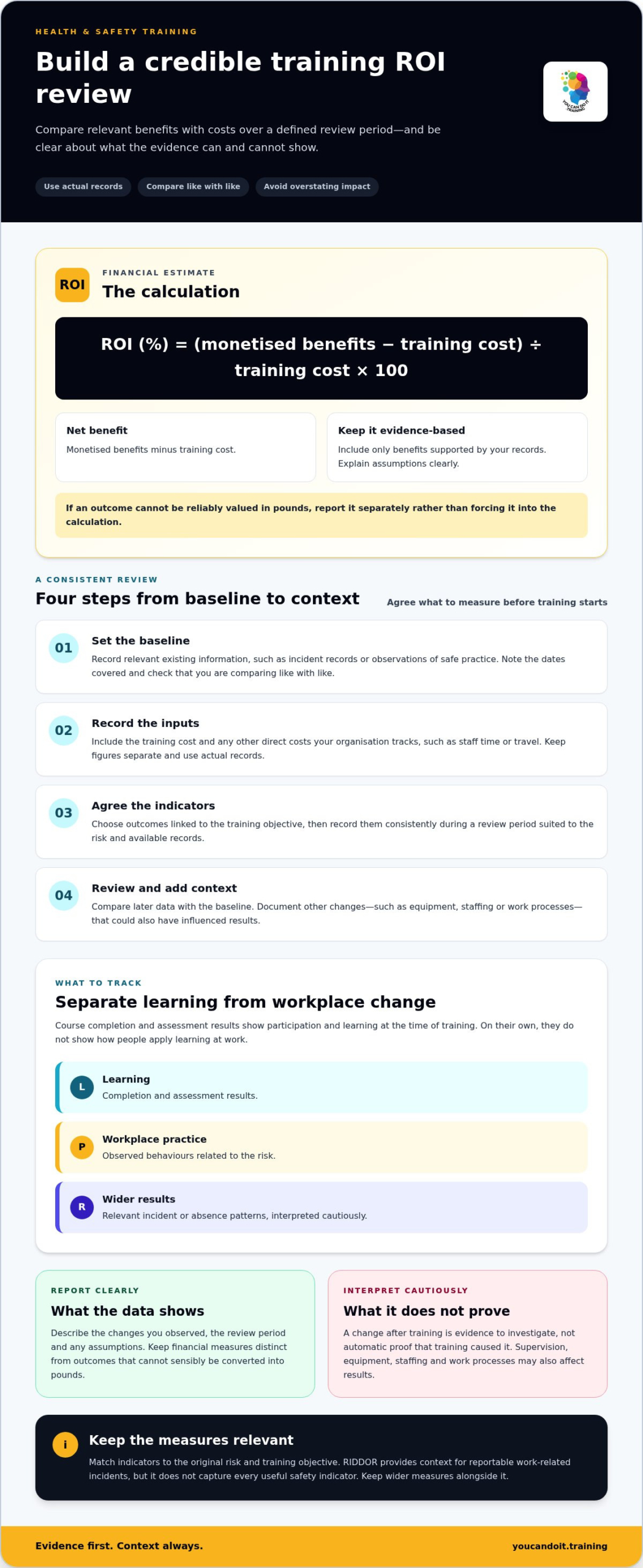
Separate evidence that learning took place from evidence of what changed afterwards. Course completion and assessment results show participation and learning at the time of training. They don’t, by themselves, show how people apply that learning at work.
Choose follow-up indicators that connect directly to the original risk. Depending on the course and workplace, these could include incident patterns or observations of safe practices. Record the measure, its starting point and the review period so comparisons have context.
- Learning: completion and assessment results.
- Workplace practice: observed behaviours related to the risk.
- Wider results: relevant incident or absence patterns, interpreted cautiously.
A change after training is evidence to investigate, not automatic proof that training caused it. Supervision, equipment, staffing and work processes may also affect results. For a defensible case, describe what the data shows, note other possible influences, and avoid claiming a positive return unless the evidence supports it. That care is central to demonstrating ROI of health and safety training without overstating its impact.
How to measure the ROI of health and safety training step by step
A consistent process makes the results easier to explain and review. Before training starts, agree what you’ll measure, where the evidence will come from and how long you’ll track it. Use a review period that suits the risk and the records available, rather than choosing one simply because it makes the figures look favourable.
- Set the baseline. Record relevant existing information, such as incident records or safe-practice observations, and note the dates covered. Check that you’re comparing like with like.
- Record the inputs. Include the training cost and any other direct costs your organisation tracks, such as staff time or travel. Keep the figures separate and use actual records.
- Agree the indicators. Choose outcomes linked to the training objective, then record them consistently during the review period.
- Review and add context. Compare the later data with the baseline. Document changes such as new equipment, staffing or work processes that could also have influenced the results.
How should you calculate and interpret training ROI?
For a financial estimate, use: ROI (%) = (monetised benefits − training cost) ÷ training cost × 100. Here, net benefit means monetised benefits minus training cost. Only include benefits supported by your records, and explain assumptions clearly. If you can’t reliably value an outcome in pounds, report it separately rather than forcing it into the calculation.
RIDDOR, the Reporting of Injuries, Diseases and Dangerous Occurrences Regulations, provides context for reportable work-related incidents, but it won’t capture every useful safety indicator. The HSE’s RIDDOR reporting guidance explains the reporting framework. Keep your wider measures alongside it, and present the result as an informed comparison, not proof that training alone caused a change. If your review identifies a skills gap, explore accredited health and safety training that aligns with the risk and roles involved.
Choose health and safety training that supports measurable workplace improvement
Start with the risk, not the course catalogue. Identify who needs to do what differently, then select training whose objectives address that need and connect to the indicators you plan to review. For example, if the aim is to improve safe working at height, define the relevant roles and the work practices supervisors will observe afterwards. A course certificate alone won’t show whether those practices have changed.
Delivery matters too. Compare classroom, onsite, webinar, online and blended learning against your team’s location, work patterns and opportunities to practise or discuss relevant scenarios. The most convenient format is useful only if it helps the right people engage with the learning and apply it in their roles.
How can training providers support a credible ROI review?
Accreditation and clear learning objectives help you understand what a course covers and what learners are expected to gain. Before booking, map those objectives to your risk assessment, worker responsibilities and planned measures. Provider evidence can inform this decision, but it isn’t proof of business ROI: the results still depend on what happens in the workplace after training.
You Can Do It Training Ltd’s trainers are Chartered Members of IOSH (CMIOSH) with 30+ years of experience, and the company reports a 99%+ pass rate. These details help describe trainer experience and learner assessment outcomes; they don’t guarantee financial savings or improved workplace indicators. Consider them alongside accreditation and feedback, then use your own follow-up measures to assess impact.
A practical way to keep the decision grounded is to write down the risk, intended learning, delivery format and post-course indicator before training begins. That gives managers and learners a shared purpose, and makes demonstrating ROI of health and safety training a more transparent exercise. To match course options with role-specific needs, explore health and safety training with You Can Do It Training Ltd.
Make your next training decision a considered one
Use your review process to shape what happens next. If the evidence points to a remaining skills gap, refine the learning objective or the way it’s put into practice. If the picture is mixed, gather more context before deciding what to change. This measured approach keeps demonstrating ROI of health and safety training grounded in what your organisation can actually observe, rather than in promises.
As you consider training, look for evidence that helps you judge the learning experience as well as the course itself. CourseCheck provides an independent feedback platform, offering another perspective to consider alongside your organisation’s own measures.
Every workplace can take a practical next step: identify the capability your team needs and choose training with that purpose in mind. Progress starts with a clear intention, and you can build your evidence from there.
Frequently Asked Questions
How do you calculate the ROI of health and safety training?
Calculate ROI by subtracting training cost from evidenced financial benefits, dividing the result by training cost, then multiplying by 100. For demonstrating ROI of health and safety training, include only values your organisation can support, such as recorded costs linked to an incident. Note the period covered and explain assumptions, including any other changes that may have affected the figures. Keep outcomes you can’t value in pounds separate.
Can health and safety training reduce workplace accidents?
Training can help workers recognise hazards and use safer practices, but it can’t guarantee fewer accidents. For example, after manual handling training, supervisors might observe whether workers use the taught techniques, while managers also review incident records. Consider whether equipment, workloads or procedures changed during the same period. These factors provide context before you decide what the accident trend might indicate.
What should businesses measure after health and safety training?
Measure outcomes that fit the course and the work people do. After fire marshal training, for instance, you could gather feedback on whether staff understand their assigned actions and record any issues raised during a practice evacuation. Use consistent questions and observation criteria each time, so responses can be compared meaningfully. Worker and supervisor feedback can also reveal barriers that figures alone may miss.
How can you justify health and safety training to senior management?
Present a concise proposal that connects a specific workplace need with the learning objective and the evidence you’ll collect afterwards. Make the decision clear: outline the training cost information available, who needs to attend, and how you’ll report financial and non-financial outcomes. Include possible limitations, such as operational changes that could affect results. This gives managers a fair basis for weighing the investment.








Leave a Reply
Want to join the discussion?Feel free to contribute!