

First Aid at Work Course: The Essential UK Guide to Workplace Safety
A first aid at work course shouldn’t be a dry, tick-box exercise that leaves your team watching the clock and hoping they never have to use what they’ve learned. In reality, the right training is a transformative opportunity to ignite a culture of mutual respect and genuine care within your business. We understand that navigating HSE requirements can feel daunting, especially when you’re balancing the pressure of compliance with the very real anxiety of how your staff might react in a genuine emergency.
Whether you’re confused about the difference between Emergency First Aid at Work and the full three-day qualification, or simply want a learning environment that prioritises human connection over clinical instruction, you’re in the right place. We’ll show you exactly how to meet your legal obligations under the Health and Safety (First-Aid) Regulations 1981 whilst fostering a team that feels truly empowered. We’ll explore the latest 2026 standards for first aid kits, provide actionable tips for your risk assessments, and explain how a focus on both physical and mental health can help your workforce soar. Grab a cup of tea, settle in with a bourbon cream, and let’s make workplace safety something your team actually looks forward to.
Key Takeaways
- Understand how a comprehensive first aid at work course transforms safety from a mandatory chore into a vital skill for preserving life and promoting recovery.
- Learn how to choose between EFAW and FAW training whilst matching the right qualification to your specific workplace risk levels and staff numbers.
- Ensure your business remains fully compliant with the Health and Safety (First-Aid) Regulations 1981 by understanding the latest HSE standards for training providers.
- Discover why a supportive, “hearts and minds” learning environment is the secret to ensuring your team feels confident and ready to act when it’s needed most.
What is a First Aid at Work Course? Defining the Essentials
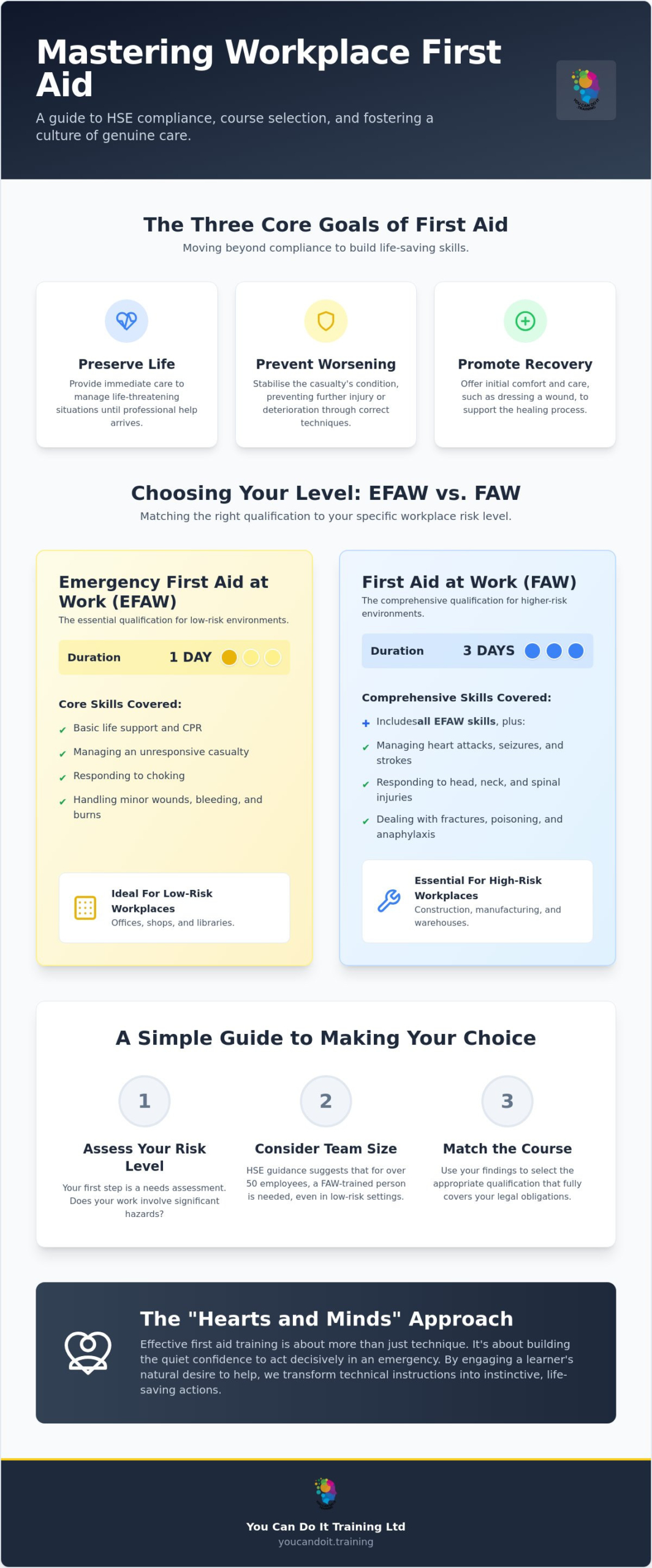
A first aid at work course is a comprehensive training programme that transforms your staff into a frontline response team capable of managing illness and injury. It’s about more than just bandages; it’s about providing the immediate, temporary care required to bridge the gap until the paramedics arrive. When we look at the fundamentals of What is First Aid?, the goals are clear: preserving life, preventing a casualty’s condition from worsening, and promoting a swift recovery.
Whilst the curriculum is grounded in official safety standards, the true value of a first aid at work course lies in the quiet confidence it instils. Your team will learn a range of vital skills, including:
- Basic life support and CPR
- Managing life-threatening bleeding
- Dealing with fractures, burns, and eye injuries
- Responding to sudden medical emergencies like seizures or heart attacks
This training doesn’t just tick a box for compliance. It creates a safer, more resilient environment where everyone knows they are looked after. The goal is to move beyond cold, clinical instruction and ignite a genuine sense of capability in every learner.
The Vital Role of the First Aider
A first aider isn’t a medical professional; they are a knowledgeable mentor within your team who remains calm under pressure. We believe in a “Hearts and Minds” approach to training that goes beyond the textbook. By engaging a learner’s natural passion for helping others, we turn technical instructions into instinctive actions. This human connection ensures that when an emergency happens, your first aiders don’t just remember the steps; they feel empowered to step forward and make a difference. It’s about fostering camaraderie and ensuring every person feels they have the tools to protect their colleagues. When you put the student at the heart of the experience, the technical skills follow naturally.
Choosing Your Level: FAW vs EFAW Training
Selecting the right first aid at work course shouldn’t feel like a confusing administrative hurdle. The choice effectively boils down to two accredited paths: the one-day Emergency First Aid at Work (EFAW) and the more comprehensive three-day First Aid at Work (FAW) course. To make the right call for your team, you need to look at your workplace through the lens of risk. Is your environment a quiet office with a handful of staff, or a bustling factory floor with heavy machinery and complex hazards?
The right training ensures your people feel empowered, not just certified. Here is a quick decision framework to help you choose:
- Low-risk environments: Offices, shops, and libraries usually find the EFAW sufficient for their needs.
- High-risk environments: Construction sites, warehouses, and manufacturing plants almost always require the full FAW qualification.
- Staff numbers: Even in low-risk settings, if you have more than 50 employees, the HSE suggests at least one person should be trained to the full FAW level.
The 1-Day Emergency First Aid at Work (EFAW)
For those in low-risk settings, the one-day course focuses on the absolute essentials of immediate response. It covers life-saving skills such as CPR, dealing with a choking colleague, and managing minor wounds or burns. It’s designed to give your team the spark of confidence needed to handle a crisis until professional help arrives. If you’re looking for a streamlined approach for a smaller team, our Emergency First Aid at Work Course guide provides a deeper look at this vital entry-level qualification.
The 3-Day First Aid at Work (FAW)
High-risk environments demand a more robust shield. The three-day programme goes much deeper, teaching your staff how to manage serious medical conditions such as heart attacks, spinal injuries, and poisoning. This level of training is a transformative experience that prepares your team for a diverse range of emergencies. For organisations needing this complete certification to meet their legal obligations, our detailed First Aid at Work Course guide outlines everything you can expect. If you’re still unsure which path matches your unique setting, why not reach out to our knowledgeable mentors for a friendly chat about your requirements?
HSE Compliance: Meeting Your Legal Obligations
Meeting your legal obligations starts with the Health and Safety (First-Aid) Regulations 1981. These rules require every employer to provide adequate and appropriate equipment, facilities, and personnel to ensure their employees receive immediate attention if they are injured or taken ill at work. It’s a fundamental duty of care. Non-compliance doesn’t just invite legal trouble; it risks the safety of your team, who are your business’s most valuable asset.
A common point of confusion is whether the HSE ‘approves’ training providers. Since 2013, the HSE no longer individualises approvals. Instead, the responsibility sits with you, the employer, to ensure your chosen first aid at work course meets the required standards. We take that responsibility seriously, acting as a knowledgeable mentor to guide you through the technical requirements whilst keeping the atmosphere relaxed and professional.
Keeping skills fresh is vital. Just as a construction leader might need an SMSTS refresher to stay current with site legislation, your first aiders need regular practice. If skills aren’t used, they can fade. This is why the HSE strongly recommends annual refresher sessions between full certifications to keep that spark of knowledge alive.
For those operating in the construction and industrial sectors, maintaining high safety standards is a multifaceted challenge. Partnering with a specialist consultancy like DL Safety can provide the technical support and tailored safety packages necessary to protect your workforce and ensure full compliance with industry regulations.
Conducting Your First Aid Needs Assessment
To determine exactly what you need, you must perform a needs assessment. Think of this as a bespoke safety plan for your unique environment. Use this simple 3-step checklist:
- Identify hazards: Look for specific risks like machinery, hazardous substances, or high-traffic areas.
- Consider employee numbers: The HSE provides guidelines based on headcount, such as needing one FAW-trained person for every 50 employees in high-risk settings.
- Account for lone workers: Don’t forget staff who work alone or travel to remote sites where help might take longer to arrive.
Certification and Requalification
Standard certificates for a first aid at work course are valid for three years. However, waiting until the very last day to organise a new session can leave your business unprotected. Setting a digital reminder in your calendar six months before a certificate expires is a great way to stay ahead. This gives you plenty of time to book your training and ensures there’s never a gap in your workplace’s safety cover.
The “Hearts and Minds” Approach to Training
The environment in which your team learns can be the difference between life and death. When a first aid at work course is delivered in a cold, clinical setting, the brain often enters a state of passive compliance, making it harder to recall vital information during a high-pressure emergency. We believe in a different way. By fostering a relaxed atmosphere built on mutual respect and camaraderie, we ensure that technical knowledge sticks. When students feel comfortable, they are more likely to engage, ask questions, and truly absorb the skills they need to protect their colleagues.
Training shouldn’t be a mandatory session that people dread. Instead, it should be a spark that ignites a passion for professional growth and workplace safety. We focus on the person at the heart of the experience, ensuring they feel empowered to act rather than intimidated by the regulations. It’s the small, human touches that create this welcoming culture: a friendly welcome, plenty of fresh tea, and of course, the legendary bourbon creams. These details aren’t just about hospitality; they signal that we value the comfort of the individual as much as the curriculum itself.
When you shift the focus from a “tick-box” exercise to a transformative opportunity, you see a real change in how your team perceives safety. It stops being a chore and becomes a point of pride. This “hearts and minds” philosophy ensures that when an emergency happens, your staff don’t just remember the steps; they have the confidence to step forward and soar.
Actionable Tips for a Safer Workplace Today
Building a culture of care doesn’t stop once the first aid at work course is over. You can start making your workplace safer today by following these practical steps:
- Introduce your first aiders: Use your next staff meeting to introduce the newly certified team members. This builds trust and ensures everyone knows exactly who to turn to in a crisis.
- Audit your kit accessibility: Walk through your site to ensure first aid kits are clearly marked and easy to reach. A kit buried under a pile of boxes is useless in an emergency.
- Create a holistic safety culture: Connect your first aid response to other risk areas. For example, ensuring your team has completed working at height training alongside their medical skills creates a comprehensive safety shield for your business.
Empower Your Team and Secure Your Workplace
Choosing the right first aid at work course is about more than fulfilling a legal mandate; it’s about building a resilient, compassionate team that can handle any crisis. By understanding the distinction between EFAW and FAW training and conducting a thorough needs assessment, you ensure your business remains fully HSE-compliant. Remember that the best training happens in a space where students feel valued, supported, and relaxed. When your staff feel at ease, they don’t just learn; they thrive.
A thriving business also relies on a secure and stable technical foundation. To learn more about Cornerstone Business Solutions and their award-winning IT services, discover how their bespoke technology solutions can support your company’s growth.
With over 30 years of industry experience and a 99% pass rate, we’ve mastered the art of delivering accredited safety training with a genuine “Hearts and Minds” touch. We’ll handle the technical details whilst your team enjoys a friendly atmosphere and the best hospitality in the business. Book your First Aid at Work course with the experts today and let us help your workforce soar with confidence. You’ve got the vision for a safer workplace; we’re here to help you achieve it.
Frequently Asked Questions
How long does a first aid at work certificate last?
A first aid at work certificate is valid for three years from the date of issue. Once this period ends, you’ll need to complete a requalification course to maintain your status as a designated first aider. The HSE strongly recommends that you undertake annual refresher training during this three-year window to keep your life-saving skills sharp and your confidence high.
What is the difference between EFAW and FAW?
The primary difference lies in the depth of training and the duration of the sessions. A one-day Emergency First Aid at Work (EFAW) course focuses on immediate life-saving techniques for low-risk environments like offices. In contrast, the three-day first aid at work course covers a broader range of medical conditions and is essential for high-risk settings like construction sites where complex injuries are more likely.
How many first aiders do I need for my business?
Your requirement depends entirely on your specific workplace risk assessment. For low-risk offices with over 50 employees, the HSE suggests having at least one person trained in First Aid at Work for every 100 staff members. In higher-risk environments such as warehouses, you’ll generally need one FAW-trained first aider for every 50 employees. Always consider lone workers and shift patterns to ensure you have adequate cover at all times.
Can I do a first aid at work course online?
You cannot complete a fully accredited first aid qualification entirely online. While you can study the theoretical elements through digital modules, the HSE requires a face-to-face practical assessment to ensure you can perform life-saving techniques correctly. Blended learning is a popular option that combines online study with in-person practice, ensuring you gain the hands-on confidence needed to act decisively in a real emergency.
What happens if my first aid certificate has expired?
If your certificate expires, you are no longer considered a competent first aider under the Health and Safety (First-Aid) Regulations 1981. You shouldn’t act as a designated first aider until you’ve successfully completed a new first aid at work course. It’s best to book your requalification training before your current certificate runs out to ensure there’s no gap in your business’s safety cover.










Leave a Reply
Want to join the discussion?Feel free to contribute!