
Construction Health and Safety: The Ultimate UK Guide for 2026
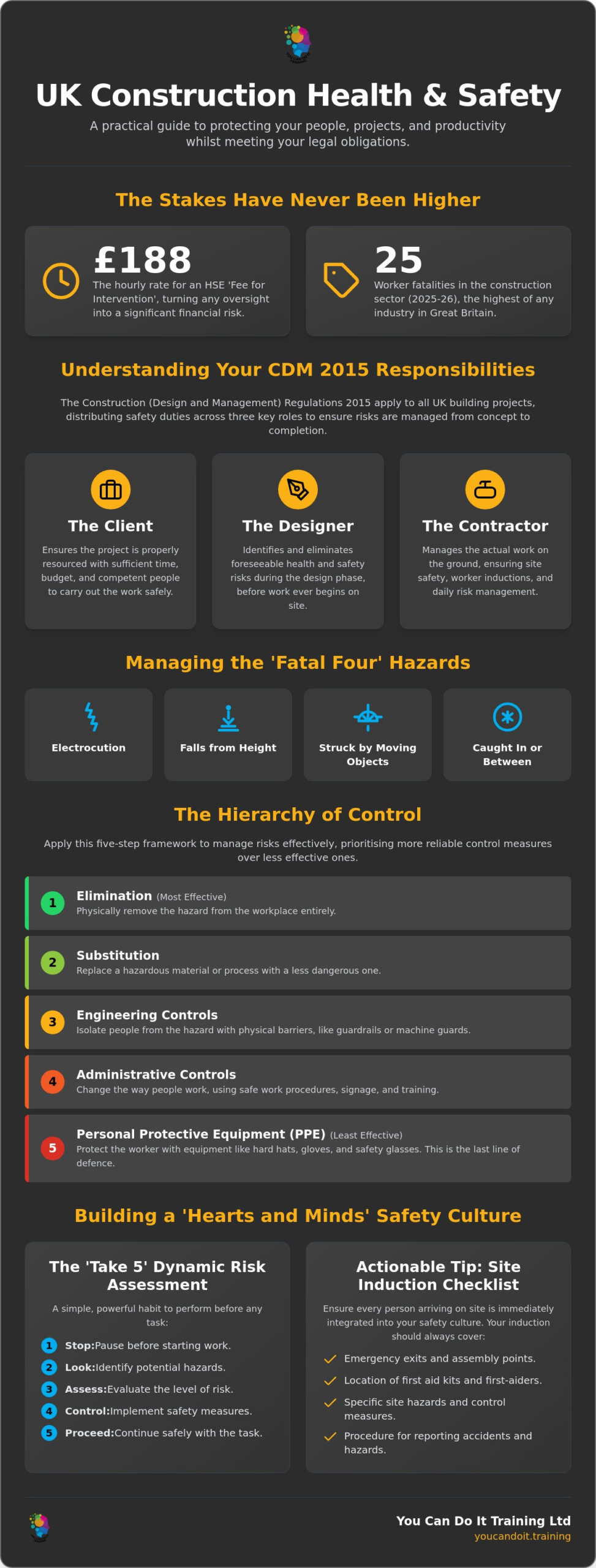
With the HSE Fee for Intervention rate now standing at £188 per hour, a single oversight on site is no longer just a safety concern; it’s a significant financial risk to your business. Between April 2025 and March 2026, the construction sector saw 25 worker fatalities, the highest of any industry in Great Britain, proving that the stakes for construction health and safety have never been higher. You likely feel that keeping up with the constant stream of new regulations, from the Building Safety Levy to the latest CDM 2015 updates, is a full-time job that pulls you away from the actual work.
We understand that the “red tape” can feel overwhelming, often making safety seem like a hurdle rather than a help. This guide is designed to clear the fog, showing you how to meet your legal obligations whilst building a genuine “hearts and minds” culture where every team member looks out for one another. You’ll discover exactly which CITB or IOSH courses your team needs to stay compliant and productive. From understanding the new independent Building Safety Regulator to mastering the basics of falls from height, we’ll help you turn mandatory training into a transformative opportunity for your business.
Key Takeaways
- Simplify complex CDM 2015 regulations by breaking down the specific legal roles of the Client, Designer, and Contractor to ensure total project clarity.
- Master construction health and safety by applying a practical “hierarchy of control” to effectively manage the “Fatal Four” hazards on any site.
- Identify exactly which CITB or IOSH training courses your team needs to progress safely from a new starter to a site supervisor or manager.
- Move beyond the perception of “red tape” by fostering a “hearts and minds” culture that protects your people whilst maintaining high productivity.
The Fundamentals of Construction Health and Safety: Beyond the Red Tape
The Health and Safety at Work Act 1974 remains the bedrock of our industry, even as we move through 2026. It isn’t just about avoiding a fine; it’s about the fundamental right of every worker to return home to their family at the end of the shift. In our training sessions, we often talk about “hearts and minds” because true construction health and safety isn’t found in a dusty folder in the site office. It’s found in the camaraderie amongst the team and the shared belief that safety is everyone’s business, regardless of the colour of their hard hat. The HSE acts as a supportive partner in this mission, providing the framework to prevent harm whilst ensuring projects remain productive.
Why CDM Regulations Matter for Every Project
The CDM 2015 regulations apply to every single building project in the UK. They ensure that safety is baked into a project from the very first sketch. This Construction Site Safety Overview highlights how these rules distribute responsibility across three core roles. The Client ensures the right resources and time are in place; the Designer identifies and removes hazards during the planning phase; and the Contractor manages the actual work on the ground. When these three roles work in harmony, the site becomes a place where people can excel.
The Cost of Non-Compliance in 2026
Failing to follow these rules carries a heavy price that goes far beyond the increased HSE Fee for Intervention. A poor safety record can lead to site shutdowns and a damaged reputation that makes winning new contracts nearly impossible. Most importantly, it leads to human suffering. Understanding RIDDOR reporting is essential for any modern business, as it ensures that accidents are tracked and lessons are learned to prevent future tragedies. A strong safety record is your favourite tool for building a business that clients trust and workers want to join.
Managing Risk on Site: Actionable Strategies for Hazard Control
Effective construction health and safety management relies on identifying the “Fatal Four” hazards that account for the majority of serious incidents: falls from height, being struck by moving objects, getting caught in or between machinery, and electrocution. Whilst these risks are well known, they still cause far too much heartache in the UK construction sector. To manage these effectively, we use a hierarchy of control. This system starts with elimination. If you can’t remove the risk entirely, you substitute the method, use engineering controls like guardrails, or implement administrative rules. For facilities with fixed installations, such as schools or leisure centres, regular sports equipment safety inspections act as a vital administrative control to ensure that equipment remains fit for purpose. Only when these options are exhausted do we rely on PPE.
The HSE Construction Safety Guidance provides a clear framework for these controls, but the real work happens on the tools. Since falls remain the biggest killer, getting your working at height training right is non-negotiable. You also need to watch out for “invisible” dangers that lurk in older buildings. Understanding what is asbestos and knowing how to recognise it is vital before you even touch a wall on a refurbishment project.
The Power of the Dynamic Risk Assessment
Static paperwork is rarely enough for a fast-moving site. We teach the “Take 5” method to keep safety at the front of your mind: Stop, Look, Assess, Control, and Proceed. It’s a simple habit that saves lives. Encourage your team to speak up if something doesn’t look right. This “no-blame” behaviour fosters a culture where construction health and safety is a shared victory, not a set of rules used to catch people out.
Essential Safety Equipment and PPE
Think of PPE as your last line of defence. It only works if it’s fitted correctly and maintained well. For specialised tasks, such as using mobile towers, standard PPE isn’t enough. You need specific PASMA qualifications to ensure the equipment is stable and safe for everyone on site. If you’re ready to empower your team, you can find the right safety training for your business to get everyone home safely at the end of the day.
The Path to Compliance: Accredited Training and the ‘Hearts and Minds’ Approach
Mastering construction health and safety requires more than just a certificate; it’s about a career-long journey of growth and professional pride. For those just starting out, the HSA course provides the ideal foundation, igniting a spark of interest that transforms safety from a mandatory chore into a core skill. We believe in a “Knowledgeable Mentor” approach where instructors don’t just recite slides but share 30 years of industry experience. This happens best in a relaxed environment where a warm cup of coffee, a few bourbon creams, and genuine camaraderie help dismantle the intimidation often felt during technical training.
Choosing the Right Course for Your Role
As you progress, your training must match your level of responsibility. The SSSTS is designed specifically for supervisors, focusing on the practicalities of monitoring site standards. In contrast, the SMSTS is the gold standard for project managers, covering the strategic planning required for Managing Construction Health Risks across an entire site. To choose the right provider, follow these three steps: first, verify their CITB or IOSH accreditation; second, check for a high pass rate (we maintain 99%); and third, ensure they offer a student-centric environment that values your comfort as much as the curriculum.
Winning Hearts and Minds: The Secret to Long-Term Safety
Strict policing might get results for a day, but emotional engagement creates a culture that lasts for years. When workers understand the “why” behind the rules, their behaviour changes naturally. We define ‘Hearts and Minds’ as a strategy that engages workers’ emotions and intellect to foster a genuine care for safety amongst the whole team. This approach ensures that construction health and safety isn’t just something you do when the boss is looking, but a standard you uphold because you value your colleagues. Ready to soar in your career? Explore our accredited safety courses today and join a learning community that puts you at the heart of everything.
Building a Safer Future for Your Site and Your Career
Navigating the complexities of CDM 2015 and the hierarchy of control doesn’t have to be a daunting task. By moving beyond the “red tape” and embracing a “hearts and minds” approach, you transform construction health and safety from a set of restrictive rules into a shared culture of care. Whether you are managing risks on a busy site or progressing through your CITB qualifications, the goal remains the same: ensuring every team member returns home safely whilst keeping your projects moving forward with confidence.
We believe that training should be a transformative opportunity rather than a mandatory chore. Our expert mentors bring over 30 years of site experience to every course, providing a supportive environment where you are always at the heart of the experience. Ignite your career with accredited safety training from the experts. With a 99% pass rate and a classroom atmosphere that values hospitality, great coffee, and top-tier biscuits, we’re here to help you soar. You’ve got the vision for a safer site; with the right partner, you can do it.
Frequently Asked Questions
What is the most important health and safety law in UK construction?
The Health and Safety at Work etc. Act 1974 is the primary piece of legislation that governs workplace safety across all UK industries. For our sector specifically, the Construction (Design and Management) Regulations 2015, commonly known as CDM 2015, provide the essential framework for managing project safety. These laws ensure that everyone from the client to the site worker has a clear, legal responsibility to protect themselves and their colleagues from harm.
How often should construction health and safety training be refreshed?
Most major accredited certificates, including CITB and IOSH courses, should be refreshed every five years to remain valid on site. However, we often suggest a three-year cycle for construction health and safety updates to ensure your team stays sharp and aware of the latest HSE guidance. Keeping your training current isn’t just a box-ticking exercise; it’s a vital part of maintaining a “hearts and minds” culture where safety knowledge is always fresh and relevant.
What is the difference between a hazard and a risk on a building site?
A hazard is anything with the potential to cause harm, such as a pile of rubble or a high-voltage cable. A risk is the calculation of how likely it is that the hazard will cause an injury, combined with how serious that injury might be. On a busy site, we focus on identifying hazards early so we can implement controls that reduce the overall risk to an acceptable, safe level for everyone involved.
Do I need a specific qualification to be a safety supervisor in 2026?
Yes, the CITB Site Supervisor Safety Training Scheme (SSSTS) is the industry-recognised qualification for supervisors across the UK. Whilst the law focuses on “competence” rather than specific certificates, most reputable contractors won’t let you lead a team without this accredited training. It proves you have the skills to monitor construction health and safety standards effectively and provides a clear pathway for those looking to progress into site management roles in the future.









Leave a Reply
Want to join the discussion?Feel free to contribute!