

CSCS Cards in 2026: The Ultimate Guide to Getting on Site
What if that plastic card in your wallet wasn’t just a mandatory chore, but the spark that ignites your entire career in the UK construction industry? Most people see the cscs scheme as a confusing maze of different colours and stressful health and safety exams that feel designed to trip you up. You might be worried that an expired card will stop you from earning on Monday morning, or perhaps you’re feeling a bit of stage fright about sitting a formal test after years away from a classroom environment. We understand those nerves because we’ve spent thirty years helping people just like you realise that these qualifications are well within their reach.
In this guide, we’ll show you exactly how to navigate the 2026 requirements so you can get on site without the stress. We’ll break down which card matches your role, explain how new government funding might even cover your costs, and share how our unique “hearts and minds” approach ensures you pass your CITB test with confidence. From the first sip of tea in our training centre to the moment your new card arrives, we’re here to prove that you can do it.
Key Takeaways
- Understand how the cscs scheme acts as your professional passport, proving your essential health and safety knowledge to major UK contractors.
- Identify the correct card colour for your specific role and experience level, ensuring you apply for the right credentials to get on site without delay.
- Master actionable revision tips, including the use of mock exams and careful question analysis, to help you navigate the CITB test with ease.
- Discover how a supportive, “hearts and minds” learning environment can transform a mandatory qualification into a genuine career opportunity.
Understanding the CSCS Scheme: Your Passport to UK Construction
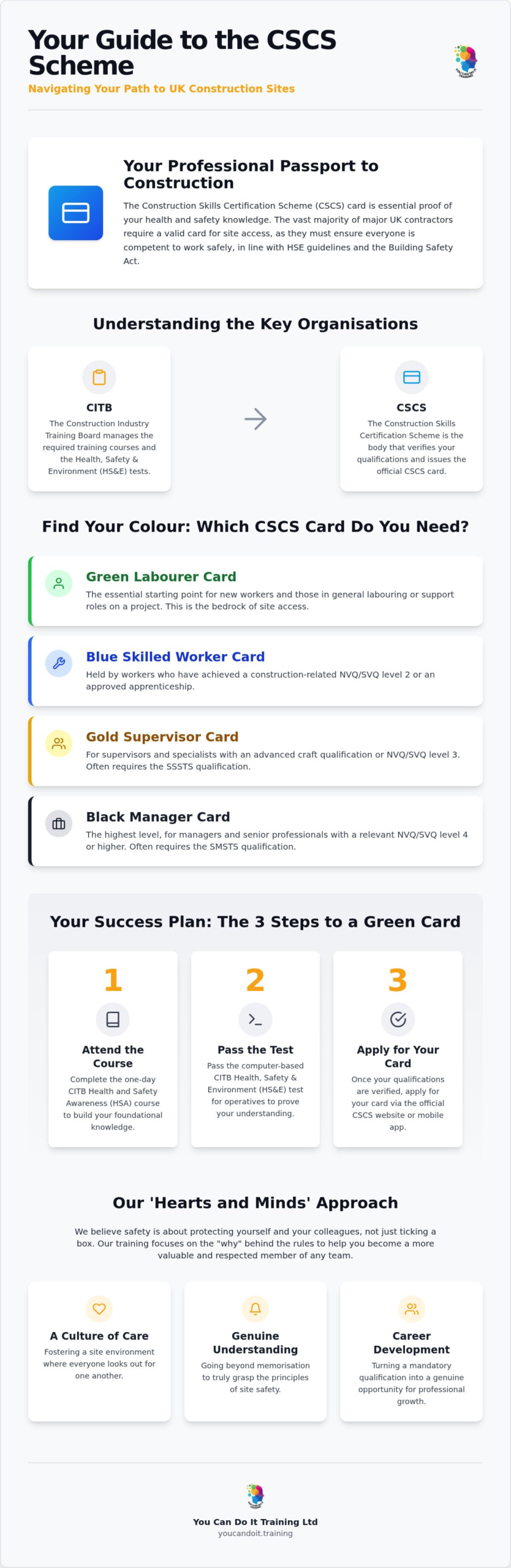
Think of the Construction Skills Certification Scheme as more than just a piece of plastic in your wallet. It’s your professional passport to the industry. In simple terms, a cscs card proves you have the specific training and qualifications needed to work safely on a modern building site. You’ll find that the vast majority of major UK contractors simply won’t let you past the site gates without one. They need to know that every person on their project understands the risks and knows how to manage them effectively.
It’s helpful to understand the difference between the organisations involved. While the card itself is issued by CSCS, the actual training and Health, Safety and Environment (HS&E) tests are managed by bodies like the CITB. Our “Hearts and Minds” philosophy goes deeper than just helping you pass a test. We believe safety is about protecting yourself and your colleagues, not just ticking a box for a supervisor. When you truly understand the “why” behind the rules, you become a more valuable and respected member of any team. It’s about fostering a culture where everyone looks out for one another.
Why Safety Certification Matters in 2026
The landscape of UK construction is shifting. The Building Safety Act has significantly raised the bar for site standards, placing a huge emphasis on individual competence. According to HSE guidelines, employers must ensure that everyone working under their control is competent to do their job safely. This means that having a valid card is now more critical than ever. Whether you’re learning about general site hazards or diving into specific risks like those found in our what is asbestos guide, staying informed is the best way to protect your career. Competence isn’t just a legal requirement; it’s the foundation of a professional workforce where everyone can soar.
Finding Your Colour: Which CSCS Card Do You Need?
Choosing the right cscs card can feel like trying to solve a puzzle without the box lid. It doesn’t have to be that way. The scheme uses a straightforward colour-coded system to signal your skill level and responsibilities to everyone on site. Whether you’re just starting out or you’ve been on the tools for years, there’s a specific card designed to represent your expertise and keep you moving forward in your career.
The most common starting point is the Green Labourer Card. This is the bedrock of site access for new workers and those providing essential support on a project. To secure this, you’ll need to complete a one-day CITB Health and Safety Awareness (HSA) course first. We know that returning to a classroom can feel intimidating if you’ve been away for a while, but our CITB HSA course focuses on making the experience inclusive and supportive, ensuring you leave with the knowledge and confidence to succeed.
The Green Labourer Card Path
- Step 1: Attend a one-day CITB Health and Safety Awareness course. This provides the essential foundation for site safety and is a mandatory requirement for the card.
- Step 2: Pass the CITB Health, Safety and Environment (HS&E) test for operatives. This is a computer-based touch-screen test that checks your knowledge of basic safety.
- Step 3: Apply for your card. You can do this easily through the Official CSCS Website or their mobile app once your qualifications are verified.
Moving Up: Gold and Black Cards
As your career grows, your card should reflect your increasing authority and skill. Skilled workers typically hold Blue cards, whilst those in supervisory roles aim for Gold. If you’re stepping up to lead a team, you’ll likely need to explore our SSSTS guide to understand the requirements for supervisors. For those aiming for senior management, the Black Manager card is the ultimate goal. This usually requires the advanced leadership training detailed in our SMSTS guide.
How to Secure Your Card: A Step-by-Step Success Plan
Securing your cscs card doesn’t have to be a stressful ordeal that leaves you feeling anxious. We’ve spent thirty years perfecting a learning environment where technical compliance meets genuine human connection. When you walk into our training centre, you’re not just a number on a spreadsheet; you’re a professional looking to soar. You can expect a relaxed atmosphere, expert mentors who’ve been in your shoes, and plenty of tea and bourbon creams to keep you going. Our “You Can Do It” mantra isn’t just a slogan. It’s a promise that with the right support, these qualifications are achievable for everyone, regardless of your background or how long it’s been since you last sat in a classroom.
Preparing for the CITB HS&E Test
The test itself is a computer-based touch-screen exam consisting of 50 multiple-choice questions. Whilst many people worry about memorising technical details, the real trick is to focus on the behavioural case studies. These questions test your real-world reactions to site hazards, asking what you’d actually do if a situation turned dangerous. We recommend using official revision apps and taking as many mock exams as possible to build your confidence. If your role involves more specialised tasks, you might find that working at height training provides the extra depth you need to complement your general safety knowledge.
Completing Your Application
Once you’ve passed your HSA or SSSTS course and the HS&E test, the final hurdle is the digital application. Use the “My CSCS” app to upload your digital certificates and pay the application fee. It’s a quick process, but make sure your contact details are accurate. Keeping your card information updated helps you avoid issues with site audits and RIDDOR reporting, ensuring your employment remains seamless. Before you head to your training day, double-check this checklist:
- Valid photo ID, such as a passport or driving licence.
- Your National Insurance number.
- A positive, “can-do” mindset.
Remember that our “Hearts and Minds” approach is designed to help you succeed. We focus on the person, not just the paperwork, ensuring you feel supported every step of the way.
Ignite Your Career on Site Today
Securing your cscs card is more than an administrative box-ticking exercise; it’s the moment you claim your place in a thriving industry. We’ve walked through identifying the correct card for your goals, preparing for the touch-screen test with confidence, and navigating the digital application process. By choosing a learning environment that prioritises human connection and mutual respect, you transform a mandatory requirement into a genuine opportunity for professional growth.
Our accredited CITB training is delivered by industry experts who understand the realities of the site. We’re proud of our 99% pass rate and our unique “hearts and minds” approach that puts you at the centre of everything we do. Whether you’re just starting with a Green card or moving into management, the right support makes all the difference to your progress.
Take that first step with a partner who believes in your potential. We’re here to help you soar and ensure you get on site with the skills and confidence you deserve. You can do it.
Frequently Asked Questions
How long does a CSCS card last before it needs renewing?
Most standard cscs cards, including the Green, Blue, and Gold versions, are valid for five years. It’s vital to check the expiry date on the front of your card well in advance. Renewing before it lapses ensures you don’t lose access to site, which could halt your employment. Some temporary cards, such as the Industry Placement card, have a shorter two-year lifespan to reflect their specific purpose.
Can I get a CSCS card if I don’t have an NVQ?
You can get a Green Labourer card without an NVQ by completing a one-day health and safety awareness course. This makes it the perfect entry point for those new to the sector or those working in supporting roles. However, as you progress to Skilled Worker (Blue) or Advanced Craft (Gold) cards, you’ll typically need to complete a relevant NVQ level 2 or 3 to prove your technical competence.
What is the difference between the CITB test and the CSCS card?
The CITB test is the actual examination you sit, whilst the card is the physical identification you receive afterwards. You must pass the Health, Safety and Environment test to prove your knowledge before you can apply for the cscs scheme. Think of the test as the qualification itself and the card as the professional passport that allows you through the site gates to start your working day.
How much does it cost to get a Green CSCS card in 2026?
The total minimum cost for a Green card in 2026 is £59.50. This figure includes the £23.50 fee for the CITB test and the £36 fee for the card application itself. From August 1, 2026, the UK Government’s Adult Skills Fund may cover these costs entirely for eligible individuals earning less than £26,800 per year. It’s always best to verify your eligibility for funding before booking to see if you can save on these expenses.










Leave a Reply
Want to join the discussion?Feel free to contribute!