

Health and safety for small business owners: what to do
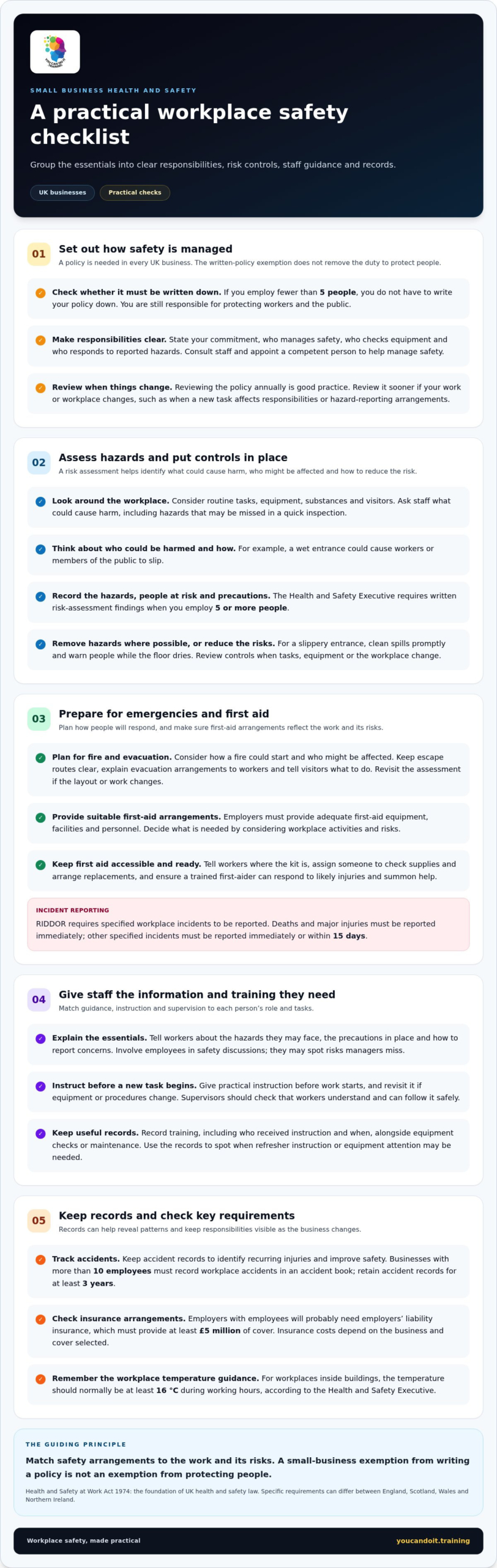
For small business owners in the UK, health and safety starts with a clear rule: every business needs a health and safety policy, but if you employ fewer than five people, you don’t have to write it down. That doesn’t remove your responsibility to protect people at work. Your approach should reflect the size of your business and the risks involved.
Health and safety can feel like another layer of paperwork when you’re already juggling customers, staff and day-to-day decisions. But keeping people safe doesn’t have to be complicated. This guide explains when a written policy is needed, how risk assessments help identify and manage hazards, and what information and training staff need. You’ll find practical steps for making safety part of running your business, rather than a separate mystery to solve.
Key Takeaways
- Work out whether your policy needs to be written down, then make responsibilities clear for your business.
- Assess hazards, who could be harmed and how you’ll reduce the risks; the Health and Safety Executive requires written findings when you employ 5 or more people.
- Give staff relevant safety information, training and supervision, and involve them in spotting workplace risks.
- Build practical safety knowledge with CITB Health and Safety Awareness (HSA) training when you or your team need a grounding in workplace health and safety.
Do small businesses need a health and safety policy?
Yes. Every UK business needs a health and safety policy, but businesses with fewer than five employees don’t have to write it down. For health and safety for small business owners UK-wide, the key is matching arrangements to the work and its risks.
Written policies and the small-business exemption
A safety policy explains how you’ll manage health and safety at work. If you employ fewer than five people, you’re exempt from putting it in writing, not from protecting workers and the public. A written policy can still help clarify your approach and keep responsibilities visible as your work changes.
Policy statements, responsibilities and arrangements
The policy statement sets out your commitment, while the arrangements explain who does what, when and how. Appoint a responsible person to manage safety, report concerns and consult staff. For example, specify who checks equipment and who responds to reported hazards. In a low-risk business, the owner or another employee may be able to manage these duties.
Writing and reviewing a policy
Build the policy around your workplace: identify key risks, assign responsibilities and explain how you’ll control them. Reviewing it annually is good practice, and you should review it sooner if your work or workplace changes. For example, a new task may require you to update who is responsible and how staff should report hazards.
Requirements across the UK
The Health and Safety at Work Act 1974 is the foundation of UK health and safety law, according to UK Government. The core duty to manage workplace safety applies across the UK; specific requirements can differ between England, Scotland, Wales and Northern Ireland. For workplaces inside buildings, the temperature should normally be at least 16 °C during working hours, according to the Health and Safety Executive.
Employers must appoint a competent person to help manage health and safety. In a low-risk business, this may be the owner or an employee. A practical approach to health and safety for small business owners across the UK matches arrangements to the work, rather than treating the written-policy exemption as an end to their duties.
Workplace risk assessments
Small business owners in the UK can use risk assessments to turn workplace concerns into practical controls. Assessments help identify hazards, consider who could be harmed and decide how to protect them.
Identifying hazards and assessing risks
Walk through your workplace and consider routine tasks, equipment, substances and visitors. Ask staff what could cause harm, including hazards that might not be obvious during a quick inspection. Then consider who could be affected and how serious the risk could be. For example, a wet entrance could cause workers or members of the public to slip.
Record the hazards, people at risk and precautions. The Health and Safety Executive says employers must record risk assessment findings in writing when they employ 5 or more people.
Risk assessment duties and controls
Use your assessment to remove hazards where possible, or reduce risks with suitable controls. For a slippery entrance, you could clean spills promptly and warn people while the floor dries. Review controls when tasks, equipment or the workplace change, and keep accident records to identify patterns.
Under the Deregulation Act 2015, health and safety law doesn’t apply to a self-employed person whose work poses no risk to other workers or the public. Employers with employees will probably need employers’ liability insurance, which must provide at least £5 million of cover. Insurance costs depend on the business and cover selected.
Fire assessments and evacuation
Consider how a fire could start, who might be affected and how people would leave safely. Keep escape routes clear, explain evacuation arrangements to workers and make sure visitors know what to do. Revisit the assessment if the layout or work changes.
Employers must provide adequate first-aid equipment, facilities and personnel under the Health and Safety (First-Aid) Regulations 1981. The Reporting of Injuries, Diseases and Dangerous Occurrences Regulations (RIDDOR) require specified workplace incidents to be reported. Deaths and major injuries must be reported immediately, while other specified incidents must be reported immediately or within 15 days. Relevant first aid training can help staff prepare to respond.
Health and safety information and staff training
Clear instructions help employees understand workplace risks and what to do if an accident happens. Match information, training and supervision to each worker’s role and tasks.
Worker information and health and safety training
Explain the hazards workers may face, the precautions in place and how to report concerns. Consult employees about safety, as they may spot risks managers miss. Give anyone starting a new task practical instruction before they begin, and revisit it if equipment or procedures change. Supervisors should check that workers understand the instruction and can follow it safely.
First-aid kits, training and first-aiders
Decide what first-aid equipment, facilities and trained personnel your workplace needs by considering its activities and risks. Keep the kit accessible, tell workers where it is, and assign someone to check supplies and arrange replacements. A trained first-aider should know how to respond to likely injuries and summon help. A workshop and a small office, for example, may need different arrangements.
Accident, training and equipment records
Keep accident records so you can identify recurring injuries and use the findings to improve safety. Businesses with more than 10 employees must record workplace accidents in an accident book; retain accident records for at least 3 years. Keep training records showing who received instruction and when, alongside equipment checks or maintenance records. These details help managers see whether someone needs refresher instruction or equipment needs attention.
You Can Do It Training: CITB Health and Safety Awareness (HSA)
You Can Do It Training Ltd delivers CITB Health and Safety Awareness (HSA) for people who need a grounding in health and safety at work. It can help build practical understanding alongside written instructions and workplace induction. For supervisors and managers, CITB SSSTS and CITB SMSTS provide role-specific training, while CITB SSSTS Refresher supports supervisors updating their training.
Choose training that matches each person’s responsibilities and the risks they face, then reinforce learning with clear workplace procedures and supervision. Training can support safer decisions, but it doesn’t replace your responsibility to assess risks and put suitable controls in place.
Contact You Can Do It Training Ltd to discuss suitable health and safety training for your team.
Make safer working part of your next step
A practical approach to health and safety for small business owners in the UK is built through everyday decisions, not paperwork alone. As your work changes, revisit how people carry out tasks, raise concerns and learn from near misses. These habits help your team keep improving workplace safety.
You Can Do It Training offers CITB Health and Safety Awareness (HSA), CITB Site Supervisor Safety Training Scheme (SSSTS) and CITB Site Management Safety Training Scheme (SMSTS). HSA provides a foundation, while SSSTS and SMSTS suit people with supervisory or management responsibilities. Match learning to each person’s role, then encourage them to apply it at work.
Every thoughtful step helps create a safer workplace. You can do it.
Frequently Asked Questions
Who Needs to Do Risk Assessments?
Employers need to assess risks created by their work, including risks to employees, contractors and visitors. Self-employed people also have duties if their work could affect others. Think beyond your regular team: a delivery driver entering a stockroom or a customer using a shared entrance may face hazards your staff know to avoid. Include them when considering who could be harmed.
Do I need to register my small business with HSE?
There isn’t a general HSE registration step simply because you run a small business. Depending on your work, the local council or HSE may oversee workplace safety, and some activities require you to send the responsible body a formal notice. A standard office doesn’t automatically have the same notification requirements as a regulated site. Find out which body oversees your workplace and whether your activities require notification.
Do different types of business pose different risks?
Yes. A salon may need to consider wet floors, chemicals and electrical equipment, while a building firm may face work-at-height and moving-material hazards. Even similar businesses can have different risks: a shop with a stockroom differs from a counter-only shop. Base your assessment on the tasks, equipment, premises and people involved, rather than relying on a generic template alone.
How do I control the risks in my workplace?
Start by removing the hazard if possible. If you can’t immediately eliminate a trailing cable, reroute it, secure it or restrict access until it’s fixed. Assign each control to someone, explain it to affected workers and check that it remains effective during normal work. If an injury, near miss or change in equipment reveals a weakness, revisit the assessment and adjust the controls.
When is employers’ liability insurance legally required, and what does it cost?
Employers with employees will probably need employers’ liability insurance, which must provide at least £5 million of cover. Costs depend on the business and the cover selected.









Leave a Reply
Want to join the discussion?Feel free to contribute!