

Riddor near misses: who reports and what counts
Could a near miss be reportable even when nobody is hurt? The answer to what a RIDDOR-reportable near miss is depends on whether the incident is a dangerous occurrence listed in Schedule 2: in Great Britain, a near miss with no injury is reportable under RIDDOR only in that case, according to The National Archives.
It’s understandable to be unsure. A close call can feel serious, but not every near miss meets the legal reporting test. Whether it must be reported depends on whether it fits a specified category, not simply on how alarming it seemed.
This article explains who must report under RIDDOR, which incidents may qualify and how to distinguish a reportable dangerous occurrence from a near miss that should be recorded internally. Practical examples help clarify when the rules apply and what to consider after an incident.
Key Takeaways
- Learn why a near miss is not automatically reportable, and the specific test that determines whether RIDDOR applies.
- Understand which dangerous occurrences can trigger a report even when nobody is injured.
- See how incidents such as a substantial scaffold collapse fit the reporting rules, including the height threshold.
- Find out how health and safety training from You Can Do It Training Ltd can help build confidence in workplace responsibilities.
Who has to report under RIDDOR?
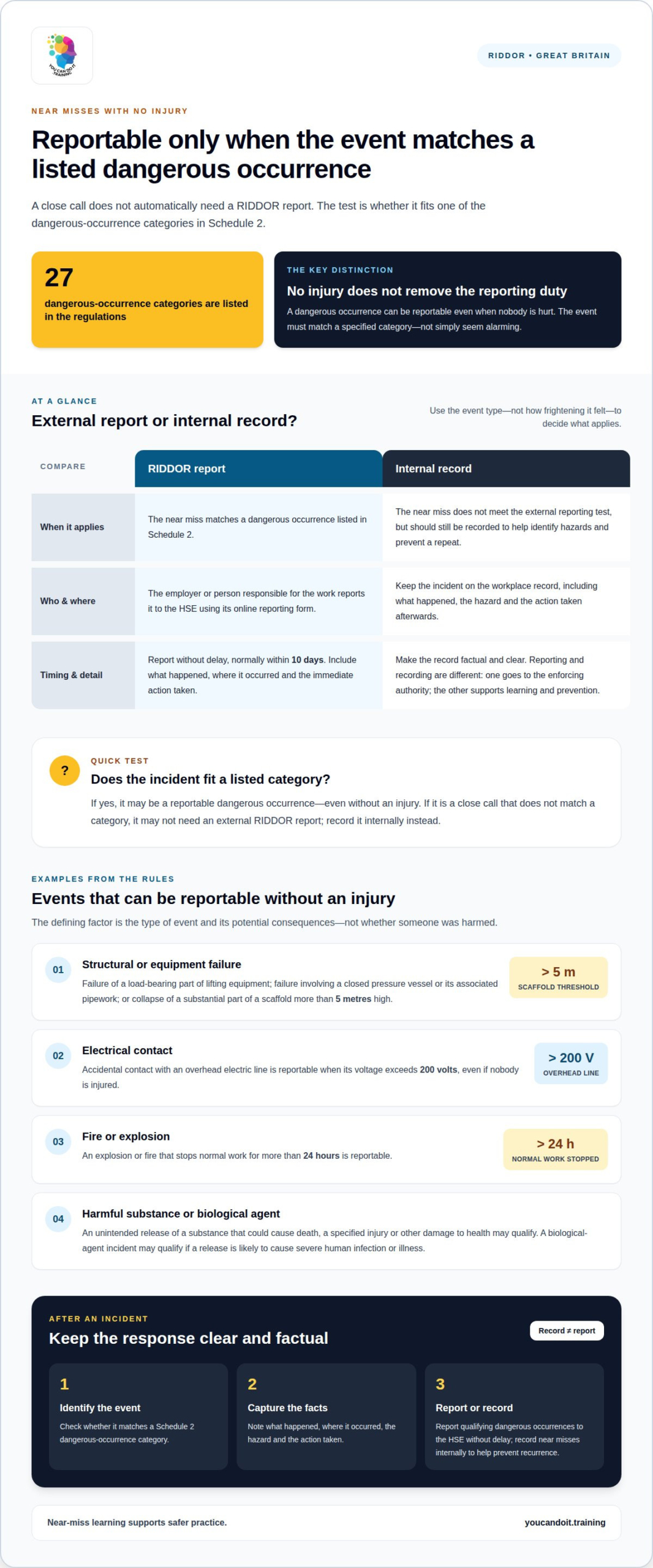
Under RIDDOR 2013, the employer or person responsible for the work must report qualifying incidents. A dangerous occurrence can be reportable even when nobody is injured, so no injury does not remove the reporting duty. The question “what is a RIDDOR reportable near miss?” is answered by checking whether the event matches a listed category.
RIDDOR defines dangerous occurrences as incidents with high potential to cause death or serious injury. Schedule 2 lists reportable events, including failure of a load-bearing part of lifting equipment or an unintended escape of a harmful substance. The regulations contain 27 categories, so the event must fit a specified type, not simply seem alarming.
The question “what is a RIDDOR reportable near miss?” comes down to the difference between a general near miss and a listed dangerous occurrence. A near miss is an incident where harm was avoided; a dangerous occurrence is a specific RIDDOR category. For example, equipment contacting an overhead power line can qualify even if nobody is injured.
Report dangerous occurrences to the HSE using its online reporting form. They must be reported without delay, normally within 10 days. Record what happened, where it occurred and the immediate action taken, so the report reflects the incident clearly.
RIDDOR also covers work-related deaths, specified injuries, some injuries to the public and diagnosed occupational diseases. A worker’s fracture is reportable unless it affects a finger, thumb or toe. An injury causing more than 7 days’ absence must be reported within 15 days. An injury causing more than 3 days’ absence must be recorded, even when it is not externally reportable.
Examples of reportable incidents
Some dangerous occurrences must be reported even when nobody is injured. The Health and Safety Executive says the scaffold-collapse rule applies when a substantial part of a scaffold more than 5 metres high collapses. A failure involving a closed pressure vessel or its associated pipework is another example. These incidents can require a report because of their potential consequences, not just the harm caused.
Fire and electrical events also have specific tests. According to the Health and Safety Executive, an explosion or fire that stops normal work for more than 24 hours is reportable under RIDDOR. Accidental contact with an overhead electric line is reportable when its voltage exceeds 200 volts, also according to the Health and Safety Executive. Record what failed, where it happened and whether work stopped.
Injuries have separate reporting criteria. A work-related injury to a member of the public must be reported without delay if they are taken from the scene to hospital for treatment. For an employed worker, an injury that prevents them from working or carrying out their normal duties for seven consecutive days is reportable. An accident causing a specified injury, such as a qualifying burn, must also be reported without delay. Some occupational diseases are reportable too, including dermatitis diagnosed by a medical practitioner and linked to work.
Reporting and recording are not the same. A report goes to the enforcing authority when RIDDOR’s criteria are met; an internal record helps identify hazards and prevent repeat incidents. Keep near misses on the workplace record even when they don’t qualify for external reporting. Managers seeking to strengthen site-safety knowledge can explore CITB Site Supervisor Safety Training Scheme.
What constitutes a RIDDOR-reportable near miss
To understand what is a RIDDOR-reportable near miss, start with the type of event, not how alarming it felt. In Great Britain, a near miss with no injury is reportable under RIDDOR only when it is a dangerous occurrence listed in Schedule 2, according to The National Archives. A close call alone does not meet that test.
Check whether the incident fits a specified category. An unintended release of a substance that could cause death, a specified injury or other damage to health may qualify. An incident involving a biological agent, a microorganism that can cause infection or illness, may also qualify if it results, or could have resulted, in a release likely to cause severe human infection or illness. Both the nature of the event and its potential harm matter.
So, what is a RIDDOR-reportable near miss in practice? It is an incident with no injury that fits one of the listed dangerous-occurrence descriptions. A frightening near miss that does not match a category may not need a RIDDOR report, but recording it internally can still help identify hazards and prevent a recurrence.
Keep the record factual: explain what happened, identify the hazard and note the action taken afterwards. Also distinguish a near miss from a work-related illness. Tendonitis, for example, may be an occupational disease if work caused or worsened it, and is assessed under separate reporting criteria.
You Can Do It Training
You Can Do It Training Ltd provides health and safety training to help you recognise workplace risks and understand your responsibilities. If you supervise a site or manage safety, the CITB Site Supervisor Safety Training Scheme (SSSTS) and CITB Site Management Safety Training Scheme (SMSTS) are relevant to those roles. CITB Health and Safety Awareness (HSA) can help build a foundation in workplace safety.
Training supports informed decisions, but it does not replace assessing an incident against RIDDOR’s reporting criteria. Use the rules in this guide to distinguish internal recording from a reportable event, then consider relevant training to strengthen your team’s safety knowledge.
For a friendly conversation about health and safety training, contact You Can Do It Training Ltd.
Turn near-miss learning into safer practice
Understanding what a RIDDOR-reportable near miss is can help your team respond clearly, but what happens after an incident matters too. Use near-miss reviews to encourage open reporting, spot recurring hazards and strengthen everyday safety conversations. This helps make prevention part of the work, rather than paperwork reserved for serious accidents. You Can Do It Training offers health and safety courses for workers, supervisors and managers who want to develop their knowledge and confidence. Make learning your next step, whether you’re refreshing existing skills or supporting people taking on greater responsibility.
Every useful conversation can help create a workplace where people feel able to speak up, learn and make safer choices.
Frequently Asked Questions
What does RIDDOR stand for?
RIDDOR stands for the Reporting of Injuries, Diseases and Dangerous Occurrences Regulations. In Great Britain, the current regulations are RIDDOR 2013, which came into force on 1 October 2013. The name describes the types of work-related events the rules cover. For a near miss, the key issue is whether the event falls within a listed dangerous-occurrence category.
When do I need to report an incident?
Report a work-related incident when it meets a RIDDOR reporting criterion, and act without delay for a fatality, specified injury or dangerous occurrence. A worker’s injury involving more than 7 days’ absence must be reported within 15 days. Count from the day after the incident, including rest days but not the incident day. The HSE provides online reporting forms.
What records do I need to keep?
Keep a record of each reportable incident and retain RIDDOR records for at least 3 years from the date of entry. A useful record should make the event understandable later: note when and where it happened, who was involved, what occurred and what action followed. For a near miss, record the hazard and steps taken to reduce the chance of recurrence.
Who is responsible for reporting injuries and when should you report them?
The employer or person responsible for the work should arrange the report when an incident meets RIDDOR criteria. A specified injury must be reported without delay, followed by a written report within 10 days. If a worker’s injury leads to more than 7 days away from work, submit the report within 15 days. Keep internal records even when an injury does not require external reporting.
What is RIDDOR and what does it require?
RIDDOR is the Great Britain regulation requiring certain work-related deaths, injuries, occupational diseases and dangerous occurrences to be reported to the relevant regulator or local authority. It also requires records to be kept for reportable events. For example, a doctor’s diagnosis can trigger reporting of an occupational disease, while a dangerous occurrence may need to be reported even when nobody is injured. The reporting route depends on the type of event.









Leave a Reply
Want to join the discussion?Feel free to contribute!