
Mental Health First Aid at Work: Comparing Training Options for UK Businesses in 2026
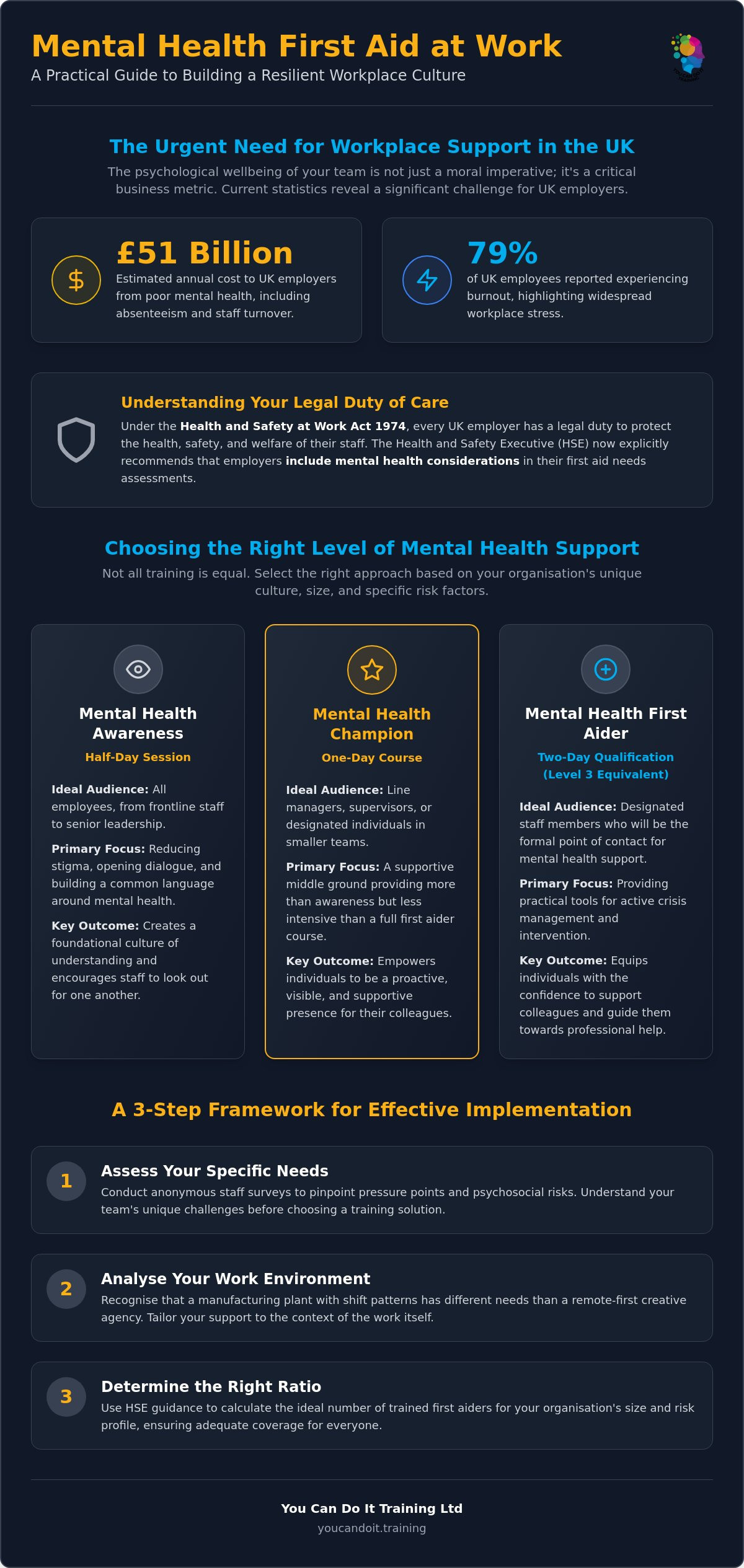
Did you know that poor mental health is estimated to cost UK employers a staggering £51 billion every year through absenteeism, presenteeism, and staff turnover? It’s a daunting figure, and we understand the very real worry that implementing mental health first aid at work might just become another “tick-box” exercise that fails to support your team when they truly need it. You want to do right by your people, but with 79% of UK employees reporting burnout in 2026, the pressure to choose the right support whilst navigating complex HSE recommendations can feel overwhelming. At You Can Do It Training Ltd, we believe in a “hearts and minds” approach that puts your learners at the centre of everything we do.
We’re here to help you move past the confusion and find a clear, practical path forward. You’ll discover how to select the right level of training that fits your specific workplace needs, ensuring your investment sparks real change rather than just filling a desk drawer. This guide compares training standards, clarifies the latest HSE wellbeing guidance, and provides actionable strategies to build a truly resilient culture where every member of your team feels empowered to soar.
Key Takeaways
- Understand your legal duty of care and see how the HSE recommends including mental health in your standard first aid needs assessments.
- Learn to distinguish between basic awareness and full Level 3 qualifications so you can implement the most effective mental health first aid at work for your staff.
- Discover a step-by-step framework for conducting staff surveys to pinpoint pressure points and determine the ideal number of first aiders for your organisation.
- Explore how the “Mental Health Champion” role can provide a supportive middle ground for smaller teams or specific departments.
- Identify the key features of a transformative learning environment that moves beyond tick-box exercises to foster genuine confidence and camaraderie.
Mental Health First Aid at Work: Legal Requirements and HSE Guidance
While the law doesn’t yet mandate a specific number of mental health first aiders like it does for physical safety, the landscape is changing. Under the Health and Safety at Work Act 1974, every UK employer holds a fundamental “Duty of Care” towards their staff. This means protecting the psychological wellbeing of every person on your team is a legal obligation. At You Can Do It Training Ltd, we see this as an opportunity to build a safety net that catches people before they fall. The HSE now explicitly recommends that businesses consider mental health as part of their standard first aid needs assessment, ensuring that mental health first aid at work becomes a core pillar of your safety strategy.
What is Mental Health First Aid? Simply put, it’s the initial support provided to someone experiencing a mental health issue until professional help is received. This proactive approach allows your team to spot the early warning signs of stress or anxiety amongst their colleagues. It fosters a culture of camaraderie where people look out for one another, ensuring that no one has to struggle in silence.
The 2026 Landscape: Why Mental Health Awareness is No Longer Optional
Proactive training doesn’t just save money; it saves lives. When your team is trained to intervene early, you’re far less likely to face serious workplace incidents that require RIDDOR reporting. RIDDOR stands for the Reporting of Injuries, Diseases and Dangerous Occurrences Regulations, which are the legal rules for reporting certain workplace accidents to the authorities. Preventing stress-related incidents moves your business from reactive crisis management to a visionary environment where everyone can soar.
HSE Wellbeing Standards and Your Risk Assessment
To truly align with HSE Management Standards, you should include “psychosocial risks” in your standard workplace risk assessments. Psychosocial risks are the aspects of job design, work patterns, and social environments that can cause psychological or physical harm. A simple actionable tip is to review your workload and support structures during your next safety audit. This small step helps ignite a spark of change, turning a mandatory chore into a transformative opportunity for your entire organisation.
Comparing Mental Health Training Options: Which Level Does Your Team Need?
Choosing the right level of mental health first aid at work depends entirely on your unique workplace culture and the specific pressures your staff face. A manufacturing plant with heavy machinery and shift patterns faces different psychological risks than a remote-first creative agency. Before booking a course, it is vital to map out your team’s environment. Are people working in isolation, or are they dealing with high-intensity deadlines? Understanding these nuances ensures you aren’t just providing training, but “igniting a spark” of genuine support tailored to your people.
Mental Health Awareness vs. Mental Health First Aider
Mental Health Awareness is typically a half-day session designed to reach the widest possible audience. It focuses on reducing stigma and starting honest conversations across the entire organisation. In contrast, the Mental Health First Aider qualification is a comprehensive two-day course, often referred to as a Level 3 equivalent. This deeper dive empowers designated individuals to lead your “hearts and minds” strategy. For smaller departments that need a supportive presence without the full intensity of a two-day curriculum, a Mental Health Champion role provides an excellent middle ground.
The primary difference lies in the level of intervention. Awareness training helps staff spot early signs of distress, whilst the full first aider course provides the practical tools for active crisis management. To ensure you have the right number of trained staff, we recommend reviewing the HSE guidance on first aid, which helps you calculate the necessary ratio of first aiders to employees based on your specific risk profile.
Accreditation and Quality Standards
Accreditation is your guarantee that the training meets the rigorous standards expected by bodies like IOSH (the Institution of Occupational Safety and Health). These recognised certificates ensure that the skills your team learns are valid and respected across the UK. At You Can Do It Training Ltd, we believe the learning environment is just as important as the curriculum. We foster a relaxed, professional atmosphere where sensitive topics are handled with mutual respect and a personalised approach. If you are ready to move beyond a “tick-box” exercise, you can explore our accredited training options to find the perfect fit for your organisation.
Implementing Mental Health First Aid: A Practical Comparison Framework
Moving from the “why” to the “how” requires a steady, logical approach that puts your people at the heart of the process. To begin, we recommend conducting a simple staff survey to identify your specific pressure points, whether that’s heavy workloads, feelings of isolation, or physical safety concerns. Once you understand the landscape, you can decide on the number of trained staff needed. The HSE suggests a similar ratio to physical first aiders, ensuring that support is always within reach, regardless of where or when your team is working. This ensures mental health first aid at work becomes a living, breathing part of your daily operations rather than a forgotten certificate on a wall.
Selecting the right people for the role is perhaps the most vital step in your implementation strategy. You’re looking for volunteers who naturally demonstrate empathy and possess the “hearts and minds” capacity to handle sensitive conversations with grace. Once your team is in place, create a clear internal policy. This document should outline who staff can turn to and, crucially, define the boundaries of the role. A mental health first aider isn’t a therapist; they’re a knowledgeable peer who provides a safe space and signposts colleagues toward professional help.
Integrating Mental Health with Physical First Aid
In a modern workplace, safety must be holistic. Whilst a First Aid at Work course provides the essential foundation for physical emergencies, mental health support is the essential second pillar of a resilient culture. By cross-training staff, you empower them to handle both physical injuries and emotional distress with equal confidence. This unified approach fosters a deep sense of camaraderie, as employees know their total wellbeing is valued by the business.
Actionable Tips for Supporting Your First Aiders
Supporting those who support others is vital for preventing burnout. Try implementing these practical steps immediately:
- First Aider for the First Aiders: Designate a senior lead or external partner to provide confidential debriefs for your volunteers after difficult interventions.
- Regular Catch-ups: Schedule quarterly meetings to share experiences, discuss challenges, and keep the team’s skills sharp.
- Refresher Sessions: Confidence can fade over time, so ensure refresher training is booked well in advance of certificate expiry.
If you’re ready to empower your team with these life-changing skills, you can view our full range of training dates and start your journey toward a more supportive workplace today.
Choosing the Right Training Partner: The You Can Do It Training Ltd Difference
Selecting a training provider is about more than just finding a date in a diary; it is about finding a partner that understands the weight of the responsibility you are placing on your staff. At You Can Do It Training Ltd, we believe that the learning environment is a physical and psychological space that directly impacts how well skills are retained. Our “Hearts and Minds” approach ensures we engage every learner emotionally, which is why we maintain a 99% pass rate across all our accredited courses. We take a genuine interest in your specific industry background, ensuring that mental health first aid at work is delivered with a personalised touch that respects the individual as much as the curriculum.
We pride ourselves on being a “Knowledgeable Mentor” who acts as both an expert and a peer to our students. Backed by three decades of experience, we have developed a national footprint whilst remaining fiercely down-to-earth and approachable. We don’t believe in cold, clinical instruction. Instead, we focus on fostering achievement through human connection and mutual respect, ensuring every learner feels they have the support needed to soar.
Why the Learning Environment Matters for Mental Health
Discussing psychological wellbeing can feel daunting, which is why we go to great lengths to ensure our classrooms are welcoming and hospitable. Our specific mention of “tea, coffee, and bourbon creams” isn’t just about the catering; it is a signal of a British training culture that values the comfort of the individual. This relaxed atmosphere helps dismantle intimidation and allows for the open, honest discussions that are essential for “igniting the spark” of genuine empathy and understanding.
Accredited Excellence with a Personal Touch
Our credibility is built on being a strategic training partner for major industry schemes. For example, we are experts in delivering the Site Supervisor Safety Training Scheme (SSSTS), which is a vital qualification for those overseeing safety on construction sites. This technical background ensures that our mental health training is grounded in the same high standards as our physical safety courses. We are a chartered member of IOSH, meaning our delivery is always “leagues ahead” in terms of quality and compliance.
If you are ready to invest in a training experience where the learner is at the heart of everything, you can book your Mental Health First Aid course with the experts who care and start building a more resilient future today.
Building a Resilient Workplace for 2026 and Beyond
We’ve journeyed through the legal landscape and the practical frameworks needed to move beyond mere compliance. By selecting the right level of support and integrating it with your existing safety protocols, you’re doing more than just meeting HSE expectations. You’re fostering a culture where every person feels seen and supported. Implementing mental health first aid at work is a definitive step toward a more sustainable, high-performing organisation where staff turnover is replaced by genuine loyalty and collective strength.
At You Can Do It Training Ltd, we pride ourselves on being more than just a provider; we’re your partner in this vital cultural shift. Our “Knowledgeable Mentor” approach and 99% pass rate ensure your team gains the confidence they need in a relaxed, person-first environment. We believe that when you engage both hearts and minds, the impact lasts long after the course finishes, turning technical knowledge into life-saving action.
Empower your team with Mental Health First Aid training from You Can Do It Training Ltd
You have the vision to create a safer, more supportive workplace; we have the passion to help you achieve it. Let’s work together to ensure your team has the resilience they need to truly soar.
Frequently Asked Questions
Is mental health first aid a legal requirement in the UK in 2026?
No, there’s no strict statutory requirement to appoint a mental health first aider as of July 2026. However, under the Health and Safety at Work Act 1974, every employer has a legal duty of care that extends to mental wellbeing. The HSE recommends including mental health first aid at work in your first aid needs assessment to help manage the risk of work-related stress effectively.
How many mental health first aiders should a business have?
The HSE suggests maintaining a similar ratio of mental health first aiders to physical first aiders based on your specific workplace risk assessment. Industry bodies like the CIPD typically recommend training at least one person for every 50 employees. This ensures that support is readily available across different shifts or departments, fostering a resilient culture where no one has to struggle in silence.
What is the difference between a mental health first aider and a counsellor?
A mental health first aider is a knowledgeable peer who acts as a first point of contact, whereas a counsellor is a professional therapist who provides clinical treatment. The first aider’s role is to offer initial support and signpost colleagues to professional services. They don’t provide therapy; they provide a safe space until expert help is received, much like a physical first aider.
How long does a mental health first aid certificate stay valid?
A full mental health first aid qualification typically stays valid for three years from the date of completion. After this period, we strongly recommend attending a refresher course to ensure your skills remain sharp and your confidence stays high. Regular updates are essential for staying current with the latest wellbeing guidance and maintaining a supportive, person-first culture within your team.
Can mental health first aid training be done online or in person?
You can choose to complete your training either online or in person, depending on what best suits your team’s schedule and learning style. While online options offer flexibility, our in-person courses provide a relaxed atmosphere that fosters genuine camaraderie and open discussion. This approach ensures that mental health first aid at work becomes a transformative skill rather than just a mandatory chore.






Leave a Reply
Want to join the discussion?Feel free to contribute!