
How to Manage Contractor Safety on Site and Collect Documents
What if the paperwork is complete, but nobody checks how the work is actually being done? A practical starting pack for managing contractor safety on site includes the contractor’s task-specific risk assessment and method statement, evidence of workers’ relevant training and experience, any required permits, and a record of the site rules, hazards, emergency arrangements and responsibilities explained before work begins.
Collecting documents matters, but it is only part of the job. In the UK, managing contractors also means sharing relevant safety information, co-operating and communicating, and overseeing the work as it progresses.
This guide explains how to choose competent contractors, gather the right compliance documents and monitor work under UK health and safety duties. You’ll also learn how to review the job, respond to unsafe practices and capture lessons for next time, so paperwork supports safer work rather than becoming the whole process.
Key Takeaways
- Before work starts, gather task-specific risk assessments and method statements, and agree any permits, site rules and safety responsibilities.
- Choose contractors based on relevant competence, training and experience, not paperwork alone.
- While work is under way, supervise it and keep track of changes to the work, people or arrangements.
- Discuss unsafe acts and incidents with the contractor, then record lessons to improve future planning.
Monitoring and reviewing contractor activities
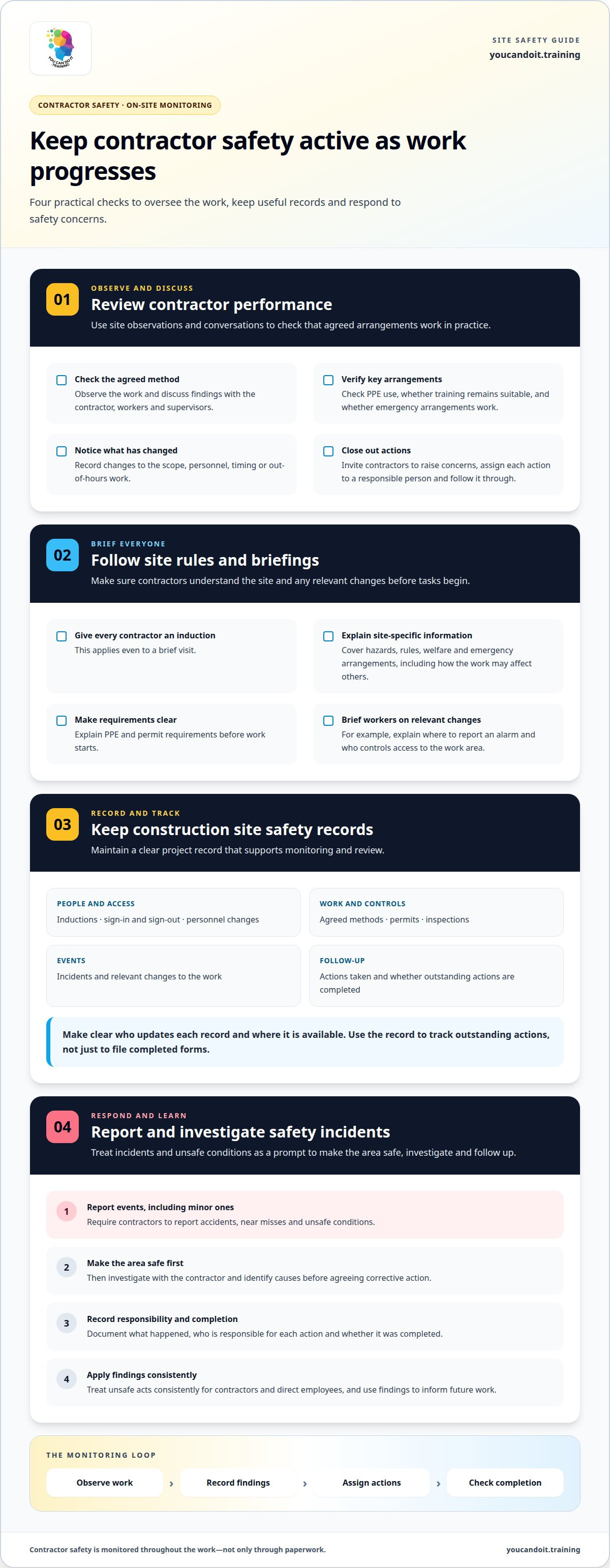
Set clear site controls, then check the work as it progresses. Use four practical steps to monitor performance, capture records and act on safety concerns.
-
Review contractor performance
Schedule site observations and discuss findings with the contractor, workers and supervisors. Check that agreed methods are followed, personal protective equipment (PPE) is used, training remains suitable and emergency arrangements work. Record changes to scope, personnel, timing or out-of-hours work. Invite contractors to raise concerns during inspections; open conversations can reveal issues a paperwork review misses. Assign each action to a responsible person and follow it through.
-
Follow site safety rules and briefings
Give every contractor an induction, even for a brief visit. Explain site-specific hazards, rules, welfare and emergency arrangements, including how their work may affect others. Make PPE and permit requirements clear, and brief workers on relevant changes before tasks begin. For example, explain where to report an alarm and who controls access to the work area.
-
Keep construction site safety records
Maintain a clear project record to support monitoring and review. Log inductions, sign-in and sign-out, agreed methods, permits, inspections, incidents, personnel changes and actions taken. Make sure the principal contractor and other responsible people know who updates each record and where it is available. Use the record to track outstanding actions, not just file completed forms.
-
Report and investigate safety incidents
Require contractors to report accidents, near misses and unsafe conditions, including minor events. First make the area safe, then investigate with the contractor and identify causes before agreeing corrective action. Record what happened, who is responsible for each action and whether it was completed. Treat unsafe acts consistently, whether they involve contractors or direct employees, and use findings to inform future work.
Selecting competent contractors
A sound approach to managing contractor safety on site starts with assessing competence against the work’s hazards and demands. Review task-specific risk assessments and methods, safety and technical capability, and workers’ relevant training and experience.
-
Assess competence and safety evidence
Ask for evidence that matches the task, then assess whether the proposed methods control its risks. A pre-qualification questionnaire can help filter applicants, but shouldn’t decide approval on its own. Review the actual risk assessments, workers’ experience and safety arrangements. For specialised heavy machinery and plant operation, consulting accredited vocational resources such as alikatraining.co.za can help managers understand the certified training standards required for safe equipment handling. ISO 45001 is an international standard for occupational health and safety management systems. Certification shows that a contractor’s system has been assessed against the standard, but doesn’t by itself establish cultural fit, supervision quality or how work will be delivered.
-
Check and approve contractors
When managing contractor safety on site, compare the evidence with the job’s scope, workplace conditions and interfaces with other work. Confirm that the contractor has suitable technical knowledge and that employees doing the work have adequate training and experience. For specialised trades such as wastewater and tank management, examining how professional services like lilstinkyseptic.com outline operational scopes and safety standards can help teams evaluate relevant trade risks. Ask how the contractor will manage safety throughout the project. Approve the work only when the planned methods address identified risks and responsibilities are clearly understood.
- Assign competent employees to manage approval and oversee the work. They need confidence to review risk assessments, manage permits, and challenge or stop unsafe work. Match their knowledge to the task: a complex or changing job needs someone able to assess revised methods, not simply file documents. Plan this oversight before the contractor arrives.
Where supervisors need to strengthen their site safety knowledge, CITB site supervisor safety training can support their role in managing contractor work.
Health and safety duties under UK legislation
Apply relevant UK duties to the work, then make responsibilities clear. When managing contractor safety on site, use the legal framework to guide practical decisions, not just paperwork. The Health and Safety Executive’s guidance on using contractors also provides a practical framework for applying these duties throughout a job.
- Use the Health and Safety at Work etc. Act 1974 as a starting point: UK legislation identifies it as relevant when managing contractors. Map the work, hazards and people who could be affected, then make sure the organisation’s safety processes cover contractor activities as well as employees’ work. Handing a task to a contractor doesn’t remove the need to manage its risks.
- The Management of Health and Safety at Work Regulations 1999 are also identified as relevant to contractor management by UK legislation. Before work begins, assess risks and agree how the organisation and contractor will cooperate, share safety information and manage changes. If the scope changes, review whether the existing controls remain suitable. These steps help make managing contractor safety on site part of everyday work.
- For construction work, the Construction (Design and Management) Regulations cited are the 2015 regulations, according to UK legislation. Under the Construction (Design and Management) Regulations (CDM) 2015, a construction project involving more than one contractor requires an appointed principal contractor, according to UK legislation. Clarify who coordinates the work and how responsibilities connect across contractors, rather than assuming each team works in isolation.
- There is no single figure for fines or penalties covering every failure to manage contractor safety in the UK; consequences depend on the specific breach and its circumstances. Focus on prevention: identify hazards, clarify responsibilities, review controls after an accident or change, and record actions that support improvement. Treat safety processes as ongoing management, not a one-off approval task.
You Can Do It Training: Institution of Occupational Safety and Health (IOSH) Managing Safely
You Can Do It Training offers the IOSH Managing Safely course as a practical next step for managers responsible for workplace health and safety. Consider this training to build your knowledge and confidence in managing risks alongside the contractor processes covered in this guide.
For construction teams, the right training depends on each person’s role. The CITB Site Supervisor Safety Training Scheme (SSSTS) and Site Management Safety Training Scheme (SMSTS) are courses for supervisors and managers. The CITB Health and Safety Awareness (HSA) course can suit people who need a grounding in site safety.
Training can clarify responsibilities, support informed conversations about hazards and encourage consistent action across a team. It complements, rather than replaces, suitable risk controls, supervision and site-specific procedures.
Contact You Can Do It Training to discuss the course that best fits your role.
Build safety into the next job
Managing contractor safety on site works best as an everyday habit, not a file assembled for an audit. Make time to review how work is coordinated, invite people to raise concerns when conditions change, and use what you learn to improve the next job. A steady routine turns responsibilities into practical decisions that teams can follow as work develops.
Choose a next step: bring supervisors together to discuss where contractor coordination feels unclear. Agree who will act and how progress will be followed. Keep the conversation open as the job changes; people closest to the work may spot issues that need attention.
Small, thoughtful improvements can help build a stronger safety culture over time. Keep moving forward, one clear action at a time.
Frequently Asked Questions
What compliance documents should I collect before a contractor starts work?
Collect documents that show how the specific job will be carried out safely, rather than relying on a generic pack. This usually means the task risk assessment and method statement, evidence of relevant training and experience, and any permits needed for the work. Keep the current versions together, with the contractor’s named supervisor and agreed emergency arrangements easy to find.
What should happen if a contractor is not working safely?
Stop the unsafe activity and make the area safe before discussing next steps. Involve the contractor in investigating what happened, including whether instructions, equipment or coordination contributed. Agree corrective actions, name who will complete them and record the outcome. If the work remains unsafe, do not allow it to continue until suitable controls are in place.
Why are contractors at risk?
Contractors may encounter unfamiliar hazards, particularly if they do not know the site layout, rules or nearby activities. Risk can increase if the job changes, different teams work in the same area, or timing creates pressure. For example, maintenance beside ongoing operations needs clear coordination so one team’s work does not expose another to danger.
What are a principal contractor’s legal duties for health and safety on a UK construction site?
Under CDM 2015, a construction project involving more than one contractor requires an appointed principal contractor, according to UK legislation. The role includes coordinating health and safety arrangements during the construction phase and working with contractors to manage site risks. Responsibilities should be clearly allocated, communicated and reviewed as the work and teams change.
How do you coordinate contractors’ risk assessments and method statements (RAMS)?
Review each contractor’s RAMS against the actual work area and other teams’ activities. Resolve clashes before work begins by agreeing a safe sequence, shared controls and who owns each safety-critical task. Brief affected workers on the arrangements, then revisit the RAMS if the scope, personnel or site conditions change.










Leave a Reply
Want to join the discussion?Feel free to contribute!