

The Practical Guide to RAMS Risk Assessment
Last Updated: 2 November 2026
Quick Summary
A rams risk assessment is the first half of a RAMS document: it identifies the hazards of a task, decides who could be harmed and how, and sets out control measures. The second half, the method statement, records the safe sequence of work. Together they prove you planned the job properly.
- Score risk on a five-by-five matrix, multiplying likelihood (1 to 5) by severity (1 to 5) for a rating from 1 to 25.
- Scores of 16 to 25 are unacceptable: stop and redesign the task or the method.
- The residual score after controls is the figure that matters, not the initial score.
- Review the RAMS when the method, people, site conditions or legal requirements change.
- Number each issue Rev A, Rev B and withdraw superseded copies from site and shared drives.
Table of Contents
- What RAMS Means in Risk Assessment Terms
- How to Write a Method Statement That Site Teams Can Follow
- Scoring Risk: Likelihood, Severity and Residual Risk
- Construction Risk Assessment Examples Beyond the Usual Sites
- Using a RAMS Template Without Copying Someone Else’s Hazards
- Reviewing and Updating RAMS When the Job Changes
- Briefing the Team and Booking the Right Training
- Frequently Asked Questions
What RAMS Means in Risk Assessment Terms
A risk assessment is the structured process of identifying hazards, deciding who might be harmed and how, and putting control measures in place.
A common failure is a risk assessment completed as a formality and a method statement copied from a previous project. The document exists, but nobody on site could tell you what it says.
For anyone wanting the practical grounding behind these documents, our Risk Assessment & Method Statement (RAMS) training covers hazard identification, safe systems of work and compliance from the ground up.
How to Write a Method Statement That Site Teams Can Follow
A method statement works when a competent person who has never seen the job could read it and carry out the task safely. That is the test.
Write it in this order:
- Describe the task and its boundaries. State what the work covers and, just as importantly, what it does not.
- List the sequence of work, step by step, in the order it will actually happen on site.
- Name the people and their competence. Who does what, and what training or certification they must hold.
- Specify plant, equipment and materials, including inspection requirements before use.
- Set out the control measures for each significant hazard, matching the risk assessment.
- Cover emergencies. First aid arrangements, escape routes, and who calls whom.
Keep sentences short and use plain language. A common mistake is writing for the client’s file rather than the person holding the spanner.
Watch out: method statements that describe the ideal job rather than the real one get ignored, and an ignored document is worse than none because it suggests control you do not have.
Scoring Risk: Likelihood, Severity and Residual Risk
Risk scoring combines two judgements: how likely harm is, and how severe it would be. Multiply or plot the two on a risk matrix, and you get a risk rating that tells you whether the activity can proceed, needs further controls, or must stop.
Most practitioners use a simple five-by-five matrix. Likelihood runs from 1 (rare) to 5 (almost certain); severity runs from 1 (minor first-aid injury) to 5 (fatality or permanent disabling injury). Multiply the two scores to get a rating from 1 to 25, then band it:
| Score | Band | Typical action required |
|---|---|---|
| 1-4 | Low | Manage by routine procedures, monitor |
| 5-9 | Medium | Additional controls required, set a review date |
| 10-15 | High | Senior sign-off, work should not start until controls are verified |
| 16-25 | Unacceptable | Stop. Redesign the task or the method |
A worked example
Take a task: replacing a roof-light on a single-storey industrial unit. Before controls, a competent assessor might score:
- Falling through the roof-light opening: likelihood 4 (the opening is unguarded and the task requires working near it), severity 5 (fall from height can be fatal). Score 20, unacceptable.
- Manual handling of the replacement unit: likelihood 3, severity 2. Score 6, medium.
- Dropping tools onto people below: likelihood 3, severity 3. Score 9, medium.
Now apply controls. For the fall hazard, install a proprietary roof-light guard and a perimeter edge-protection system, and brief the operative on the permit-to-work. Re-score: likelihood drops to 1 (the opening is now physically guarded and the task is supervised), severity stays 5. Residual score 5, medium, tolerable with monitoring.
The residual score is the figure that matters, because nobody works in a risk-free environment. The question is whether what is left is tolerable.
Common scoring failures
A common mistake is scoring down to justify starting work. Score honestly, then let the controls do the work.
A third failure is treating the matrix as the answer rather than a prompt. The matrix prioritises; it does not replace judgement. If a hazard scores medium but the consequence would be life-changing, treat it as high regardless of the arithmetic.
For a fuller walkthrough of the scoring process, see this guide on how to carry out a risk assessment in the workplace.
Construction Risk Assessment Examples Beyond the Usual Sites
Standard site examples cover excavation, working at height and lifting operations well. The gaps appear in the less obvious tasks, and those are where assessments get thin.
Consider these:
- Refurbishment in an occupied building. The hazards change daily as partitions come down and services are isolated. The RAMS needs review triggers built in, not a single issue date.
- Confined space entry for drainage inspection. Atmosphere testing, rescue arrangements and communication protocols all need naming, not assuming.
- Night works near a live carriageway. Lighting, traffic management and fatigue management belong in the method statement, not just the risk assessment.
- Demolition adjacent to a retained facade. Temporary works design, sequencing and exclusion zones need explicit sign-off points.
The regulatory duties sitting behind construction assessments, particularly under CDM 2015, are worth understanding properly.
Using a RAMS Template Without Copying Someone Else’s Hazards
A RAMS template is a structure, not a solution. Use it for the headings, the layout and the prompts. Never use it for the hazards.
The reason is simple: hazards belong to a specific task, in a specific place, with specific people. A template written for a groundworks package tells you nothing useful about a roof-level plant installation. Precision remains the primary safeguard against such negligence, a principle that holds equally true when navigating the complexities of medical device risk assessments.
Use a template this way instead:
- Keep the section headings and the sign-off structure
- Delete every pre-filled hazard before you start
- Walk the actual work area and write hazards from what you see
- Cross-check each control measure against the equipment you actually have
- Have the people who will do the job read it back to you
Reviewing and Updating RAMS When the Job Changes
A rams risk assessment is a live document, and treating it as a one-off issue is one of the most common compliance failures we encounter. Review it when the work changes, when the people change, when the site conditions change, and at a set interval regardless.
Specific triggers to build in:
- A change in method, sequence or programme
- New plant or equipment arriving on site
- A change in ground conditions, weather exposure or adjacent activity
- An incident, near miss or unsafe condition report
- New personnel or a change in supervision
- A change in the legal or client requirements applying to the task
Version control and document control
Record each review with a date, the reason, and who signed it off. Version control matters here: if two versions are circulating on site, you have no control at all. A simple convention works: number each issue (Rev A, Rev B, Rev C), record the reason for the revision in a revision table at the front, and withdraw superseded copies from the site office and from any shared drive.
When RAMS are created or shared digitally, the same discipline applies but the risks shift. Address these explicitly:
- Single source of truth. Keep one master copy in a controlled location and give site teams read-only access rather than letting them download and edit their own versions.
- Approval workflow. Route the document through the competent person, the supervisor and, where required, the client or principal contractor before it is issued. Record who approved it and when.
- Audit trail. Use version history so you can show what changed, who changed it and why. A PDF emailed around loses that trail; a controlled document system keeps it.
- Access control. Restrict editing rights to named competent persons and log when documents are viewed or acknowledged.
- Withdrawal on change. When a revision is issued, mark the previous version as superseded and confirm it has been removed from site folders and shared drives.
Keeping the document current
Set a review interval proportionate to the risk: a short-duration task may need review only on change, while a long-running project should be reviewed at agreed intervals (for example, at each phase handover) even if nothing appears to have changed.
When an incident or near miss occurs, review the RAMS before work restarts, not after. Record what changed as a result, so the learning is captured and the next revision reflects it.
Briefing the Team and Booking the Right Training
A signed briefing record proves nothing on its own. What matters is that the people doing the work can explain the hazards and the controls in their own words.
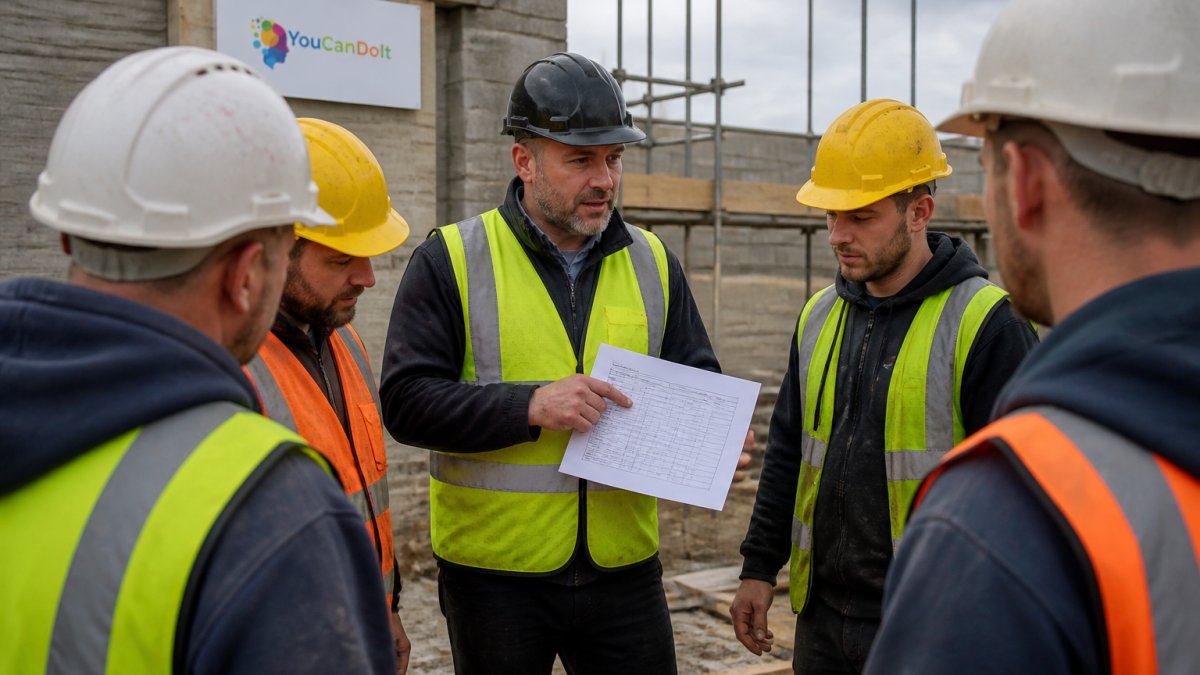
Brief the team before work starts, not on the morning it begins.
Competence sits alongside briefing. Supervisors leading this process need the right training behind them.
At You Can Do It Training, we deliver health and safety training across construction and plant operations. Our instructors cover the practical side of risk assessment, method statements and supervisor duties.
Frequently Asked Questions
What do RAMS stand for in construction?
RAMS stands for Risk Assessment and Method Statement. The risk assessment identifies the hazards in a task, who could be harmed and how, and the control measures that reduce the risk. The method statement sets out the safe sequence of work, the equipment and competence needed, and the emergency arrangements. Together they form one document that a site team can read, understand and sign to confirm they are working to it.
Who is responsible for preparing and reviewing RAMS?
The employer or contractor carrying out the work is responsible for preparing the rams risk assessment, usually through a competent person such as a supervisor or site manager. Reviewing it is a shared duty: the author checks it before issue, the principal contractor checks it before work starts, and supervisors review it whenever conditions, personnel or the work method change. Workers should also feed back problems so the document stays accurate.
Are RAMS legally required for every construction task?
Health and safety law requires employers to assess risks to workers and others affected by their work, and to plan safe systems of work. For straightforward, low-risk tasks a short risk assessment may be enough. For higher-risk work such as work at height, demolition or tasks near live services, a written method statement alongside the risk assessment is expected. Always check the principal contractor’s site rules, as they often require RAMS for every task.
When should RAMS be reviewed or updated?
Review RAMS before the task starts, after any change to the work method, equipment, site conditions or personnel, and after any near miss or incident. A fixed annual review is not enough on its own. Set review triggers in the document itself, such as a change in weather, a new subcontractor joining or a delay that alters the sequence of work, so the team knows exactly when to stop and reassess.
What should a RAMS document include?
A complete rams risk assessment includes the task description, the location and dates, the people at risk, a hazard list with likelihood and severity ratings, control measures, residual risk ratings, the safe work method step by step, plant and equipment needed, competence and training requirements, PPE, emergency procedures, and a briefing record with signatures. Add review dates and the name of the person who prepared and approved it.
How do you complete a construction risk assessment?
Start by breaking the task into steps, then identify the hazards at each step and who could be harmed. Rate each hazard for likelihood and severity, choose control measures that follow the hierarchy of control, and re-rate the residual risk. Record the findings, brief the team, and keep the document available on site. Construction risk assessment examples for tasks similar to yours can guide the hazard list, but always adapt them to your actual site conditions.
The gap between a compliant RAMS and a useful one is usually competence, not paperwork. If your supervisors are signing documents they could not confidently explain, that is the risk worth addressing first.
Get started with You Can Do It Training and build a team that writes, briefs and reviews RAMS with real confidence, backed by hands-on instruction, industry-recognised certification and scheduling built around your programme.


Leave a Reply
Want to join the discussion?Feel free to contribute!