
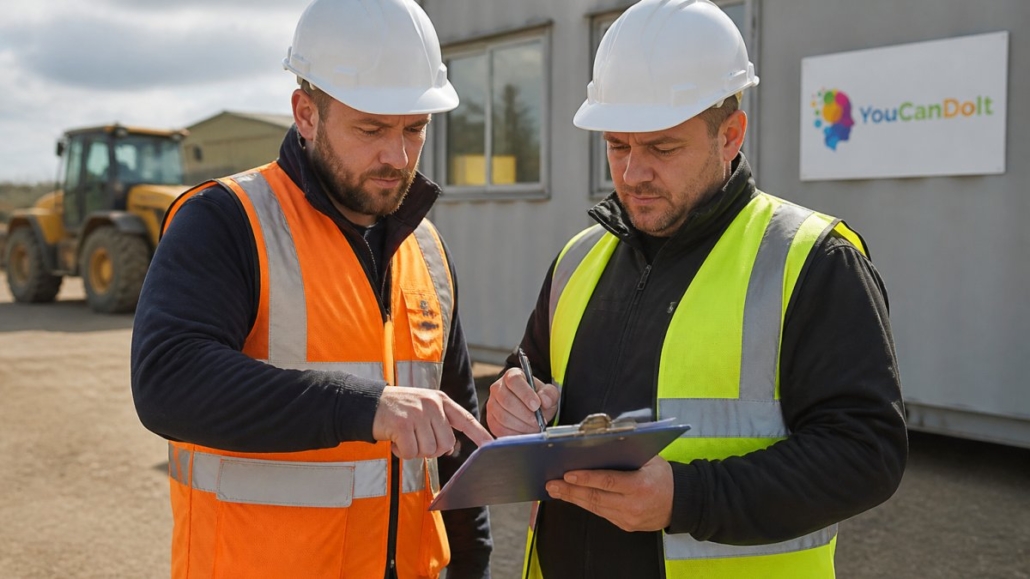
How to Encourage Safety Reporting on Site
Last Updated: 1 November 2026
Quick Summary
To encourage safety reporting on site, make reporting channels simple and accessible, respond to every report quickly, and build a no-blame culture where workers trust that speaking up leads to action. Offer anonymous routes, treat near misses as wins, and recognise people publicly for reporting hazards.
- Test whether a worker in gloves can report a hazard in under two minutes without help.
- Route every channel into one log so nothing is lost between paper and digital.
- Keep near misses separate from accidents in your paperwork so people keep reporting them.
- Acknowledge reports within the same shift where possible and tell the reporter what happens next.
- Track time to acknowledge, time to close and repeat hazards rather than report volume alone.
Table of Contents
- Why Safety Reporting on Site Falls Short
- Step 1: Make Hazard Reporting at Work Simple and Accessible
- Step 2: Get Near Miss Reporting Right
- Step 3: Offer Anonymous Safety Reporting
- Step 4: Use a Workplace Incident Report Template
- Step 5: Respond to Every Report, Every Time
- Step 6: Build a No-Blame Safety Culture That Lasts
- Book Safety Reporting Training for Your Site Team
- Frequently Asked Questions
Why Safety Reporting on Site Falls Short
Most sites don’t have a reporting problem. They have a trust problem wearing a reporting problem’s clothes.
Workers see the hazard. They know it’s there. They walk past it anyway, because the last person who spoke up got a sigh, a shrug, or a nickname. Safety reporting is the practice of capturing hazards, near misses and incidents before they turn into injuries, and it only works when the people closest to the risk believe something will happen next. This guide walks through six practical steps to build that belief, from simple channels to a no-blame culture that lasts.
The gap is rarely paperwork. It’s follow-through. Below, we’ll show you exactly how to close it.
Step 1: Make Hazard Reporting at Work Simple and Accessible
A reporting system nobody can reach is a filing cabinet with extra steps. Make hazard reporting at work as easy as sending a text, and participation climbs. The practical test is whether a worker in gloves, in the rain, with no signal and limited English can report a hazard in under two minutes without asking for help.
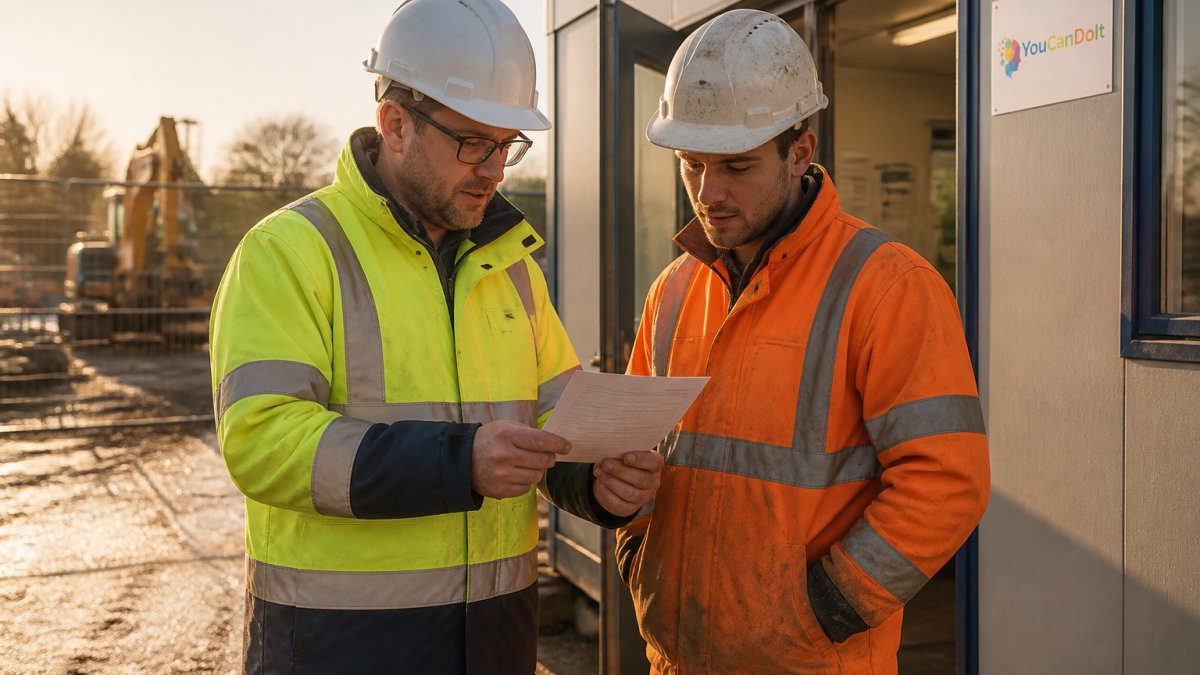
Reporting Channels That Work on a Live Site
Site conditions decide the channel. Mud, gloves and noise rule out anything fiddly. Compare the main options before you commit:
- Paper cards in a weatherproof box at the site office and each welfare unit. Reliable with no connectivity, but only works if cards and pens are stocked and the box is emptied daily.
- A QR code on the cabin wall linking to a short online form. Fast for smartphone users, but useless where signal is poor or workers do not carry phones on site.
- A dedicated phone number for verbal reports, answered by a named person. Good for accessibility and language barriers, but needs a rota so it is always answered.
- A two-minute slot at the daily briefing for anything spotted overnight. Keeps reporting visible, but should feed into the same log as other channels.
- A tablet at the site office with a simple form. Useful where phones are banned, but needs charging and a named keeper.
Whichever mix you choose, route every channel into one log so nothing is lost between paper and digital.
Removing the Barriers That Stop People Speaking Up
The barriers are usually practical, not attitudinal. Fix these before you blame the workforce:
- No pens, no cards, no signal: stock and check your kit weekly
- Forms that demand a name, a trade and a witness statement: cut them to three fields
- Reports that vanish into an inbox: tell people who reads them and when
- Fear of blame: see Step 6, because this one needs culture, not a form
Accessibility and language deserve specific thought. Offer a verbal route for workers who struggle with written forms, keep a translated version of the card or form where you have a multilingual workforce, and make sure the QR form works on a small screen with large tap targets. For workers with limited connectivity, paper and phone routes are not fallbacks; they are the primary channel.
If resistance is the sticking point, our guide on how to get team buy-in for safety training covers the practical side of winning people over.
Step 2: Get Near Miss Reporting Right
Near miss reporting is the highest-value habit on any site. A near miss is an event that could have caused harm but didn’t, and it’s free intelligence: the accident that didn’t happen yet.
Treat near misses as wins, not warnings. Thank the reporter publicly. Log the event, the location and what nearly happened. Then close the loop fast, because a near miss fixed today is an injury that never arrives.
Watch out: if near misses get lumped in with accidents in your paperwork, people stop reporting them. Keep the categories separate so the data stays useful and the tone stays positive.
Step 3: Offer Anonymous Safety Reporting
Anonymous safety reporting removes the biggest single barrier: the fear of being identified. Offer it as an option, never a requirement.
- Use a sealed box or an online form with no login
- Never ask for a name, trade or gang on the anonymous route
- Publish the outcome so people see anonymity still gets action
- Keep the reporter’s identity out of any investigation notes
Anonymity is a bridge, not a destination. As trust builds, most workers will happily put their name to a report. Until then, the anonymous route keeps the information flowing.
Step 4: Use a Workplace Incident Report Template
A workplace incident report template turns a vague complaint into something you can act on and measure. Keep it to one side of A4.
| Field | What to Capture | Why It Matters |
|---|---|---|
| Date, time, location | When and exactly where | Spots patterns and repeat areas |
| What happened | Plain description, no blame | Keeps the facts clean |
| Who was involved | Names only where needed | Supports investigation and care |
| Risk level | Low, medium or high | Sets the response priority |
| Immediate action | What was done on the spot | Shows visible action |
| Reporter | Name or “anonymous” | Enables follow-up |
The template is the easy part. The discipline is filling it in every time, including for the small stuff.
Step 5: Respond to Every Report, Every Time
The fastest way to kill safety reporting is to ignore a report. Respond to every single one, even the ones that turn out to be nothing.
- Acknowledge within the same shift where possible
- Tell the reporter what happens next and who owns it
- Update them when it’s fixed, or explain why it can’t be
- Log the closure so patterns become visible
If you need to make the business case for chasing every report, our guide on calculating the cost of workplace accidents shows what incidents really cost when they’re left to escalate.
Step 6: Build a No-Blame Safety Culture That Lasts
A no-blame culture is the difference between a reporting system that works and one that exists only on paper. It is built from small, repeated signals, not a launch event. The aim is psychological safety: the shared belief that you can raise a concern without being punished or humiliated for it. Consistent leadership commitment remains the primary driver for improving safety culture, a long-term endeavour that requires moving beyond simple policy to foster genuine trust.
Protecting Reporters and Handling Confidentiality
Trust is fragile. A single sigh, shrug or nickname can undo months of encouragement. Protect reporters by:
- Keeping names out of investigation notes unless the reporter agrees
- Limiting who sees a report to those who need it to act
- Never discussing a report in a way that identifies the reporter
- Having a clear route to raise a concern about retaliation itself
Anonymous reporting is a bridge, not a destination. As trust builds, most workers will happily put their name to a report. Until then, the anonymous route keeps the information flowing.
Recognising Good Reporting
Thank people for reporting, in public. Recognise the act of reporting, not just safe behaviour, and do it consistently rather than only when a report prevents a serious incident. A simple mention at the briefing, a note in the site diary or a word from the supervisor carries more weight than a poster.
Measuring Whether It Is Working
Report volume alone is a poor measure. Track quality and follow-through instead:
- Time to acknowledge a report
- Time to close a report
- Corrective-action completion rate
- Repeat hazards in the same location
- Proportion of reports that lead to a visible change
Review these monthly and share the trend with the workforce. If reports are rising but closures are slow, the culture is working and the response is not.
Keeping It Going
- Investigate systems, not individuals
- Share lessons learned at every briefing
- Review policy after every significant report
- Train supervisors to respond without judgement, because their first reaction sets the tone
For the wider compliance picture behind these habits, see our construction health and safety compliance guide. And if you’re rolling this out across several sites, our page on raising safety standards across multiple sites covers how to keep the standard consistent. The Hearts and Minds approach to construction safety problems goes deeper on culture change if you want the full method.
Book Safety Reporting Training for Your Site Team
The hardest part isn’t designing the system. It’s getting a busy site team to use it when the pressure is on and the programme is tight.
We can help with that. At You Can Do It Training, we deliver practical health and safety training, including SMSTS, SSSTS, CSCS and asbestos awareness courses. Our expert instructors deliver practical, industry-recognised training.
Get started with You Can Do It Training and turn reporting into a routine your team trusts.
Frequently Asked Questions
How can managers encourage workers to report near misses?
Make near miss reporting as easy as possible, then show people it leads somewhere. Keep the form short, offer a quick verbal route to a supervisor as well as a written one, and always tell the reporter what happened next. When workers see a near miss fixed within days, reporting stops feeling pointless. Recognition matters too: a quiet thank-you in the next safety meeting does more than a poster campaign. Supervisors should treat every report as useful information, not as an accusation or a sign of carelessness.
What should happen after a worker reports a safety concern?
Acknowledge the report the same day where possible, then triage it by risk so the most serious hazards get fixed first. Investigate enough to understand the cause, agree a corrective action with an owner and a date, and close the loop with the person who reported it. Record what was done and share the lesson in the next safety meeting or toolbox talk. If the concern cannot be fixed immediately, explain why and what interim controls are in place. Silence after a report is the fastest way to stop people reporting.
How can you make hazard reporting at work easier for site workers?
Cut the friction. Use a short form with a handful of fields, place paper cards where people actually work, and offer a QR code or phone number for quick submissions. Accept verbal reports to a supervisor and log them yourself, so nobody is turned away because they cannot face a form. Keep the language plain and avoid jargon. Make sure workers on different sites and shifts know the route, including subcontractors and anyone whose first language is not English.
Does anonymous safety reporting actually work?
It works well as one channel among several, particularly where people fear blame or retaliation. Anonymous routes remove the worry about being identified, which raises reporting in the short term. The trade-off is that you cannot ask follow-up questions, so make the form ask for enough detail to act on. Pair anonymity with a visible no-blame response so people eventually feel able to report openly. Never try to work out who submitted an anonymous report, as that destroys trust in the whole system.
A reporting system only works when your supervisors know how to receive a report and act on it. If yours need that grounding, we can help. Our courses are recognised by UKATA, PASMA, NPORS and CSCS, and they’re built to fit around live construction programmes. Get started with You Can Do It Training and give your team the confidence to speak up and the skills to respond.


Leave a Reply
Want to join the discussion?Feel free to contribute!