7 Alternatives to Traditional Classroom CDM Training
Last Updated: 8 November 2026
Quick Summary
Alternatives to classroom CDM training include self-paced e-learning, in-house delivery and blended programmes that combine online modules with a short live session. These formats cut travel and time away from site while still covering the CDM Regulations 2015 syllabus. Match the format to the role, not the cheapest ticket.
- Self-paced e-learning removes travel entirely and suits scattered teams needing CDM awareness.
- A one-day classroom course can consume two days of a supervisor’s time once travel is added.
- In-house delivery removes travel for delegates and suits teams of ten or more on one site.
- Blended learning moves knowledge content online so live time focuses on applying duties.
- Ask providers for guided learning hours rather than attendance hours when comparing courses.
Table of Contents
- Why Classroom CDM Training Is Not Your Only Option
- Online CDM Awareness Training: Self-Paced Learning That Fits Around Site Hours
- In-House CDM Training: Bringing the Course to Your Site
- CDM Training Duration: How Long Each Format Really Takes
- Blended Learning: Combining E-Learning With Live Instruction
- CDM Training Provider Comparison: How to Judge Course Quality
- Which Format Suits Your Role and Training Need?
- Book the CDM Training Format That Keeps Your Programme Moving
- Frequently Asked Questions
Why Classroom CDM Training Is Not Your Only Option
Classroom CDM training has long been the default route to a Construction (Design and Management) Regulations 2015 certificate, but it is not the only one. Pulling a supervisor off site for a full day can cost more than the course fee once travel, lost billable hours and programme delays are counted. The Construction (Design and Management) Regulations 2015 set out legal duties for clients, designers, principal designers, principal contractors, contractors and workers, and the HSE guidance on CDM 2015 confirms that duty holders must be competent for their role.
Online CDM Awareness Training: Self-Paced Learning That Fits Around Site Hours
Online CDM awareness training is a self-paced e-learning course covering the same core syllabus as a classroom session, completed on a laptop, tablet or phone. Learners work through modules on the CDM Regulations 2015, duty holder roles, risk management and construction health and safety, then sit an online exam. The format suits contractors, designers and workers who need CDM awareness rather than a supervisor-level qualification, and it removes travel entirely.
What a Self-Paced CDM Awareness Course Covers
A typical self-paced course covers the regulations themselves, the roles of client, principal designer, principal contractor and contractor, notification duties, construction phase plans, and the principles of risk assessment. Course objectives and learning outcomes should be published before you buy. Check that the content references the 2015 Regulations specifically, not the superseded 2007 version.
Where Online Learning Falls Short
Self-paced e-learning cannot replicate a trainer reading the room. Delegates who rush the modules retain less, and there is no one to challenge a weak risk assessment in real time. If your team needs to apply CDM duties to live projects, pair the e-learning with a live session. Our guide to assessing safety training effectiveness through workplace behaviour explains how to check whether learning actually changed site practice.
In-House CDM Training: Bringing the Course to Your Site
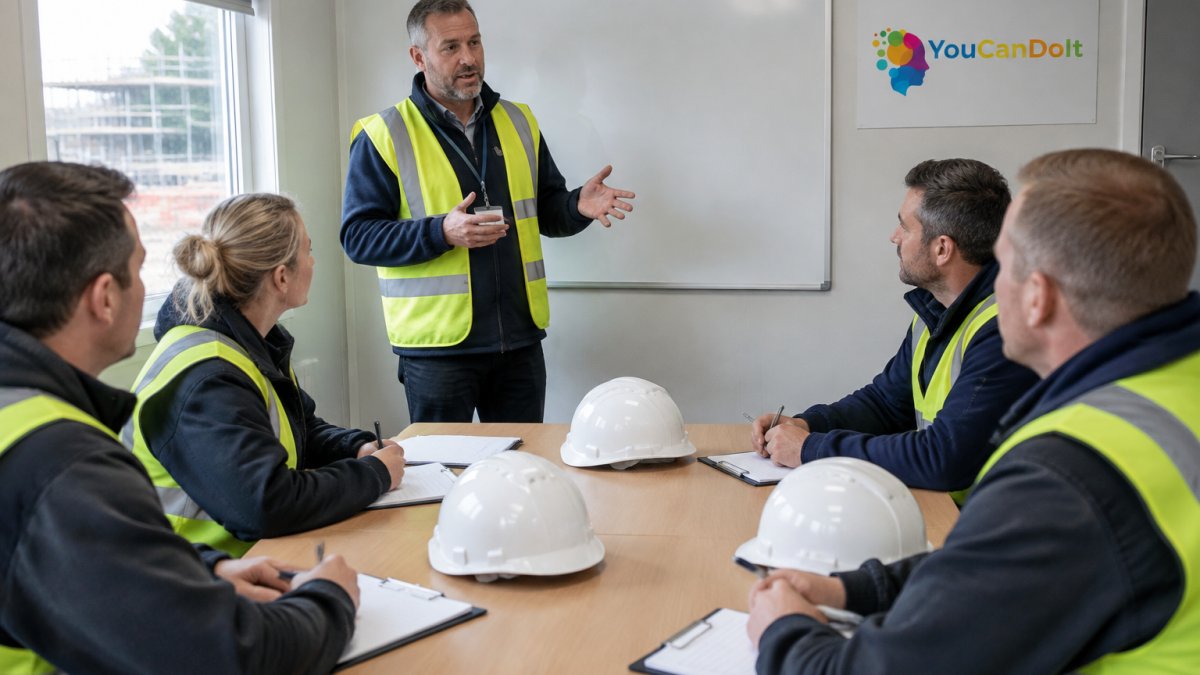
In-house CDM training is a course delivered by a trainer at your own premises or site cabin, for a group from one organisation. It removes travel for delegates and can be tailored to your projects.
Group Size, Venue and Equipment Requirements
Some providers set a minimum group size for in-house sessions, so a small team may need to join a shared course instead. You will need a room large enough for the group, a projector or screen, and a whiteboard. Confirm the minimum number and any travel charge before booking, because pricing depends on quantity, dates and delivery location.
CDM Training Duration: How Long Each Format Really Takes
CDM training duration ranges from a short awareness module to a multi-day supervisor course, and the format changes the total time commitment more than the syllabus does. A self-paced awareness course typically takes a few hours of study, spread over days or weeks. A classroom awareness session usually runs half a day to a full day. Supervisor-level CDM courses run longer. The hidden cost is travel: a one-day classroom course can consume two days of a supervisor’s time once journey and cover are added.
| Format | Typical study time | Time lost to travel | Best for |
|---|---|---|---|
| Self-paced e-learning | A few hours, flexible | None | Awareness for scattered teams |
| Classroom | Half to one day | Up to a full day | Focused, structured learning |
| In-house | Half to one day | None for delegates | Teams of ten or more |
| Blended | E-learning plus a short live session | Minimal | Applying duties to real projects |
Matching Duration to Role and Responsibility
The length of course you need depends on what you are expected to do under the CDM Regulations 2015, not on how much time you can spare.
A practical way to judge whether a course is long enough is to check its learning outcomes against your duties.
Watch out: a course advertised as a full day may include registration, breaks and an exam, leaving less teaching time than the timetable suggests. Ask for the guided learning hours rather than the attendance hours.
Flexibility and Time Away from the Job
Flexibility is not only about when learning happens but about how much of the working day it removes. Choosing between live instruction and self-paced study therefore depends on how much scheduled time a team can spare, a distinction captured by The Brilliant Suite.
For teams working to a programme, the total time commitment matters more than the course length. A one-day classroom course plus a day of travel is two days lost. The same content delivered as a short virtual session plus self-paced modules may remove only a few hours from the programme.
Blended Learning: Combining E-Learning With Live Instruction
Blended learning combines self-paced modules with a live session, either in a virtual classroom or on site. Delegates complete the knowledge content online, then use the live time for scenario work, risk assessment exercises and questions. This design addresses the main weakness of pure e-learning, which is the gap between knowing the regulations and applying them. It also cuts the time a trainer spends on basic content, so the live session focuses on your projects. For teams that need both flexibility and practical application, blended is usually the strongest option.
CDM Training Provider Comparison: How to Judge Course Quality
CDM training provider comparison comes down to three things: accreditation, trainer competence and regulatory accuracy. A cheap course that teaches the wrong version of the regulations wastes money and leaves duty holders exposed. Ask each provider the same questions before you book.
A Like-for-Like Comparison of Alternatives
Most course listings promote a single format rather than comparing formats against the same criteria. To judge alternatives fairly, score each option against the same measures: syllabus coverage of the CDM Regulations 2015, guided learning hours, assessment method, trainer construction experience, certificate recognition, learner support, and total time away from the job. A format that scores well on price but poorly on trainer experience may cost more in the long run if delegates cannot apply what they learned.
| Criterion | What to ask | Why it matters |
|---|---|---|
| Regulatory accuracy | Does the syllabus cite the CDM Regulations 2015 and current HSE guidance? | Outdated content leaves duty holders exposed |
| Trainer competence | What construction experience does the trainer have? | Real site scenarios benefit from real site knowledge |
| Assessment | Is there an exam, and what does it test? | Confirms understanding rather than attendance |
| Learner support | Is there a tutor to contact during self-paced study? | Reduces drop-off and unanswered questions |
| Certificate recognition | Is the certificate accepted by your clients or principal contractor? | Avoids repeat training |
| Time away from the job | How many hours will delegates lose? | Travel and cover often outweigh the course fee |
Accreditation, Trainer Competence and Regulatory Accuracy
Check whether the course is CPD-accredited or approved by a recognised body, and ask what construction experience the trainer has. A trainer who has never managed a construction phase will struggle with real site scenarios. Confirm the syllabus cites the CDM Regulations 2015 and the current HSE guidance. Our guide to accredited health and safety training sets out the quality markers to look for, and our buying guide to health and safety training providers covers the wider market.
Total Cost, Not Just the Course Fee
The course fee is only part of the total cost. Add travel, accommodation where an overnight stay is needed, cover for absent staff, and lost billable hours. An in-house course with no travel can work out cheaper per delegate than a budget classroom seat once those costs are counted. Ask for a quote based on your group size and dates rather than comparing headline prices.
Watch out: a low headline fee may exclude the exam, certificate or venue costs. Ask for the total price per delegate including assessment and certification before you compare.
Accessibility and Learner Support
Digital alternatives are not equally accessible to every learner. Check whether self-paced courses work on the devices your team actually uses, whether they need reliable connectivity, and whether captions or adjustable text are available. Some learners struggle with self-directed study and need a tutor to check progress. Ask what support is included and whether delegates can ask questions during the course. A format that excludes part of your team is not a cheaper alternative; it is a gap in competence.
Which Format Suits Your Role and Training Need?
Match the format to the role, not to the cheapest ticket. Use this decision framework:
- Worker or contractor needing CDM awareness: self-paced online course.
- Designer or principal designer: blended learning, so duties can be applied to real designs.
- Site supervisor or foreman: classroom or in-house course with scenario work.
- Team of ten or more on one site: in-house delivery.
- Team scattered across several sites: self-paced e-learning plus a virtual classroom session.
- Facilities team of fewer than ten: shared open course, unless the provider runs small-group sessions.
Before committing, check the legal requirements for workplace safety training so the format you choose meets your duties as an employer.
Book the CDM Training Format That Keeps Your Programme Moving
Choosing between alternatives to traditional classroom CDM training is really a scheduling decision. The right format keeps supervisors compliant without stalling the programme. You can book a course and confirm availability directly.
The gap between a certificate and a competent duty holder is usually the format, not the learner. Pick the route that fits your roles and your programme, and the compliance follows. Get started with You Can Do It Training and keep your team certified without losing site days.
Frequently Asked Questions
What are the alternatives to classroom CDM training?
The main alternatives are self-paced online CDM awareness courses, live virtual classrooms, in-house training delivered at your own site, and blended programmes that mix e-learning with instructor-led sessions. Each format covers the same core content on the CDM Regulations 2015, duty holders and risk management, but they differ in scheduling, interaction and how much practical site context the trainer can bring. The right choice depends on your role, the number of learners and how disruptive time off site would be.
Can you complete CDM awareness training online?
Yes. Online CDM awareness training is widely available as a self-paced e-learning course that you complete on a laptop or tablet, usually finishing with an online assessment and an instant certificate on passing. It suits people who need a working knowledge of the CDM Regulations 2015, such as smaller clients, designers or supervisors, without leaving site. Check that the course states its learning outcomes clearly and that the provider can confirm how the certificate is issued.
How long does CDM awareness training take?
CDM training duration varies by format and depth. A self-paced online awareness course is typically completed in a few hours, while a live virtual or classroom session usually runs for half a day to a full day. In-house CDM training follows a similar pattern but can be tailored to your projects, which may extend the session. Ask the provider for the guided learning hours and whether the assessment is included before you book.
How do I choose a CDM training provider?
Start with the course objectives and learning outcomes, then check the trainer’s competence and how current the content is against the CDM Regulations 2015. A CDM training provider comparison should weigh accreditation, delivery format, assessment method and how the certificate is issued, not just headline price. Ask for references from similar firms and confirm whether in-house CDM training can be delivered at your site to avoid pulling the team off the programme.


Leave a Reply
Want to join the discussion?Feel free to contribute!