

HSA Course Requirements: Your 2026 Guide to the CITB Health and Safety Awareness Certification
What if the most stressful part of starting your construction career wasn’t the safety rules themselves, but simply wondering if you’ve ticked the right boxes to get through the door? We know that the road to your CSCS Green Card can sometimes feel like a maze of technical jargon and rigid regulations. It’s perfectly natural to feel a little anxious about formal exams or worry that you might arrive with the wrong identification. You’re looking for a clear path forward, not a list of obstacles that make you feel like you’re back in a cold, clinical classroom.
In this guide, we’ll demystify the 2026 hsa course requirements, providing you with a clear checklist of the right documents, the right prerequisites, and the right mindset needed to succeed. We’ll explain how the CITB standards align with UK Health and Safety Executive guidelines, whilst showing you how our “Hearts and Minds” approach ensures you feel supported every step of the way. You’ll discover exactly what you need to bring and how this training transforms from a mandatory chore into an empowering opportunity to ignite your career, build your confidence, and secure your future on-site.
Key Takeaways
- Understand that no prior construction experience is required, as this one-day course is designed to be an accessible starting point for everyone.
- Meet all the hsa course requirements by ensuring you have the correct photo identification, like a passport or UK driving licence, ready for the day.
- Approach the 25-question exam with confidence, knowing that a “near miss” resit option provides a safety net for your success.
- Learn the specific steps to turn your HSA certificate into a CSCS Green Card, allowing you to start work on-site legally and safely.
- Benefit from a training environment that prioritises your comfort and understanding, helping you achieve the outstanding results you need to soar.
The CITB Health and Safety Awareness (HSA) Course: Eligibility and Purpose
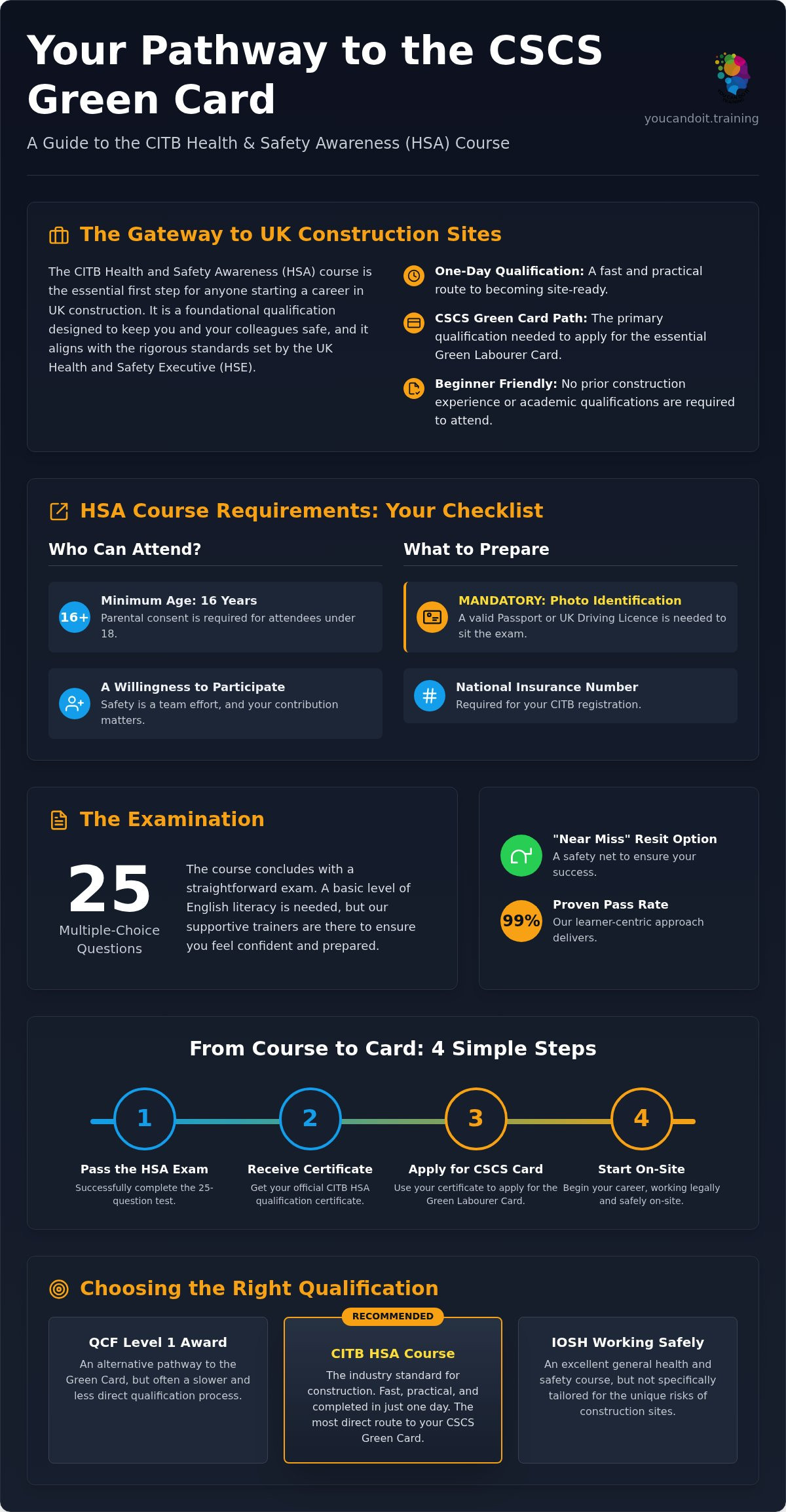
The CITB Health and Safety Awareness (HSA) course acts as the essential gateway for anyone stepping onto a UK construction site. This one-day qualification isn’t just a box-ticking exercise; it’s a foundational pillar of site safety. One of the most welcoming aspects of the hsa course requirements is the lack of formal barriers. You don’t need years of on-site experience or previous academic qualifications to get started. It’s designed to be accessible to everyone, from school leavers to those changing careers later in life.
Our “Hearts and Minds” approach ensures this isn’t just another dry lecture. We focus on real-world impact, helping you understand why these rules exist rather than just memorising them for a test. This qualification is the recognised path toward the Green Labourer Card issued by the Construction Skills Certification Scheme. By following this curriculum, you’re aligning your skills with the rigorous expectations of the UK Health and Safety Executive (HSE), ensuring you can protect yourself and your colleagues from day one.
Is the HSA Course Right for You?
This course is ideal for new starters who need to understand the basics of site safety, such as manual handling and working at height. It’s also perfect for experienced workers who need to refresh their knowledge to stay compliant with modern standards. For many, this is just the beginning of a journey. It serves as a vital stepping stone for those who eventually want to soar into leadership roles, such as site supervision, which requires the SSSTS certification.
HSA vs. Other Health and Safety Qualifications
You might compare this to the QCF Level 1 Award. Whilst both can lead to a Green Card, the HSA is often the faster and more practical choice because it’s completed in a single day. It also differs significantly from the IOSH Working Safely course. Whilst IOSH is a brilliant general safety qualification, the CITB HSA is built specifically for the unique, high-risk environment of construction sites, making it the industry’s preferred choice for site-based workers.
Core HSA Course Requirements: What You Need Before You Start
Preparing for your training day shouldn’t feel like an interrogation. When you understand the hsa course requirements early, you can focus on the “Hearts and Minds” of safety instead of worrying about paperwork. You must be at least 16 years old to attend. If you’re under 18, we’ll simply need a signed parental consent form before the session starts.
Beyond the age limit, we look for a “human requirement”: a willingness to participate. Safety is a team effort, and your voice matters in our group discussions. If you’re joining us for a remote session, ensure you have a stable internet connection, a quiet space, and a device with a camera and microphone. This technology allows us to maintain the camaraderie that makes our training special, even whilst we’re apart.
Identification and Documentation Checklist
Valid, in-date photo ID is a mandatory part of the hsa course requirements under the CITB Site Safety Plus scheme rules. Usually, a Passport or UK Driving Licence is the best choice. If you don’t have these, contact us early to discuss alternatives as you cannot sit the exam without verification. You’ll also need your National Insurance number and any previous CITB registration details, which helps us organise your records accurately. If you’re ready to take the first step, you can view our upcoming course dates to find a session that fits your schedule.
Language and Literacy Support
The course is delivered in English and requires a basic level of literacy to complete the final exam, which aligns with HSE expectations for clear communication on-site. We understand that many learners feel nervous about formal reading or writing tasks. Our trainers are there to support you and ensure you feel comfortable throughout the day. We pride ourselves on a 99% pass rate, which comes from putting the learner at the heart of everything we do.
The Examination and Beyond: Requirements for Success
The final piece of the hsa course requirements involves a 25-question multiple-choice assessment at the end of your training day. We don’t believe in “gotcha” questions or creating a high-pressure environment that makes you freeze up. Instead, this exam is a straightforward way to confirm you’ve understood the core safety modules covered during our sessions. With our 99% pass rate, you can feel confident that you’re in safe hands. If you happen to have a “near miss” on your score, we often provide the opportunity for a same-day resit to ensure you leave with the result you deserve.
Passing the course is a massive achievement, but it’s important to remember that the HSA certificate is just one half of the puzzle. To secure your physical card, you must also pass the CITB Health, Safety and Environment (HS&E) operatives touchscreen test at a local Pearson VUE centre. Think of the HSA course as the “why” and the touchscreen test as the “how” of site safety. Together, they prove to employers that you’re ready to contribute to a safe working culture on any UK site.
Action Plan: From Classroom to Construction Site
To move from the classroom to the site as quickly as possible, follow these three clear steps:
- Step 1: Attend your HSA course with us and pass the end-of-day assessment to receive your certificate.
- Step 2: Book and pass your CITB HS&E Operatives Touchscreen Test at an approved centre.
- Step 3: Apply for your Green CSCS Card through the official CSCS online portal using both your HSA certificate and your touchscreen test pass.
Maintaining Your Certification
Your HSA certificate remains valid for five years. However, the industry moves fast, and HSE guidelines are regularly updated to protect workers. You’ll need to retake the course before your certificate expires to keep your card eligibility active. As you grow in confidence, you might find your ambitions soaring toward leadership. The HSA is the perfect springboard for moving into an SMSTS qualification later in your career. Many of our learners also choose to add value to their team by completing a First Aid at Work course, ensuring they are prepared for any situation on-site.
Take the First Step Toward Your Future on Site
Mastering the hsa course requirements is the very first step in dismantling the intimidation often felt when starting a career in construction. We have explored how accessible this qualification is, from the simple eligibility criteria to the straightforward multiple-choice assessment that confirms your knowledge. This journey is about more than just a CSCS Green Card; it’s about building the confidence to work safely and effectively alongside your new colleagues whilst aligning with the latest HSE standards.
Our expert trainers bring decades of real-world site experience to every session, ensuring you feel supported and inspired throughout the day. With our CITB Site Safety Plus accreditation and a 99% pass rate, we provide a learning environment where your success is the priority. We focus on the “Hearts and Minds” of safety, turning a mandatory requirement into a transformative opportunity for your professional growth.
Your new career is ready to soar, and we’re here to ensure you have everything you need to succeed. You can do it.
Frequently Asked Questions
Do I need any prior experience to meet the HSA course requirements?
You don’t need any prior construction experience or specific qualifications to meet the hsa course requirements. This one-day course is designed as a foundational entry point for anyone new to the industry. Whether you’re a school leaver or transitioning from a different career, our trainers will guide you through the basics of site safety in a supportive environment. Actionable tip: Download the CITB revision app a few days before to familiarise yourself with common site terminology.
What happens if I do not have a valid passport or driving licence for ID?
If you lack a valid passport or driving licence, you must contact us before your course date to discuss alternative forms of identification. CITB rules are strict regarding photo ID for exam verification. We can often accept a combination of other documents, such as a citizen card, but these must be verified early to ensure you aren’t turned away. Actionable tip: Check your ID expiry date today to avoid any last-minute stress on your training day.
Can I take the HSA course online, and are the requirements different?
You can certainly take the HSA course online through a remote classroom setting. While the curriculum remains the same, the technical hsa course requirements include a stable internet connection and a device with a working camera and microphone. This allows the trainer to verify your identity and ensure you’re participating fully throughout the day. Actionable tip: Restart your router and test your microphone ten minutes before the session starts to ensure a smooth connection.
How long does the HSA certificate stay valid under CITB rules?
Your CITB HSA certificate stays valid for five years from the date of issue. To keep your CSCS Green Card active, you’ll need to retake the course and pass the exam again before this period expires. We recommend booking your refresher early so there’s no gap in your ability to work on-site legally. Actionable tip: Set a calendar reminder for four years from your pass date so you aren’t caught out by an unexpected expiry.
Is the HSA course the same as the CSCS touchscreen test?
No, the HSA course and the CITB Health, Safety and Environment (HS&E) touchscreen test are two different things. You need to pass both to apply for your Green CSCS Card. The HSA is a full day of training, while the touchscreen test is a shorter, computer-based assessment taken at a separate Pearson VUE centre. Actionable tip: Book your touchscreen test for a date shortly after your HSA course while the knowledge is fresh in your mind.
What is the pass mark for the CITB Health and Safety Awareness exam?
The pass mark for the CITB Health and Safety Awareness exam is 20 out of 25 questions. The test consists of multiple-choice questions covering the core safety modules taught during the day. Our trainers focus on making sure you understand the material, which is why we maintain a 99% pass rate. Actionable tip: Focus your revision on manual handling and fire safety, as these are frequently covered in the final assessment.










Leave a Reply
Want to join the discussion?Feel free to contribute!