

Health and Safety Awareness (HSA): Practical UK Guide 2026
What if health and safety awareness training helped you make your next everyday decision safer, rather than giving you another set of rules to remember? It can feel technical or too general, especially if you’re unsure how awareness training differs from instruction for a particular job. The key is connecting what you learn with the hazards, procedures and choices you encounter at work.
Look for training that’s relevant to your role and practical enough to use. This guide explains what awareness training can help you do, how to apply it and what to check before booking. It also covers when more role-specific training may be suitable, including CITB Health and Safety Awareness, and why current HSE guidance matters. The aim is to help you make safer everyday choices with confidence.
Key Takeaways
- Health and safety awareness training builds understanding of workplace hazards and safer ways of working, but doesn’t replace suitable instruction, supervision or risk controls.
- Put learning into practice: notice hazards, report them through workplace procedures, ask questions and follow site instructions.
- Before booking, check the learner’s role, work activities, relevant risks, course scope and any employer or site requirements.
- Choose training to match responsibilities. Awareness courses and supervisor or manager training serve different needs, so check the current course scope.
What is Health and Safety Awareness (HSA) Training?
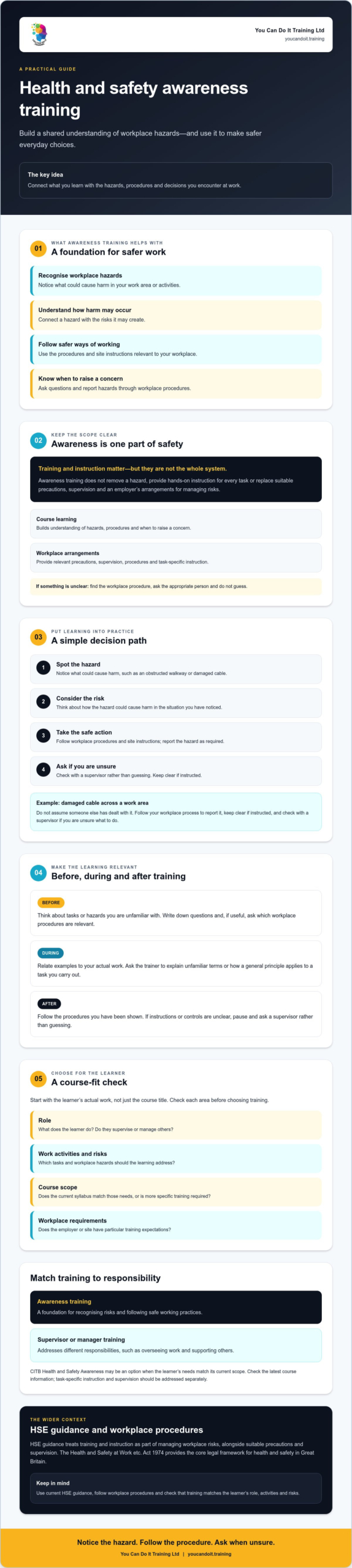
Health and safety awareness training helps people recognise workplace hazards, understand how harm may occur and know the safer ways of working expected in their workplace. It gives learners a shared foundation: what to look out for, how to follow procedures and when to raise a concern. The wider field of occupational safety and health covers protecting workers from risks to their safety and wellbeing.
Awareness is useful, but it isn’t a complete safety system. HSE guidance treats training and instruction as part of managing workplace risks, alongside suitable precautions and supervision. A course can explain why a control matters, but it can’t remove a hazard, provide hands-on instruction for every task or replace an employer’s arrangements for managing risks. Learners should know where to find workplace procedures and who to ask if something is unclear.
Who may benefit from workplace safety awareness training (HSA)?
Workers and employers can benefit from a shared understanding of everyday hazards, particularly when people need to spot risks and follow consistent procedures. On a construction site, for example, a worker might notice an obstructed walkway and need to know how to report it, whilst following site instructions. That doesn’t mean every construction worker has the same training needs: tasks, responsibilities and risks vary.
Before choosing a course, consider the learner’s role, workplace risks and any applicable site requirements. Someone who needs a general introduction may have different needs from a supervisor responsible for coordinating work. CITB Health and Safety Awareness is an option to consider when the learner’s needs match its current scope. Check the latest course information and HSE guidance, and make sure task-specific instruction and supervision are addressed separately.
How to put health and safety awareness (HSA)training into practice
Awareness makes a difference when it shapes what happens next. Spot the hazard, consider the risk, then take the safe action set out in your workplace procedures. Learners can put health and safety awareness training into practice by noticing what could cause harm, asking questions and applying the instructions relevant to their work.
For example, if you find a damaged cable across a work area, don’t assume someone else has dealt with it. Follow your workplace process to report it, keep clear if instructed and check with a supervisor if you’re unsure what to do. The Health and Safety at Work etc. Act 1974 provides the core legal framework for health and safety in Great Britain. HSE guidance can help employers and workers understand the wider context.
What should learners do before, during and after training?
- Before: Think about tasks or hazards you’re unfamiliar with. Write down questions and, if useful, ask your employer which workplace procedures are relevant.
- During: Relate the examples to your actual work. Ask the trainer to explain unfamiliar terms or how a general principle applies to a task you carry out.
- After: Follow the procedures you’ve been shown. If instructions or controls are unclear, pause and ask a supervisor rather than guessing.
Learning is easier to apply when people can connect it to real situations and speak up when something is unclear. If CITB Health and Safety Awareness matches your learning needs, review the CITB Health and Safety Awareness course as one training option.
How to choose health and safety awareness training that fits your needs
Start with the learner’s actual work, not just a course title. Before booking health and safety awareness training, check:
- Role: What does the learner do? Do they supervise or manage others?
- Work activities and risks: Which tasks and workplace hazards should the learning address?
- Course scope: Does the current syllabus match those needs, or is more specific training required?
- Workplace requirements: Does the employer or site have particular training expectations?
Awareness training gives workers a foundation for recognising risks and following safe working practices. Supervisor or manager training addresses different responsibilities, such as overseeing work and supporting others. For example, compare the focus of the SSSTS course guide with the IOSH Working Safely course guide. Check each course’s current scope rather than assuming the title tells you everything. The HSE’s information on the Health and Safety at Work etc. Act 1974 is also a useful reference for the wider UK health and safety framework.
When might CITB Health and Safety Awareness be a suitable next step?
You Can Do It Training Ltd provides CITB Health and Safety Awareness (HSA). Consider it when its current scope fits the learner’s role and requirements. Before choosing the course, confirm the latest course content and any relevant requirements with the provider and the employer. This helps you check that the training matches the need rather than relying on assumptions. If it appears suitable, explore the CITB HSA course as a possible next step.
Build safer habits, one decision at a time
Health and safety awareness training can help people recognise hazards and make safer everyday choices. It works best when learners apply it alongside workplace procedures and suitable supervision. Before choosing a course, consider the learner’s role, the risks they face and whether the course scope meets employer or site requirements. If the learner supervises or manages others, check whether a more role-specific course is a better fit.
CITB Health and Safety Awareness is a key course offered by You Can Do It Training Ltd. The provider also offers SSSTS, SMSTS and IOSH training for different learning needs, giving learners options to consider as their responsibilities develop.
Explore CITB Health and Safety Awareness training
Each hazard noticed, question asked and safe procedure followed can help strengthen a shared approach to safety. Build that understanding one decision at a time.
Frequently Asked Questions
Is health and safety awareness training a legal requirement in the UK?
There isn’t one generic health and safety awareness course that every worker must take. Employers need to provide appropriate information, instruction and training based on the work and risks involved. The right approach depends on the role and workplace. Employers should assess what people need to work safely, then decide whether general awareness training or more specific instruction is suitable.
What does health and safety awareness training cover?
Health and safety awareness training generally helps learners recognise workplace hazards, understand how harm could happen and follow safer ways of working. It may also help people understand workplace procedures and how to raise concerns. Course content varies, so check the current syllabus before booking. Awareness training alone may not provide the task-specific instruction, supervision or risk controls required for particular work.
Who should take health and safety awareness training?
It may suit workers who need a shared understanding of everyday workplace hazards and safe working practices. Before choosing a course, employers should consider each learner’s role, activities, workplace risks and any site requirements. For example, someone working on a construction site may need general awareness as well as instruction for particular tasks. Training needs can differ, even amongst workers on the same site.
Is health and safety awareness training the same as SSSTS or IOSH Working Safely?
No. These are distinct courses, and their scope and intended learners can differ. SSSTS is a supervisor-focused course, whilst IOSH Working Safely is another workplace safety training option. You Can Do It Training Ltd also provides CITB Health and Safety Awareness. Compare current course content with the learner’s responsibilities and employer requirements before deciding which option fits.










Leave a Reply
Want to join the discussion?Feel free to contribute!