

Calculating the Cost of Workplace Accidents in the UK: A Practical Guide
A £22.9 billion estimate sounds like a useful benchmark, but it represents the cost of workplace injuries and new cases of work-related ill health across Great Britain in 2023/24, not the bill for one employer. Calculating cost of workplace accidents UK employers actually bear means looking beyond immediate expenses to lost time, disrupted work and other impacts that can be easy to miss.
It’s understandable to want one clear figure, especially when you need to show why prevention deserves attention. A consistent estimate can help you understand the impact of an incident, explain your method and identify where better records or safer working practices could make a difference.
This guide sets out which costs to include, how to record them and how to interpret HSE figures without treating national estimates as your own. The aim is an incident-specific picture that supports practical, proportionate action.
Key Takeaways
- Separate direct expenses from less visible impacts, such as disrupted work, to build a fuller incident estimate.
- When calculating the cost of workplace accidents, define the incident period and trace each figure back to its evidence.
- Label each cost as actual or estimated, and record the source, calculation and assumptions.
- Compare cost patterns with incident trends and existing controls, then consider relevant training where it can support prevention.
What does calculating the cost of workplace accidents in the UK include?
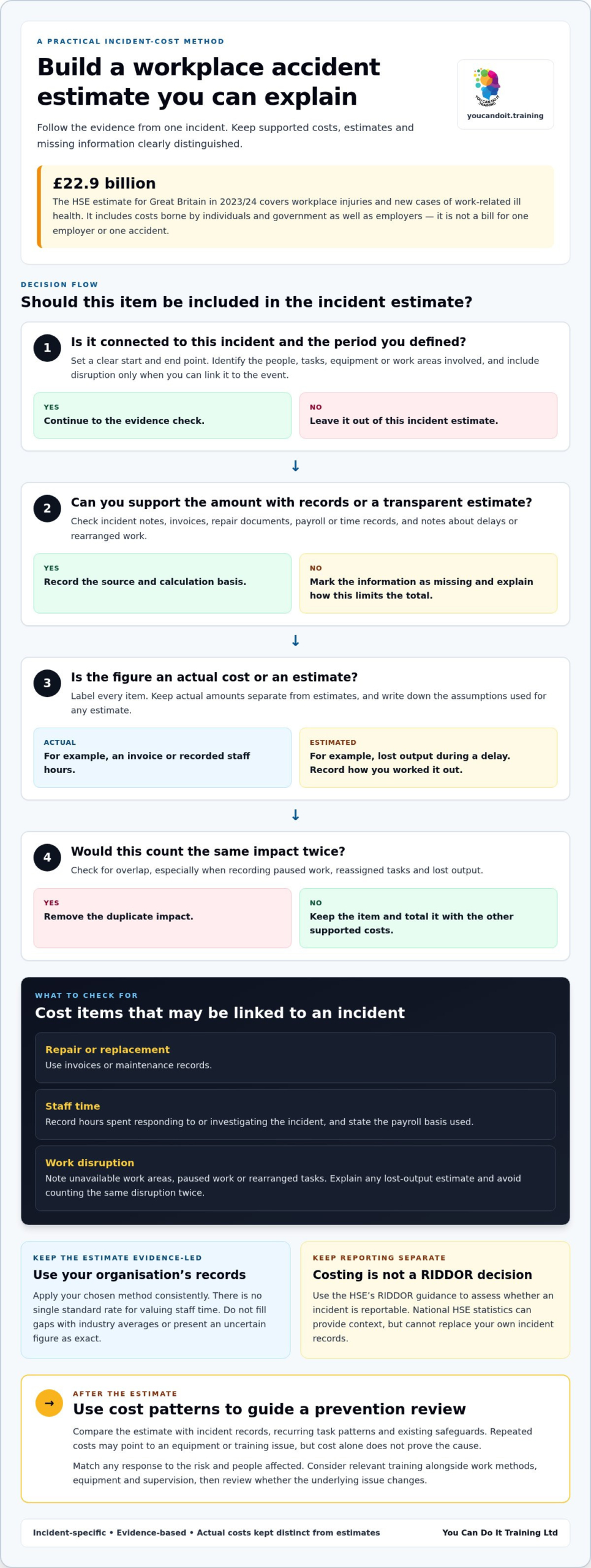
An employer-level accident cost is the recorded business impact of a specific incident over a defined period. It isn’t a share of a national estimate. The HSE’s figure describes costs across Great Britain, while your calculation should show what your organisation can evidence, such as repair bills, staff hours or work that had to be rearranged.
The HSE’s £22.9 billion estimate for 2023/24 covers Great Britain and includes workplace injuries and new cases of work-related ill health. It includes costs borne by individuals and government as well as employers. It is not the amount businesses collectively paid, or a price tag for one accident.
For calculating cost of workplace accidents UK businesses can use, keep direct and indirect costs distinct. Direct costs are usually easier to trace to an invoice or payroll record. Indirect costs may include time spent investigating, lost output while work is paused, or disruption when tasks are reassigned. These impacts matter too, but may need a transparent estimate rather than a precise bill.
Which accident costs can a business reasonably record?
Start with items linked to the incident and supported by evidence. Record each cost once, noting its source and whether it is an actual amount or an estimate.
- Repair or replacement costs, supported by invoices or maintenance records.
- Paid staff time spent responding to or investigating the incident, based on recorded hours and the payroll basis used in your calculation.
- Documented disruption, such as a work area being unavailable or planned work being rearranged. Explain how you estimated any lost output and avoid counting the same disruption twice.
Keep actual amounts separate from estimates. An invoice is an actual cost; an estimate of output lost during a delay should be labelled as estimated, with the assumptions recorded. Costing and reporting are separate questions. Use the HSE’s RIDDOR guidance to assess whether an incident is reportable.
How to calculate a workplace accident cost step by step
A consistent method makes estimates easier to explain and compare. For calculating cost of workplace accidents UK employers can use, keep each incident’s evidence and assumptions together rather than relying on a general average.
- Define the incident and period. Record what happened and set a clear start and end point for the estimate. This helps prevent unrelated costs from being included.
- Identify the work affected. Note which tasks, people, equipment or work areas were involved. Include disruption only where you can connect it to the incident.
- Gather evidence. Collect incident records, invoices, repair documents, payroll or time records, and notes showing work delays or rearrangements.
- Total the recorded costs. Add supported amounts, keeping actual costs separate from estimates. Don’t fill gaps with industry averages or present an uncertain figure as exact.
For each item, record its source, calculation basis, assumptions and status as actual or estimated. For example, staff time might be calculated from recorded hours using the payroll information selected for your method. Apply that method consistently. If the hours or impact can’t be established, mark the information as missing and explain how that limits the total.
What evidence should go into an incident cost estimate?
Use records relating to the event, such as incident notes, invoices, repair records and timesheets. Log investigation and management time consistently, including the hours counted and how you valued them. There is no single standard rate for this calculation, so explain the basis you used. Cost estimation is separate from reporting: refer to the HSE’s RIDDOR guidance to determine whether an incident must be reported.
For context, compare your method with the HSE statistics on the costs of workplace accidents and ill health, but don’t use national figures as a substitute for your own records. If reviewing the estimate highlights a skills need, relevant workplace safety training can form one part of a wider prevention plan.
Using accident cost findings to strengthen prevention
A cost estimate can help focus attention, but it doesn’t explain by itself why an incident happened or which control will work. Review it alongside incident records, recurring task patterns and the safeguards already in place. Look for patterns, then investigate them. Repeated costs linked to an activity may point to a training or equipment issue, but cost alone doesn’t prove the cause.
Turn the review into a proportionate next step. If records point to repeated handling-related incidents, consider whether Manual Handling training could address a relevant knowledge or practice gap. Where incidents involve working at height, review the controls and consider whether Working at Height training is appropriate. For broader worker awareness, IOSH Working Safely may be relevant. Match the response to the risk and the people affected, then review whether the underlying issue changes.
How can training support a practical prevention plan?
Training can build awareness and support safer workplace practice. It can’t guarantee that accidents will be prevented or deliver a particular saving. Make it one part of a wider plan that also considers work methods, equipment and supervision. Choose a format that fits the team and the work: classroom, onsite, webinar, online and blended learning are available.
For a general worker safety foundation, consider how IOSH Working Safely training could fit the needs identified in your review. The useful question isn’t simply whether an incident had a high recorded cost, but what practical learning or workplace change the evidence supports. Explore practical health and safety training as one possible step in an evidence-led prevention plan.
Make your next safety review count
A sound estimate is most useful when it helps your team decide what to examine next, rather than becoming a score attached to an individual. As you refine your approach to calculating cost of workplace accidents UK employers can use, connect each review to a practical action, assign responsibility and revisit the evidence after changes are made. This keeps attention on safer work and shared learning, not blame.
Where your findings point to a training need, choose learning that fits the work and the people involved. You Can Do It Training Ltd offers accredited health and safety training, with trainers who are Chartered Members of IOSH (CMIOSH) and have 30+ years of experience. The pass rate is 99%+.
Each thoughtful step can help build a workplace where people feel informed, supported and ready to work safely.
Frequently Asked Questions
How much does a workplace accident cost in the UK?
There’s no single cost for every employer or incident. The HSE’s 2023/24 estimate covers workplace injuries and new cases of work-related ill health across Great Britain, rather than setting a price for one accident. To estimate your organisation’s impact, use its records to identify costs linked to the event, and distinguish documented amounts from estimates.
Does the HSE’s £22.9bn figure represent employers’ costs alone?
No. For 2023/24 across Great Britain, the HSE’s estimate attributes £4.3 billion to employers, with the remaining costs borne by individuals and government. The employer share is still a national total, not a figure to allocate directly to one company or incident. Use your own records to establish which costs your business actually incurred.
Can a business calculate accident costs if some records are missing?
Yes. You can make a provisional estimate from the evidence available, but clearly mark gaps and assumptions. For instance, if a repair invoice exists but staff time wasn’t recorded, include the invoice as a documented amount and leave the time cost as unknown or estimated. Note the method used, and don’t present an uncertain total as exact. Better records can support future reviews.
Should near misses be included in a workplace accident cost calculation?
Keep a near-miss review separate from costs already incurred through an accident. A near miss may involve no injury, damage or immediate business expense, but recording it can help identify hazards and consider possible consequences. Don’t enter hypothetical losses or potential savings as actual costs. Instead, note any real response time or disruption and use the report to inform risk reviews.










Leave a Reply
Want to join the discussion?Feel free to contribute!