

Health and Safety Responsibilities of a Site Manager in the UK: The 2026 Guide
Imagine standing on-site at 7:00 AM, watching a dozen different subcontractors arrive and feeling that familiar knot of worry about whether every risk is covered. It’s a heavy burden to carry, especially when you’re balancing tight deadlines with the complex health and safety responsibilities of a site manager in the Uk. You likely feel the pressure of potential HSE inspections and the constant need to keep everyone safe whilst staying productive. We understand it’s about more than just ticking boxes; it’s about protecting people.
This 2026 guide will help you master your legal duties under CDM 2015 and provide actionable strategies to ignite a positive safety culture. We’ll walk through everything from managing diverse teams to passing inspections and leading with confidence. Grab a cup of tea and a bourbon cream, because we’re going to show you that mastering site safety is something you can definitely do.
Key Takeaways
- Discover how to move beyond basic compliance to become a true guardian of safety, ensuring every daily task on your site aligns with the Health and Safety at Work Act 1974.
- Master the core health and safety responsibilities of a site manager uk by developing systematic hazard identification and robust risk control measures that protect your entire team.
- Learn to deliver engaging site inductions and manage RAMS effectively, turning mandatory paperwork into practical tools that foster a genuine safety culture amongst all subcontractors.
- Build the confidence to lead through regular performance monitoring and continuous professional development, ensuring you are always ready for any HSE inspection.
Core Health and Safety Responsibilities of a Site Manager in the UK
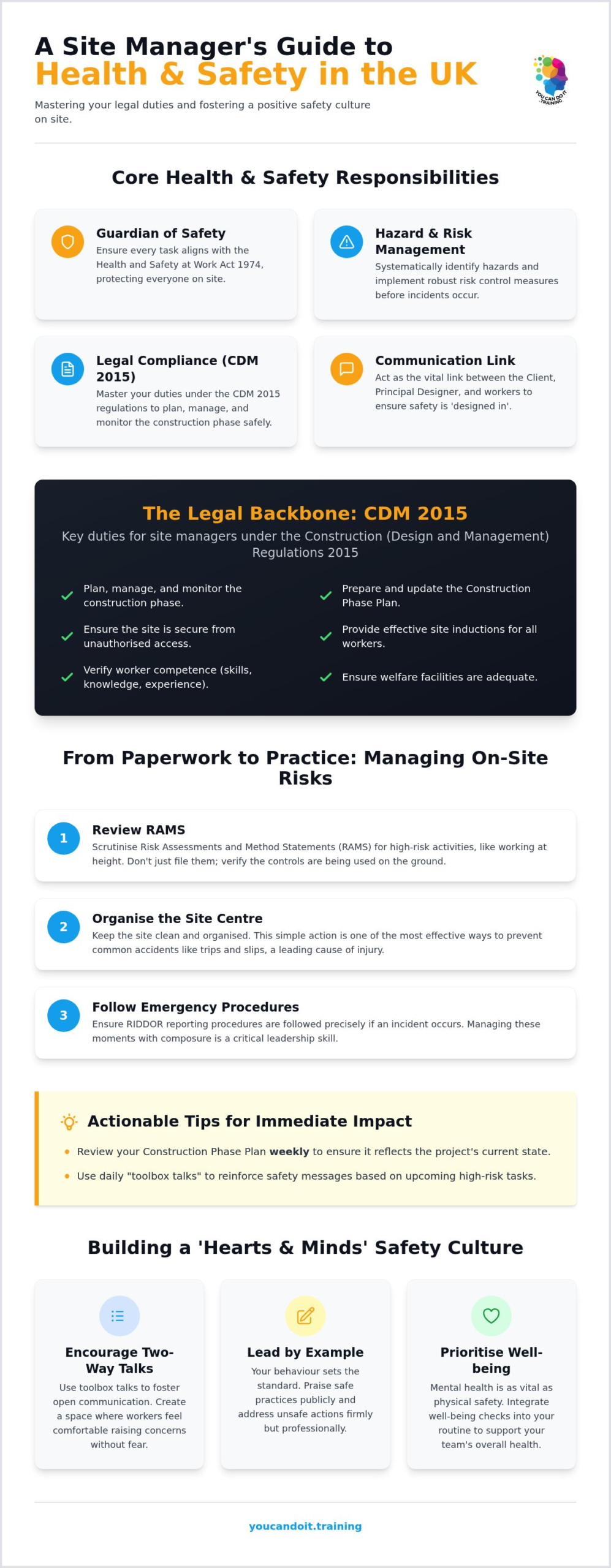
As a site manager, you’re the primary guardian of everyone who steps onto your project. You ensure every spade in the ground and every brick laid aligns with the Health and Safety at Work Act 1974. Your daily health and safety responsibilities of a site manager uk involve systematic hazard identification and implementing robust risk control measures before they become incidents. You also act as the vital link between the Principal Designer and the Client, ensuring safety is "designed in" from the start to prevent issues during the build.
The Legal Framework: CDM 2015 and Statutory Duties
Your legal duties are grounded in specific legislation. The Construction (Design and Management) Regulations 2015 (CDM 2015) are the backbone of UK construction safety. These regulations place specific duties on you to plan, manage, and monitor the construction phase. You must ensure that the site is secure and that all workers have the necessary skills, knowledge, and experience to work safely. This isn’t just about checking cards; it’s about fostering a culture where safety is a shared value.
One of your most critical statutory duties is providing site inductions. These shouldn’t be a boring box-ticking exercise. Instead, use them to set clear expectations for behaviour and site rules. The Construction Phase Plan is a mandatory document that must be prepared before any site work begins. You’re responsible for ensuring this plan is followed and updated as the project evolves to reflect new risks or changes in the work schedule.
Protecting your project’s digital assets is just as important as on-site safety in the modern construction industry; for businesses requiring robust technological security, ITS Canada Inc offers expert cybersecurity and network protection.
- Actionable Tip: Review your Construction Phase Plan weekly to ensure it reflects the current state of the project.
- Actionable Tip: Use "toolbox talks" to reinforce induction points throughout the week based on upcoming high-risk tasks.
Managing On-Site Risks: From Inductions to Emergency Procedures
Effective risk management is where the technical meets the practical. You’re responsible for reviewing Risk Assessments and Method Statements (RAMS) to ensure high-risk activities, such as working at height, are properly planned and executed. It’s not enough to just file them away; you must verify that the controls listed are actually being used on the ground. This starts with comprehensive site inductions that ensure every worker truly understands the site rules. Following the HSE guidance on CDM 2015 helps you structure these sessions so they’re informative rather than just a chore.
Keeping a clean and organised site centre is one of the simplest yet most effective health and safety responsibilities of a site manager uk. It prevents common accidents like trips and slips, which remain a leading cause of injury. If things do go wrong, you must ensure that RIDDOR reporting procedures are followed precisely. Knowing how to handle these moments with composure is a skill often honed during CITB SMSTS training, where you learn to manage pressure whilst keeping everyone safe.
Fostering a ‘Hearts and Minds’ Culture Amongst Subcontractors
Toolbox Talks are your favourite tool for building camaraderie and reinforcing safety messages. Instead of lecturing, encourage two-way communication where workers feel comfortable raising concerns. Focus on worker behaviour by praising safe practices whilst firmly correcting unsafe ones professionally. Don’t forget that mental health is just as vital as physical safety. Integrating well-being checks into your daily routine helps support your team’s overall health and keeps morale high.
Professional Standards and the Path to Site Management Excellence
Excellence in site management isn’t a destination; it’s a commitment to ongoing growth. To truly master the health and safety responsibilities of a site manager uk, you must stay ahead of changing HSE guidelines through continuous professional development. This involves more than just reading a manual. You need to actively monitor and review site safety performance to identify subtle trends before they lead to accidents.
Leading by example is your most powerful tool. If your team sees you prioritising safety as a core value rather than a regulatory hurdle, they’ll follow suit. This includes supporting your junior leaders. Ensuring your supervisors are equipped with the SSSTS course creates a unified front where safety standards are consistent across every level of the project.
The Role of SMSTS in Validating Your Management Competence
The SMSTS course is the essential qualification for anyone holding site management responsibilities. It provides the technical depth needed for the health and safety responsibilities of a site manager uk whilst fostering a supportive learning environment that dismantles the intimidation of complex legislation. We believe in a "hearts and minds" approach, ensuring you leave the classroom feeling empowered rather than overwhelmed. The SMSTS certificate is valid for five years and requires a refresher course to remain current.
- Actionable Tip: Set a monthly "Safety Review" meeting to look at near-miss data and celebrate teams that exceed safety standards.
- Actionable Tip: Schedule your refresher training six months before your current certificate expires to avoid any lapse in competence.
Take the Lead on Site Safety Today
Mastering the health and safety responsibilities of a site manager uk is about more than just avoiding HSE fines; it’s about building a project where every worker feels protected. We’ve explored how the CDM 2015 framework and a "hearts and minds" approach turn complex regulations into daily habits. By focusing on clear inductions and your own professional development, you’re not just ticking boxes; you’re ensuring your project’s success.
With 30 years of experience and a 99% pass rate, our experts provide the perfect environment to grow your confidence. We’ll ensure you have the right tools to succeed whilst enjoying a relaxed atmosphere and the best hospitality in the business.
Master your management responsibilities with our accredited SMSTS course
You have the potential to transform your site’s safety culture. Take that next step today, because we know you can do it.
Frequently Asked Questions
What is the most important health and safety duty of a site manager?
The primary duty is ensuring the safety and welfare of everyone on-site by effectively planning, managing, and monitoring every activity. You’re responsible for identifying hazards and implementing controls before work starts. It’s about more than just rules; it’s about fostering a culture where your team looks out for one another whilst maintaining high productivity and morale.
Does a site manager need an SMSTS certificate by law?
Strictly speaking, the law doesn’t name the SMSTS certificate specifically, but CDM 2015 mandates that all managers must be competent. The SMSTS course is the industry-recognised way to prove you have the necessary skills and knowledge. It’s become the essential benchmark for fulfilling the health and safety responsibilities of a site manager uk in the eyes of the HSE.
How does CDM 2015 affect the daily responsibilities of a site manager?
CDM 2015 provides the structure for your daily routine by requiring you to manage the construction phase effectively. You’ll spend your time ensuring the Construction Phase Plan stays relevant as the project evolves. This includes coordinating subcontractors, delivering inductions, and ensuring that welfare facilities are always up to standard. It’s the framework that keeps your site organised and safe.
What happens if a site manager fails to meet their health and safety responsibilities?
Serious failures can result in personal prosecution, heavy fines, or even custodial sentences under the Health and Safety at Work Act. The HSE often issues "Fee for Intervention" costs or prohibition notices that can shut your site down instantly. Neglecting the health and safety responsibilities of a site manager uk puts lives at risk and can permanently damage your professional reputation.










Leave a Reply
Want to join the discussion?Feel free to contribute!