

How to Carry Out a Risk Assessment in the Workplace UK: A 2026 Guide
What if the most effective way to protect your team wasn’t a complex spreadsheet, but a simple conversation shared over a cup of tea and a bourbon cream? Many managers feel overwhelmed by health and safety jargon, fearing that a single missed hazard could lead to legal action or a preventable injury. It’s easy to view these requirements as mere paperwork, but learning how to carry out a risk assessment in the workplace UK is actually about fostering a culture where everyone feels looked after.
In this 2026 guide, you’ll master the five essential HSE steps with confidence, even amidst new regulations like Martyn’s Law. We’ll show you how to move beyond the technicalities to ignite a hearts and minds approach that keeps your people at the centre of everything. You’ll discover practical tips to identify risks and implement controls, ensuring your organisation stays compliant whilst truly soaring.
Key Takeaways
- Understand your legal obligations under the 1999 Regulations and how to identify hazards to protect your team, contractors, and the public.
- Discover how to carry out a risk assessment in the workplace uk by following the five-step HSE framework to ensure every potential danger is addressed.
- Learn to evaluate risk levels accurately by weighing likelihood against severity, with a specific focus on protecting vulnerable groups like expectant mothers.
- Master the professional recording of significant findings and foster a “hearts and minds” safety culture through accredited training such as SSSTS or SMSTS.
The Foundation: UK Legal Duties and Identifying Workplace Hazards
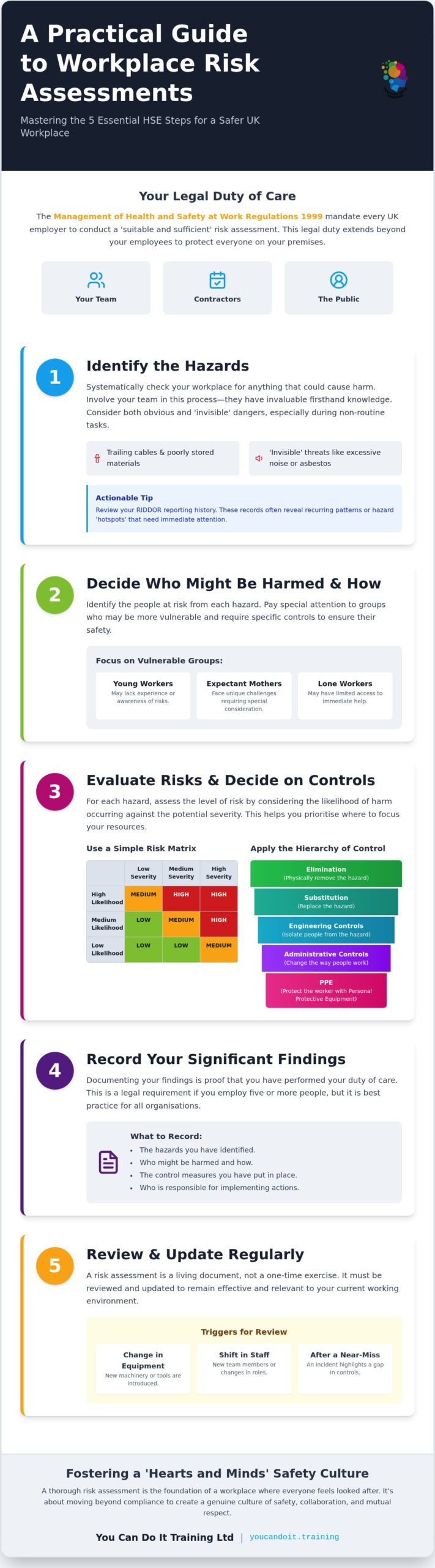
Understanding your legal obligations shouldn’t feel like a mountain to climb. The Management of Health and Safety at Work Regulations 1999 mandate that every employer must conduct a ‘suitable and sufficient’ assessment. This duty of care extends beyond your immediate staff; it covers contractors and any members of the public visiting your premises too.
You might worry that you need to be a safety expert to begin, but that isn’t the case. You simply need to be a ‘competent person’ with the right knowledge and training. Learning how to carry out a risk assessment in the workplace UK is a skill you can master, especially when you put the safety of your people at the heart of the process. Understanding what a risk assessment is gives you the confidence to lead safety talks effectively.
Spotting Hazards: Look, Listen, and Talk
Some dangers are obvious, like trailing cables or poorly stored materials. Others are harder to see. You must account for ‘invisible’ threats such as excessive noise or what is asbestos. It’s often the non-routine tasks, like quarterly maintenance or deep cleaning, where the most unusual hazards hide amongst the daily grind.
Don’t do this alone in a cold office. Walk the floor with your team and discuss how to carry out a risk assessment in the workplace UK together. They’re the ones who know the ‘workarounds’ and near-misses that don’t always make it into the official logs. This collaborative approach doesn’t just tick a box; it ignites a culture of mutual respect and safety awareness.
Evaluating Levels of Risk and Implementing Practical Controls
Once you’ve identified the hazards, you need to look at the human impact. This is Step 2 of the five steps to risk assessment. You must decide who might be harmed and how, paying special attention to vulnerable groups like young workers or expectant mothers. They often face unique challenges that require extra care and attention.
Step 3 is where you evaluate the risk. You’ll consider the likelihood of an incident occurring against the potential severity of the harm. It’s a balancing act. Learning how to carry out a risk assessment in the workplace uk helps you focus your time and resources on the areas that matter most for your team’s safety.
The Hierarchy of Control: Working Smarter, Not Harder
The Hierarchy of Control provides a structured way to choose safety measures. Always aim to eliminate the hazard first. If that’s impossible, try substitution by swapping a risky process for a safer alternative. Administrative controls, such as signage and rotas, then help to organise work behaviour safely.
Engineering controls and PPE act as your final lines of defence. Proper working at height training ensures your team knows how to use safety equipment effectively. When you master how to carry out a risk assessment in the workplace uk, you move from ticking boxes to truly protecting your colleagues. Our accredited safety courses help you build this confidence in a supportive atmosphere.
Recording Your Findings and Fostering a Safety Culture
Recording your significant findings is Step 4 of the process. While it’s only a legal requirement if you employ five or more people, we always recommend putting pen to paper regardless of your team size. A written record proves you’ve considered the risks and taken action; it’s much easier to demonstrate your commitment to safety when you have a clear trail. Accredited training like SSSTS or SMSTS provides the perfect template for professional recording, ensuring you don’t miss a thing.
Step 5 involves reviewing your assessment regularly. Don’t let it gather dust in a drawer. You must revisit it if there’s a change in equipment, a shift in staff, or after a near-miss. This keeps the document relevant and effective. Mastering how to carry out a risk assessment in the workplace uk means treating it as a living part of your daily routine rather than a one-off paperwork exercise.
Reviewing Your Assessment: A ‘Hearts and Minds’ Strategy
A successful review is one where your staff feel comfortable suggesting improvements without any fear of reprimand. This is the core of our ‘Hearts and Minds’ philosophy. Use the review process as a mentoring opportunity to ignite the spark of safety awareness in your newer workers. It’s about human connection and mutual respect, positioning the learner at the heart of everything you do.
Ignite a Culture of Safety and Success
Mastering how to carry out a risk assessment in the workplace uk is about more than just legal compliance; it’s about protecting the people who make your business soar. By following the five essential HSE steps and embracing a hearts and minds approach, you transform a mandatory chore into a meaningful opportunity for connection and respect. You’ve learned how to spot hazards, evaluate risks, and record findings in a way that truly engages your team. Remember that safety is a living conversation, best shared in a relaxed, professional environment where every voice matters.
Join thousands of successful supervisors with our 99% pass rate and thirty years of industry experience. We provide a relaxed, professional environment where the learner is at the heart of everything, ensuring you lead with confidence whilst keeping your team safe. You can do it.
Frequently Asked Questions
Do I legally need a written risk assessment if I have fewer than 5 employees?
No, you don’t legally have to write down your significant findings if you employ fewer than five people. However, the HSE still requires you to complete the full risk assessment process. We always suggest keeping a written record anyway. It helps you demonstrate your commitment to safety and provides a clear, reliable guide for your team during briefings.
How often should a workplace risk assessment be reviewed in the UK?
There isn’t a fixed legal expiry date, but you should review your assessment whenever it’s no longer valid. This usually happens if there’s a significant change to your equipment, staff, or work processes. If a near-miss or accident occurs, you must revisit the document immediately. Most businesses find that an annual check ensures their hearts and minds approach stays effective.
What is the difference between a hazard and a risk?
A hazard is anything with the potential to cause harm, such as a trailing cable or a chemical spill. A risk is the chance, high or low, that somebody could be harmed by that hazard, combined with how serious that harm might be. Understanding this distinction is key when learning how to carry out a risk assessment in the workplace uk effectively.
Who is considered a ‘competent person’ to carry out a risk assessment?
A competent person is someone with the necessary skills, knowledge, and experience to manage health and safety. You don’t need a specific degree, but you must understand the hazards in your specific environment. Many managers gain this competence through accredited courses. This training empowers you to understand how to carry out a risk assessment in the workplace uk with professional authority.








Leave a Reply
Want to join the discussion?Feel free to contribute!