

Accredited Health and Safety Training: UK Guide for 2026
Threatening teams with enforcement notices or site shutdowns rarely builds a genuinely safe workplace. Real compliance doesn’t stem from fear; it happens when people truly engage with the skills that protect their colleagues. If you are booking health and safety training or coordinating courses across the UK with You Can Do It .Training, you already know the dread of dreary, tick-box sessions that staff forget the moment they leave the room.
You deserve an approach that meets statutory duties without extinguishing enthusiasm. This 2026 guide reveals how to choose accredited health and safety training that guarantees full compliance with official Health and Safety Executive (HSE) standards. We examine core legal requirements, break down recognised CITB and IOSH credentials, and show you how practical, supportive instruction protects both your workforce and your business.
Key Takeaways
- Clarify your statutory employer obligations under the Health and Safety at Work etc. Act 1974 to keep your team protected and avoid costly enforcement actions.
- Match specific operational roles to the right CITB, IOSH, and safety qualifications when organising health and safety training stoke on trent or nationwide.
- Track critical certification lifespans and strict refresher deadlines for credentials like SMSTS, SSSTS, and workplace first aid before they lapse.
- Choose an accredited provider whose supportive, people-first approach turns dry compliance into engaging, practical habits on site.
Understanding UK Workplace Safety Regulations and Employer Legal Duties
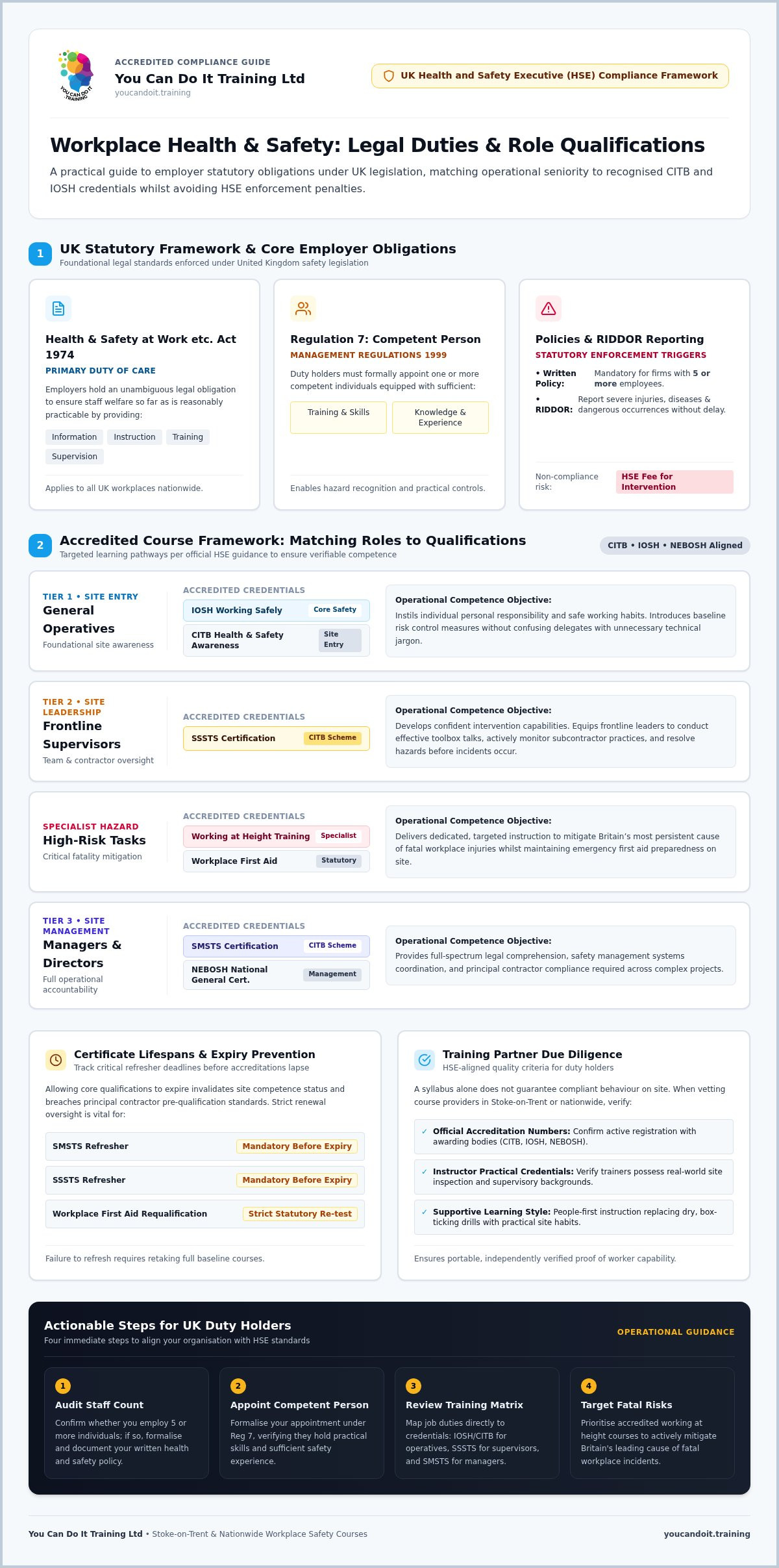
Every UK employer carries an unambiguous legal obligation to safeguard their workforce. Under the foundational Health and Safety at Work etc. Act 1974, businesses must provide the information, instruction, training, and supervision needed to ensure staff welfare so far as is reasonably practicable. Treating this responsibility as a defensive chore misses the point entirely. Investing in high-calibre health and safety training stoke on trent or across nationwide worksites replaces passive box-ticking with genuine operational confidence, transforming safety from an administrative hurdle into shared workplace pride.
Workplace learning actively prevents accidents by teaching staff why safeguards exist rather than just handing down rigid rules. It bridges the gap between written policy and real-world behaviour.
Core HSE Standards and Statutory Compliance Requirements
Under Regulation 7 of the Management of Health and Safety at Work Regulations 1999, duty holders must formally appoint one or more competent persons to assist in undertaking safety measures. Within UK statutory guidance, a competent person is defined as someone possessing sufficient training, knowledge, practical skills, and experience to recognize workplace hazards and implement sensible controls. In practice, this requires employers to:
- Assess site-specific operational risks and implement proportionate physical or administrative control measures.
- Maintain an up-to-date, written health and safety policy if employing five or more people.
- Establish robust procedures for statutory RIDDOR reporting to document severe workplace injuries, occupational diseases, and specified dangerous occurrences without delay.
Meeting these official Health and Safety Executive (HSE) standards protects your team from preventable harm while shielding your business from costly Fee for Intervention enforcement charges.
Essential Health and Safety Courses: Matching Qualifications to Roles
A blanket approach to workplace compliance leaves critical gaps in operational safety. As outlined in the official HSE guidance on health and safety training, effective instruction matches directly to daily tasks, operational seniority, and actual hazard exposures. Recognised qualifications give duty holders portable, independently verified proof of competence that reassures clients and satisfies principal contractors nationwide.
Accredited Frameworks from Site Entry to Senior Operations
Structuring a clear training pathway dispels confusion and builds genuine capability as staff advance through your organisation:
- General Operatives: Groundwork begins with personal responsibility. Accessible programmes like IOSH Working Safely or the CITB Health and Safety Awareness course introduce foundational controls and safe working habits without overwhelming learners with technical jargon.
- Frontline Supervisors: Stepping into site leadership demands confident intervention skills. Reviewing a comprehensive SSSTS course guide shows how team leaders learn to conduct effective toolbox talks, monitor subcontractor practices, and resolve site safety issues before incidents occur.
- High-Risk Operations: Specific workplace hazards require targeted competence. Completing dedicated working at height training directly mitigates Britain’s most persistent cause of fatal workplace injuries.
When arranging accredited health and safety training stoke on trent or coordinating nationwide workforce development, aligning qualifications with operational duties prevents costly gaps. If you are reviewing your company training matrix, explore accredited courses with You Can Do It Training to ensure your staff gain practical, industry-recognised credentials.
Selecting an Accredited Training Partner to Maximise Delegate Success
A comprehensive syllabus alone doesn’t guarantee safer behaviours once delegates return to their everyday duties. When vetting training providers, look beyond glossy marketing to verify official accreditation numbers, instructor credentials, and proven track records. Whether preparing personnel for broader safety coordination alongside qualifications like the NEBOSH National General Certificate or delivering frontline courses, instruction should be led by seasoned mentors. Tutors backed by Chartered IOSH status and decades of dedicated industry experience translate statutory concepts into relatable, working practices.
The Impact of a Supportive Learning Environment
Adult learners often arrive at training sessions feeling anxious about formal tests or fatigued by past tick-box instruction. Overcoming that hesitation requires a deliberate "hearts and minds" approach. A relaxed, encouraging atmosphere, accompanied by simple hospitality like fresh tea and friendly conversation, helps delegates settle in and actively participate. This psychological comfort is particularly crucial when mastering life-saving emergency actions, such as managing trauma or cardiopulmonary resuscitation during accredited first aid at work courses.
Arranging high-impact health and safety training stoke on trent or across nationwide facilities means partnering with trainers who position the student at the heart of the experience. When delegates feel supported rather than scrutinised, knowledge sticks, site confidence soars, and a 99% pass rate follows naturally. Contact You Can Do It Training today to explore upcoming course dates and empower your team with practical, accredited qualifications.
Transform Your Workplace Safety Culture Today
Meeting statutory obligations doesn’t have to feel like an uphill battle against dry regulations. When you match the right qualifications to operational roles and choose supportive mentors, compliance becomes an empowering foundation for everyday teamwork. Whether booking health and safety training stoke on trent or organising nationwide workplace programmes, partnering with an experienced provider makes all the difference. With over thirty years of dedicated industry expertise, full accreditation across CITB, IOSH, PASMA, and UKATA frameworks, and a consistent 99% delegate pass rate, creating a safer worksite is completely within your reach.
Discover accredited courses with You Can Do It Training
Equip your team with practical skills, protect your business from costly operational delays, and build lasting site confidence today.
Frequently Asked Questions
What health and safety training is legally required for UK businesses?
UK law doesn’t prescribe a single mandatory certificate for every business. Instead, the Health and Safety at Work etc. Act 1974 requires employers to provide adequate instruction tailored to their identified risks. Baseline requirements typically include workplace inductions, task-specific risk controls, emergency first aid, and fire safety, alongside appointed competent supervisor training for higher-risk operations.
How do CITB site safety schemes differ from IOSH courses?
CITB Site Safety Plus courses cater specifically to the construction and civil engineering sectors, establishing clear site leadership pathways from entry-level awareness through to site management. IOSH programmes provide cross-industry safety education relevant to any commercial environment. If you are organising health and safety training stoke on trent or nationwide, selecting between them depends on your specific trade and site requirements.
How often do workplace health and safety qualifications require refresher training?
Renewal intervals depend directly on the awarding body. CITB qualifications like SSSTS and SMSTS remain valid for five years with zero renewal grace period, meaning you must complete an official refresher before expiry. Workplace first aid certificates require requalification every three years, whilst the HSE recommends annual skill refreshers to maintain practical emergency readiness across your workforce.
What should delegates expect during an accredited safety training course?
Delegates should expect an interactive, supportive learning environment rather than days of passive slide lectures. High-calibre providers use open group discussions, practical workplace scenarios, and approachable mentoring over hot tea and biscuits to demystify complex compliance. This encouraging atmosphere builds genuine camaraderie, dispels test anxiety, and ensures learners leave with lasting practical confidence for the job.









Leave a Reply
Want to join the discussion?Feel free to contribute!