
Work at Height Training Requirements for UK Employers
A fall can cause serious injury even when a job is close to the ground. The working at height training requirements in the UK focus on workers’ competence, not on completing one particular course.
It’s understandable to want a clear rule for deciding who needs training and what that training should cover. According to the UK Government, the Work at Height Regulations 2005 don’t specify a particular training course; people carrying out the work must be competent. There’s also no minimum height threshold: the key question is whether someone could fall a distance liable to cause injury.
This guide explains what counts as working at height, how employers should prioritise controls and what competent workers need to know. It also shows how training fits into planning and supervision, helping employers put their legal duties into practice and protect their teams.
Key Takeaways
- Decide whether a task could cause an injurious fall; there’s no minimum height threshold.
- Prioritise avoiding work at height, then assess the risks and choose suitable controls and equipment.
- Plan and supervise the work, including what happens if someone needs rescuing.
- Match training and instruction to the task so workers can carry it out competently and safely.
What is the hierarchy of control for work at height?
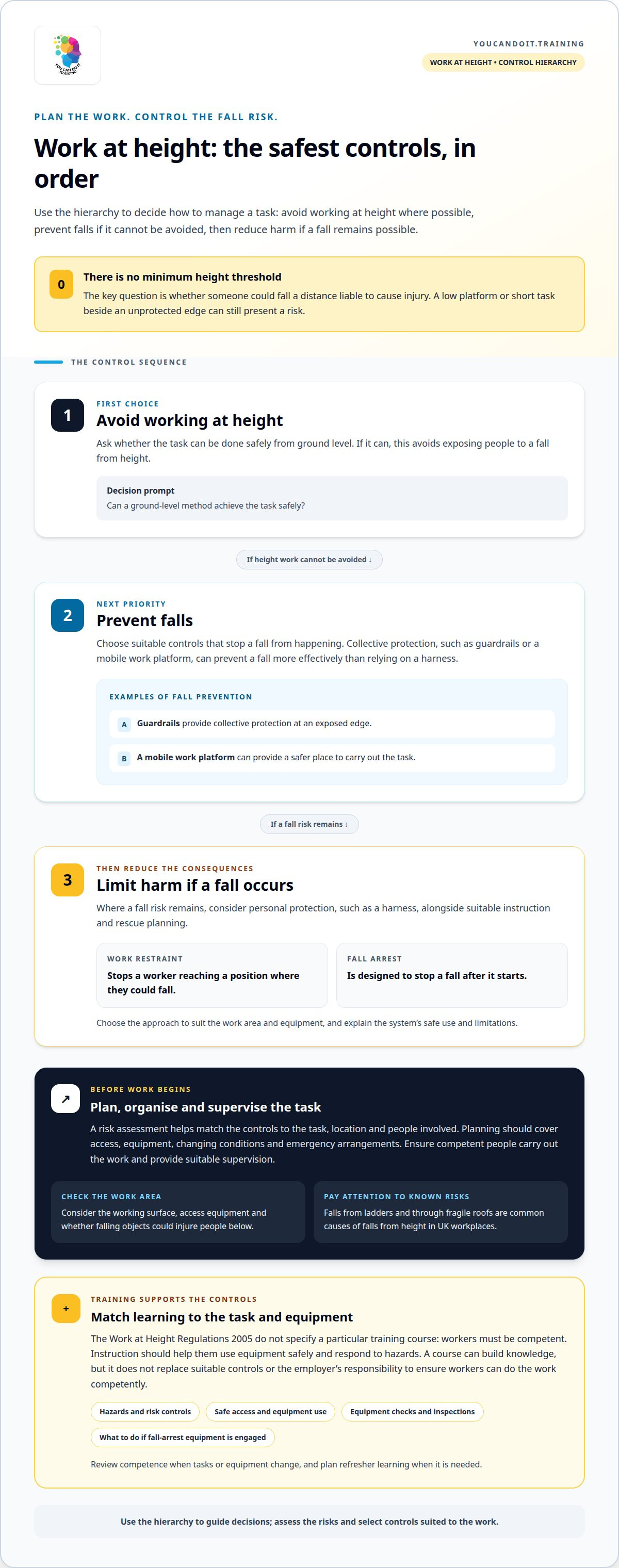
A risk assessment helps employers choose controls suited to the task, location and people involved. The hierarchy is to avoid working at height where possible, prevent falls if the work cannot be avoided, and minimise the consequences if a fall remains possible. For example, a safe work platform may prevent a fall more effectively than a harness.
According to UK Government, Regulation 4 of the Work at Height Regulations 2005 concerns organisation and planning. Employers must organise and plan the work, provide suitable supervision, and ensure competent people carry it out. Planning should cover access, equipment, changing conditions and emergency arrangements.
- Avoid the work: use a ground-level method where it achieves the task safely.
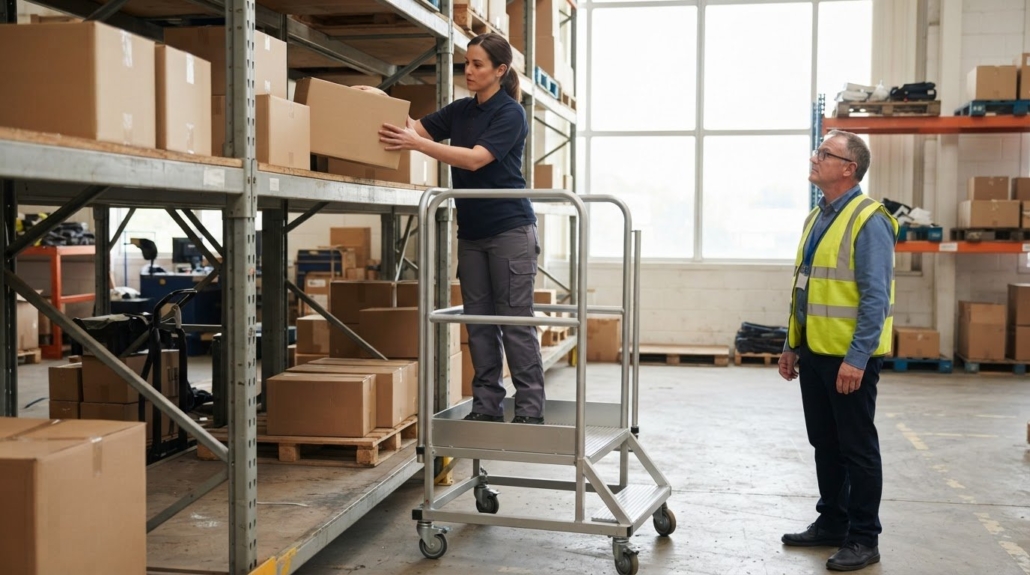
- Prevent falls: select suitable collective protection, such as guardrails or a mobile work platform.
- Reduce harm: where a fall risk remains, consider personal protection, such as a harness, alongside instruction and rescue planning.
Training supports these controls but does not replace them. Instruction should match the equipment and task, so workers know how to use equipment safely and respond to hazards. A course can build knowledge, but employers must also ensure workers are competent to do the work.
Falls from ladders and through fragile roofs are common causes of falls from height in UK workplaces. A risk assessment should consider the working surface, access equipment and whether falling objects could injure people below.
Workers must take reasonable care of themselves and others, and co-operate with their employer’s health and safety arrangements. Employers can consult HSE guidance on working at height for practical information about planning, equipment choices and training.
What is Working at Height?
Two UK regulations shape how employers assess fall risks and prepare people to work at height. Their requirements depend on the risk of injury, not on a fixed distance above the ground.
Regulations governing work at height
The Work at Height Regulations 2005 apply where a person could fall a distance liable to cause injury. The Management of Health and Safety at Work Regulations 1999 require employers to assess risks and introduce suitable controls. According to the UK Government, the 2005 Regulations require competence, not a particular training course. Managers and supervisors need instruction suited to their planning and oversight duties. Training costs depend on the course format, delivery arrangements and learner requirements; the price depends on the case and is given after a quote request.
The no-minimum-height rule
The Work at Height Regulations 2005 set no minimum height threshold. The deciding factor is whether someone could fall far enough to suffer injury, so a low platform or an elevated work area can still present a risk. For example, assess a short task beside an unprotected edge as carefully as work at greater height. Employers should consider the task, access, surface and people affected, then choose appropriate precautions before work is carried out.
Fall arrest and work restraint
A work restraint system stops a worker from reaching a position where they could fall. A fall arrest system, such as a harness connected to suitable equipment, is designed to stop a fall after it starts. This distinction matters when choosing controls: restraint prevents access to the hazard, while fall arrest relies on equipment to catch the worker. Employers should assess the work area, platforms and equipment, then instruct workers on the system’s safe use and limitations. Managers and supervisors must ensure the approach is suitable for the task and properly planned.
Training and competence
Training should prepare each person for their task, equipment and workplace. Employers also need to plan supervision and check that workers can apply what they have learnt.
Competence, planning and supervision
Competence means having the knowledge, training and practical ability to carry out assigned work safely. The UK Government says the Work at Height Regulations 2005 do not specify a particular training course; they require people carrying out work at height to be competent. The working at height training requirements in the UK therefore focus on suitable competence for the task. Employers should match instruction to each task, then plan supervision around workers’ experience and risks. Review competence when tasks or equipment change.
General and equipment-specific training
General training covers hazards, risk controls and safe working practices. Equipment-specific training explains how to use particular equipment correctly. A worker who understands fall risks may still need instruction before using a ladder, platform or fall-arrest system. Employers should match learning to the task, including equipment checks and inspections, so workers can recognise when conditions make the work unsafe.
Qualifications and certificates
No particular qualification or certificate is universally required by the height regulations 2005. The requirement is that workers are competent for the work they carry out. A certificate can record completed learning, but employers still need to consider whether the person can perform the specific task safely. For construction work, consider the environment, access equipment and fall risks liable to cause injury.
Online and practical learning
Online learning can explain hazards, procedures and controls, while practical instruction helps workers use equipment correctly. The working at height training requirements in the UK call for learning suited to the task and to what workers need to demonstrate. Training can cover recognising risks, safe access, equipment use and inspections, as well as what to do if fall-arrest equipment is engaged. Plan refresher learning when tasks, equipment or a worker’s competence change.
You Can Do It Training: Working at Height Training
You Can Do It Training Ltd provides Working at Height Training to help workers recognise fall hazards and understand safer working practices. It can support employers in building workers’ knowledge alongside task-specific instruction, equipment familiarisation and supervision.
For broader site responsibilities, CITB Site Supervisor Safety Training Scheme (SSSTS) and CITB Site Management Safety Training Scheme (SMSTS) cover safety duties at supervisor and manager level. Choose training that suits each person’s role, then connect the learning to the risks and equipment they encounter at work.
Training contributes to competence but does not replace suitable planning or controls. To build your team’s working-at-height knowledge, contact You Can Do It Training Ltd to discuss Working at Height Training and the other courses that may suit your team’s responsibilities.
Make training part of safer work
Make training a practical part of how work is organised. When tasks, equipment or responsibilities change, consider whether workers and supervisors need further instruction to carry out their roles. To address the working at height training requirements in the UK, match learning to each person’s responsibilities, from site awareness to supervision and management.
You Can Do It Training offers CITB Health and Safety Awareness (HSA), CITB Site Supervisor Safety Training Scheme (SSSTS) and CITB Site Management Safety Training Scheme (SMSTS). These courses can complement working-at-height learning when broader site safety responsibilities are relevant.
Keep building a workplace where people feel prepared to make safer choices.
Frequently Asked Questions
Are ladders and stepladders banned under WAHR?
No. Ladders and stepladders can be used when a risk assessment finds the risk low and the work lasts 15-30 minutes, or site features make an alternative impossible. For example, assess the task, footing and access before choosing a ladder. The equipment must suit the work, and workers need to understand its safe use.
Do the Regulations only apply above 2 metres?
No. The Work at Height Regulations 2005 set no minimum height threshold. They can apply whenever someone could fall a distance liable to cause personal injury, including from a low platform or step. Consider what lies below the work area, the surface and how the task is carried out, rather than relying on a height cut-off.
How many people die from falls at work in the UK?
In Great Britain, 35 workers died from falls from height in 2024/25. The figure shows why even familiar tasks, such as accessing a roof or using a ladder, deserve careful attention. Employers can use incident patterns within their own workplace to identify tasks needing closer review, while remembering that one severe fall can have life-changing consequences.
Is a rescue plan really a legal requirement?
Yes. Work at height must be properly planned, including emergency and rescue procedures. A rescue plan should suit the work and equipment, rather than relying on the emergency services as the only response. For example, if fall-arrest equipment stops a fall and leaves a worker suspended, the plan needs to explain how they will be brought to safety.
What’s covered?
Working at height training should help workers recognise hazards and follow the safe system for their task. Relevant topics include access equipment, ladders, fragile surfaces, falling objects, equipment checks and emergency arrangements. For example, someone using a mobile platform needs instruction suited to that equipment, not just general awareness of fall risks.








Leave a Reply
Want to join the discussion?Feel free to contribute!