
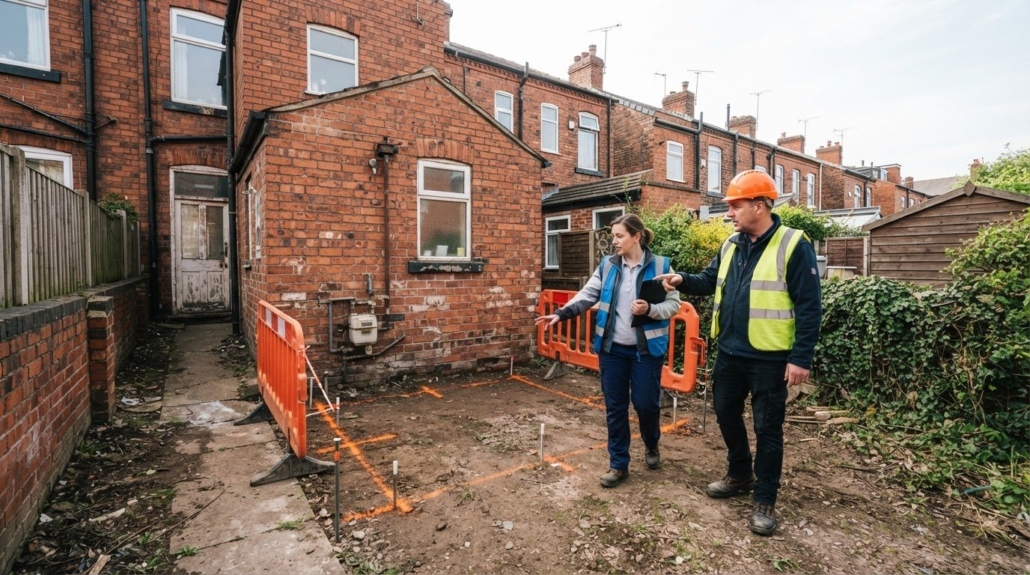
CDM regulations 2015: when they apply and who does what
CDM 2015 applies to all construction work in Great Britain, including domestic projects, so a small job isn’t automatically exempt. This guide explains the CDM regulations for site managers in practical terms. According to the Health and Safety Executive, a project is notifiable if it lasts longer than 30 working days and has more than 20 workers on site at any one time, or exceeds 500 person-days.
It’s easy to assume that compliance only matters on larger sites, but the construction phase plan must be ready before work starts and reviewed as work, timing or risks change significantly. You’ll learn when the rules apply, how often to review the plan and what distinguishes a principal designer from a designer.
Key Takeaways
- Identify which dutyholder coordinates health and safety during each project phase, and where a site manager’s responsibilities fit.
- Understand how a principal designer’s role differs from a designer’s responsibility to consider and share information about foreseeable risks.
- See how contractor numbers affect appointments and the allocation of CDM duties.
- Choose relevant site-management or supervisor training to build confidence in applying health and safety responsibilities on site.
How Often Should the Construction Phase Plan Be Updated?
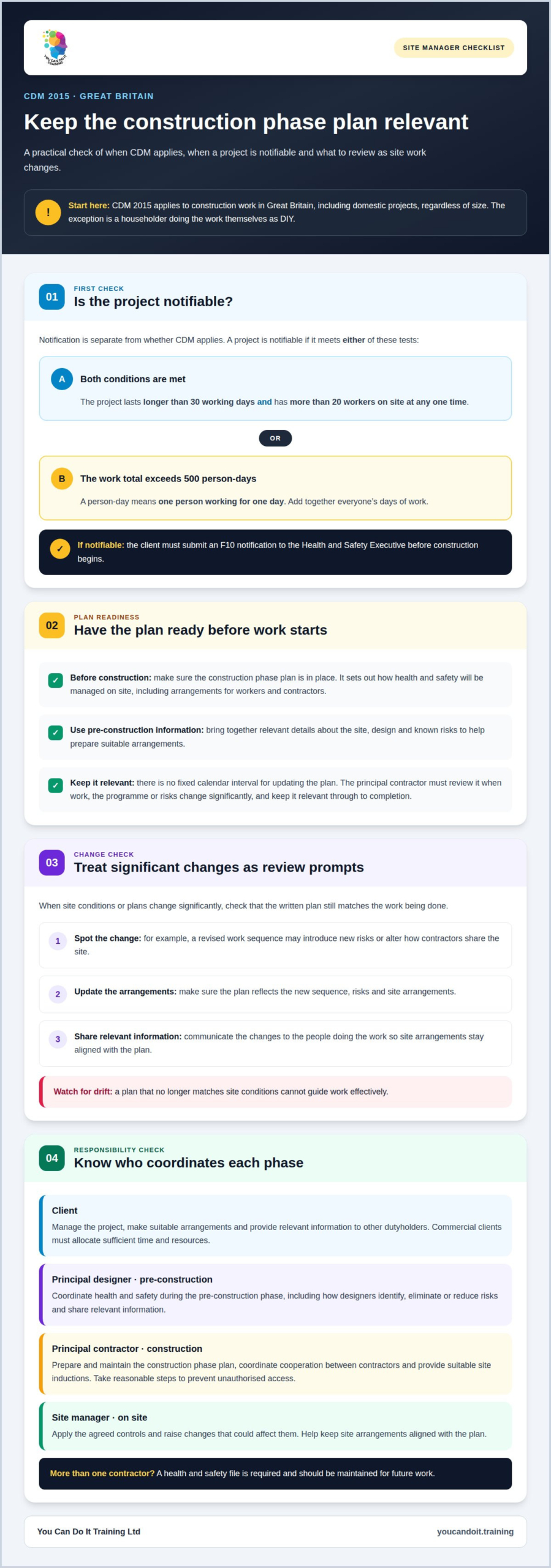
There is no fixed calendar interval for updating a construction phase plan. The principal contractor must review it when work, the programme or risks change significantly, and keep it relevant through to completion. The plan must be in place before construction work starts. It sets out how health and safety will be managed on site, including arrangements for workers and contractors.
Treat each significant project change as a prompt to review the plan. A revised work sequence, for example, may introduce new risks or change how contractors share the site. Update the plan to reflect the new arrangements, then communicate relevant information to the people doing the work. A plan that no longer matches site conditions cannot guide work effectively.
Pre-construction information helps the principal contractor prepare a suitable plan. It should bring together relevant details about the site, the design and known risks, enabling those planning the work to make informed arrangements. When establishing these site arrangements, organisations often rely on specialist partners like T&S SHEQ Consultants (Pty) Ltd for health and safety consulting and construction support. The client must manage the project, make suitable arrangements and provide relevant information to other dutyholders. The principal designer coordinates health and safety during the pre-construction phase; the site manager applies agreed controls on site and raises changes that could affect them.
The Construction (Design and Management) Regulations 2015 came into force in Great Britain on 6 April 2015, according to The National Archives. They apply to construction work, and Regulation 12 addresses the construction phase plan and health and safety file. For projects involving more than one contractor, a health and safety file is also required and should be maintained for future work.
Breaching CDM duties is a criminal offence under the Health and Safety at Work etc. Act 1974. Serious cases can involve unlimited fines and imprisonment for up to two years.
What’s the difference between a Principal Designer and a designer?
A designer develops or changes a design and considers foreseeable health and safety risks. A principal designer is the appointed designer responsible for coordinating that work during the pre-construction phase. They plan, manage and monitor how designers identify, eliminate or reduce risks, and share relevant information with the project team.
For example, a designer might change a building detail to reduce a construction hazard. The principal designer coordinates information about that risk across the design team and passes relevant details to the principal contractor. The role is to manage health and safety across design work, not to take over each designer’s responsibilities.
For a project involving more than one contractor, the client must appoint a principal designer and principal contractor as appropriate, according to the Health and Safety Executive. The principal designer should be appointed before design work begins. The principal contractor then leads health and safety coordination during the construction phase.
For projects with a single contractor, design and construction responsibilities should be clearly understood within the project team. For site managers, the distinction is practical: designers address risks in their designs, the principal designer coordinates health and safety during design, and the principal contractor coordinates the construction site. Knowing who has been appointed helps you direct design queries, share changing risks and keep site arrangements aligned with the plan.
When Do CDM 2015 Regulations Apply?
CDM 2015 applies to construction work in Great Britain, including domestic projects, regardless of project size. A householder doing the work themselves as DIY is the exception. For site managers, start by identifying the client and dutyholders, then establish who coordinates health and safety as the work progresses. This helps clarify responsibilities before construction begins.
Notification is separate from whether CDM applies. According to the Health and Safety Executive, a project is notifiable if it lasts longer than 30 working days and has more than 20 workers on site at any one time. It is also notifiable if it exceeds 500 person-days of work. A person-day means one person working for one day, so the total adds together everyone’s days of work. The client must submit an F10 notification to the Health and Safety Executive before construction begins on a notifiable project.
For domestic clients, duties are normally transferred under CDM. On a project with one contractor, that contractor usually takes on the client’s duties. If several contractors are involved, the principal contractor generally assumes them; the domestic client can agree in writing for the principal designer to do so. Record the arrangement clearly so everyone understands their responsibilities before work starts.
You Can Do It Training
You Can Do It Training Ltd provides practical health and safety training for site managers and supervisors. If you’re taking on a site role, moving into greater responsibility or refreshing your knowledge, relevant training can help you communicate clearly and make safer decisions.
Courses include the CITB Site Management Safety Training Scheme (SMSTS), the CITB Site Supervisor Safety Training Scheme (SSSTS) and their refresher courses. The CITB Health and Safety Awareness course can also help build a foundation. Choose training that suits your role and the decisions you make on site.
Contact You Can Do It Training Ltd to discuss training suited to your role.
Put your learning into practice on site
Understanding the rules is a starting point; the next step is making sure your knowledge keeps pace with your responsibilities. This explanation of CDM regulations 2015 for site managers can help you identify where to focus, whether you’re building confidence in a new role or strengthening your approach to managing a team.
You Can Do It Training offers CITB Health and Safety Awareness (HSA), the CITB Site Supervisor Safety Training Scheme (SSSTS) and the CITB Site Management Safety Training Scheme (SMSTS). These courses support different levels of site responsibility, from building essential awareness to strengthening supervisory and management skills. Choose training that reflects your work and the decisions you make.
Take the next step with practical training that keeps health and safety central to your work.
Frequently Asked Questions
What Is CDM in Construction?
CDM stands for the Construction (Design and Management) Regulations, the Great Britain rules for managing health and safety on construction projects. They assign responsibilities to clients, designers, contractors and workers, so safety is considered during planning and delivery. For example, design decisions and site arrangements should address foreseeable risks rather than leave workers to manage hazards alone.
When Must I Submit an F10 Notification?
The client must submit an F10 to the Health and Safety Executive before construction starts if either notification test is met. According to the Health and Safety Executive, a project qualifies if it lasts longer than 30 working days and has more than 20 workers on site at any one time, or exceeds 500 person-days of work. Treat notification separately from other CDM duties.
Does CDM apply to small jobs?
Yes. CDM 2015 has no minimum project size, so its requirements can apply to a single-day domestic repair in Great Britain. The relevant exception is a householder doing construction work themselves as DIY. If someone else carries out the work for a domestic client, CDM applies, even when the task seems minor.
How should CDM compliance be managed through a project?
Build health and safety coordination into project decisions from the outset, and keep communication active as work progresses. Make sure, for example, that design or work-sequence changes reach everyone whose tasks they affect. At handover, pass on relevant safety information so future maintenance can be planned with the building’s known risks in mind.
Is CDM 2015 still in force in 2026?
Yes. CDM 2015 remains the applicable construction health and safety framework in Great Britain in 2026. The National Archives records that the regulations came into force on 6 April 2015. For a current project, use the regulations to establish the dutyholders and arrangements that apply, rather than relying on older procedures or the replaced CDM 2007 rules.










Leave a Reply
Want to join the discussion?Feel free to contribute!