
How to Show Management the Value of a Safety Training Budget
According to the Health and Safety Executive, an estimated 680,000 workers in Great Britain sustained a non-fatal workplace injury in 2024/25. That’s why learning how to justify a safety training budget to management means showing how prevention supports both people and business priorities.
It can be hard to make the case for safety training when the cost is clear but the cost of preventable incidents is less visible. A focused proposal makes the risks and potential consequences easier to assess, and explains how training addresses them.
This article explains why workplace safety needs a budget, how direct and indirect costs differ, and how to present a training proposal to senior management. Use the practical steps to connect training needs with business priorities and build an evidence-based case.
Key Takeaways
- Use workplace absence and incident patterns to show why safety spending deserves a place in the budget.
- Separate immediate costs from less visible effects, such as disruption, lost productivity and reputational harm.
- Build a management case by linking training proposals to current risks and business priorities.
- Identify whether management training, such as the CITB Site Management Safety Training Scheme (SMSTS), fits the needs of your team.
Why should you have a workplace safety budget?
A safety budget helps leadership plan training around workplace risks and business priorities. Use evidence to show how prevention can support employees and operations.
-
Build a legal-responsibility business case
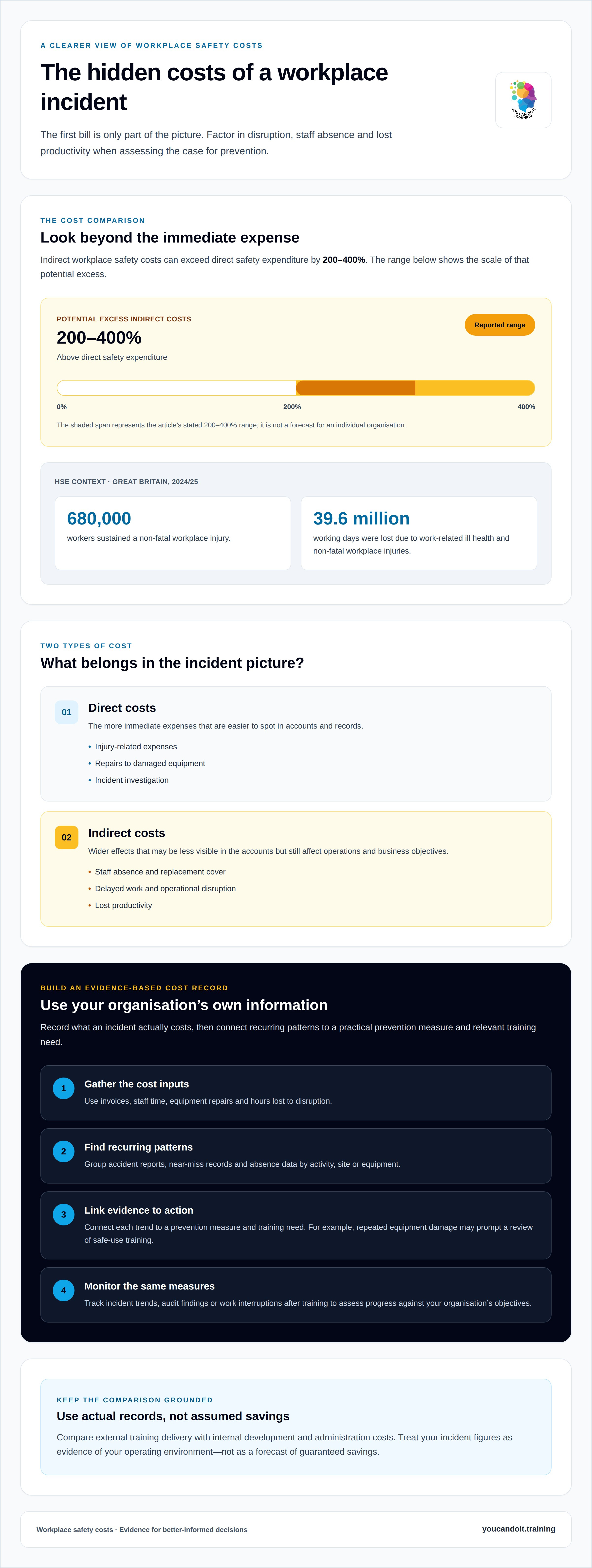
Map each critical workplace risk to the training and action that address it. According to the Health and Safety Executive (HSE), 680,000 workers in Great Britain sustained a non-fatal workplace injury in 2024/25, and 39.6 million working days were lost due to work-related ill health and non-fatal workplace injuries. HSE guidance says employers must provide suitable health and safety training. Use these figures and guidance to explain why internal monitoring, planned prevention and appropriate training matter. Avoid claiming a course alone guarantees compliance.
-
Align training with business objectives
Link each training priority to a business aim, such as safer project delivery or fewer operational interruptions. Record who needs training, why their role creates that need, and when the training should take place. There is no single grant for every UK employer: potential support depends on sector, eligibility and course. Consider internal training funds and relevant sector schemes before finalising the programme.
-
Link training to measurable outcomes
Choose an internal measure before training begins and monitor it afterwards. Track near-miss reports, audit findings, corrective actions or work interruptions against a baseline. Set a review date and name the person responsible for gathering results. This gives leadership evidence to assess whether the investment supports its intended outcome, rather than relying on attendance records alone.
-
Present safety investment in business terms
Calculate the cost per employee using the actual course fee, number of learners and any relevant delivery or travel costs. There is no single UK cost per employee, as these factors shape the total. Present the requested spend alongside the risk it addresses, the operational benefit sought and the monitoring plan. This gives leadership a clear basis for weighing the investment and its potential return.
What is the difference between direct and indirect safety costs?
Separate immediate bills from the wider disruption an incident can cause. Considering both gives your organisation a fuller financial picture.
-
Distinguish direct and indirect costs
List direct costs first: injury-related expenses, repairs to damaged equipment and incident investigation. Then record indirect effects, such as staff absence, replacement cover, delayed work and lost productivity. These costs can be less visible in the accounts, but they still affect the workplace and business objectives. Indirect workplace safety costs can exceed direct safety expenditure by 200-400%, so avoid presenting the initial invoice as the full cost.
-
Quantify incident costs
Build a cost record from invoices, staff time, equipment repairs and hours lost to disruption. Use your organisation’s own records to show how an incident affects its operating environment, rather than treating that figure as a forecast. Compare external training delivery with internal development and administration costs. E-learning can reduce training logistics costs and support flexible delivery, tracking and analytics. For role-specific learning, explore external safety training as one option.
-
Use accident and incident data
Group accident reports, near-miss records and absence data by activity, site or equipment. Look for recurring patterns, then connect each one to a practical prevention measure and training need. For example, repeated equipment damage may prompt a review of how employees are trained to use it safely. Present incident trends alongside direct and indirect costs, then monitor the same measures after training. This helps leadership assess progress against organisational objectives without promising guaranteed savings.
Justifying safety expenditure to senior management
Make the proposal a business decision, not just a request for courses. Connect workforce risks, compliance needs and learning plans to evidence management can assess. To answer “how to justify safety training budget to management,” present a focused case tied to the organisation’s priorities.
- Show the scale of the exposure. Set out the injuries, ill health and operational disruption your organisation faces. Use this context alongside your own incident records, without presenting a national estimate as your organisation’s expected saving.
- Make the risk specific to your workforce. Identify the jobs, tasks or sites where a training need is most pressing. In 2024/25, 964,000 workers in Great Britain reported work-related stress, depression or anxiety, resulting in 22.1 million working days lost. Explain which risks your proposal addresses and why the selected learning is relevant.
- Present clear options and measures. Explain how to justify safety training budget to management by setting out the courses, intended learners, delivery approach and total internal cost. Add measures you can monitor, such as completion, incident trends or audit findings. Link each measure to an objective instead of promising a particular reduction in injuries.
- Ask for a decision and review point. State the funding required, the risk it addresses and when management will review progress. Fines for larger organisations under health and safety sentencing guidelines can run to millions of pounds, so explain the compliance exposure without implying a fine is inevitable. A clear review lets leadership assess the evidence and adjust future spending.
Explore safety training options
You Can Do It Training Ltd: CITB Site Management Safety Training Scheme (SMSTS)
You Can Do It Training offers the CITB Site Management Safety Training Scheme (SMSTS), a relevant option when your proposal identifies a need for site management training. Match the course to roles and risks in your organisation, then explain that connection in your request to leadership.
For different workforce needs, CITB Health and Safety Awareness (HSA) may suit an awareness-focused proposal, while CITB Site Supervisor Safety Training Scheme (SSSTS) is relevant to supervisor training. CITB SSSTS Refresher is another option when refresher training is the priority. Selecting a course by role keeps proposed spending connected to the identified training need.
Contact You Can Do It Training Ltd to discuss which training option fits your team’s needs.
Turn the proposal into a practical next step
Knowing how to justify a safety training budget to management is most useful when it leads to a practical plan. Start by identifying the next decision: which role needs development, what work-related risk the learning should address, and how progress will be reviewed. This gives leadership a clear route from approval to action, with employees and their day-to-day work at the centre.
A focused conversation can help turn your training priorities into a workable proposal for your team.
Contact You Can Do It Training Ltd
Build the case one step at a time, making safer working part of how your organisation moves forward.
Frequently Asked Questions
What If Safety Is Too Expensive?
Safety spending can be phased around the most urgent training needs rather than approved as one unrestricted programme. Separate essential role-specific learning from development that can wait, then explain the operational consequences of delaying each item. This helps management weigh the trade-offs without treating course fees as the only cost or suggesting training alone prevents every incident.
What evidence shows safety training reduces workplace injuries and costs?
Use several forms of evidence to build a balanced picture. Course assessments can show knowledge gained, while supervisor observations can indicate whether safe practices are being applied. Review incident records for longer-term context, comparing similar tasks and periods and noting changes in staffing or processes. Avoid attributing every improvement to training; careful assessment is more credible than attendance records alone.
How can you calculate the return on investment of safety training?
Estimate return on investment by comparing documented financial benefits with the full cost of training. One useful calculation is: (estimated avoided incident costs minus training costs) divided by training costs, then multiplied by 100. Treat any avoided costs as an estimate, not a guaranteed saving. Include delivery, employee time and follow-up, and explain which records support your assumptions.
What are the costs of workplace accidents to UK employers?
Costs vary with the incident and its consequences. These estimates help frame potential financial exposure, but an employer’s own costs depend on factors such as disruption, absence and equipment damage.
How can you link safety training to business goals and performance measures?
Start with a clear business objective, then choose a measure that reflects the work affected. If a project needs fewer delays, for example, connect relevant learning to safe task execution and monitor equipment-related disruption alongside supervisor observations. Assign someone to collect the results and agree when leadership will review them. This makes the link between learning and operational performance easier to assess.









Leave a Reply
Want to join the discussion?Feel free to contribute!