

Stoke-on-Trent Working at Height Training 2026
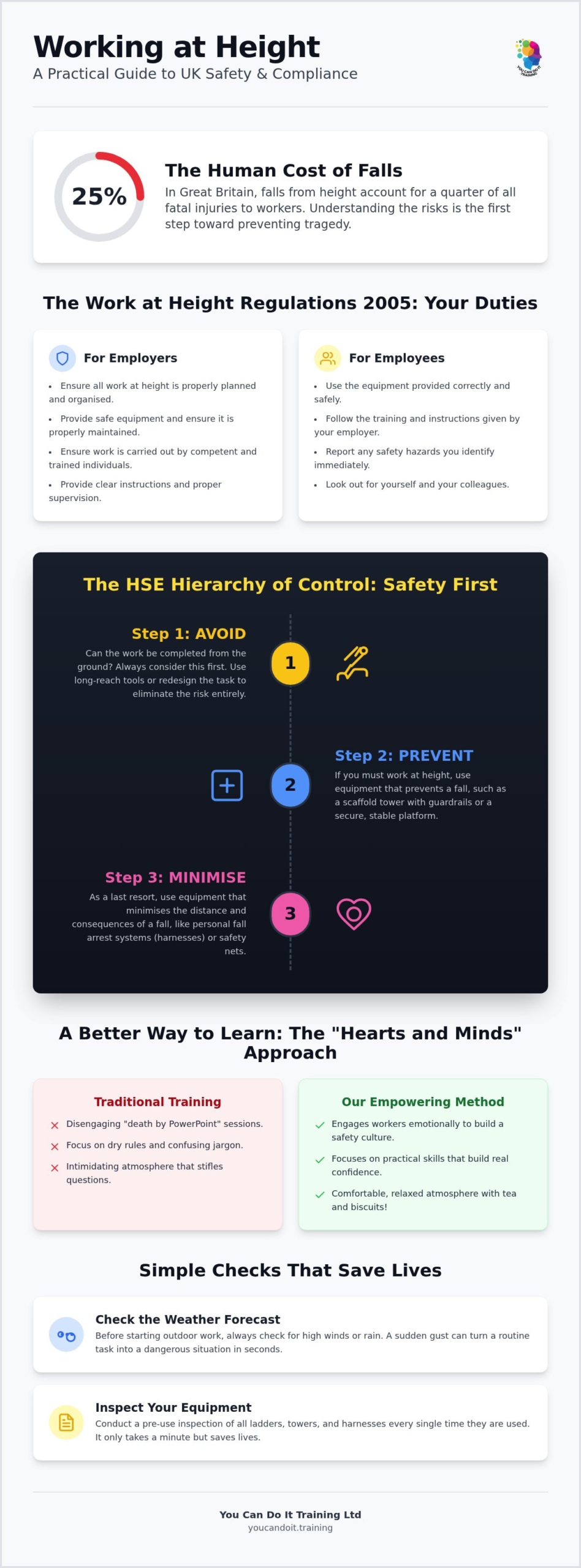
Did you know that in 2025/26, falls from height caused 31 workplace fatalities in Great Britain, accounting for a quarter of all fatal injuries? If you’re seeking working at height training stoke on trent, you want more than a certificate; you want the peace of mind that your team is truly safe. We know that the Work at Height Regulations 2005 can feel like a mountain of confusing jargon, and the dread of an HSE inspection often turns safety sessions into a boring chore.
Our “Hearts and Minds” approach changes that by focusing on empowerment rather than just instruction. We’ll help you master the essentials of height safety and UK compliance through practical, hands-on skills that build workplace confidence. You’ll learn how to prevent falls and protect your colleagues in a relaxed environment, all whilst enjoying a proper brew and a bourbon cream.
Key Takeaways
- Understand your legal obligations under the Work at Height Regulations 2005, which define working at height as any location where a person could fall a distance liable to cause personal injury.
- Master the HSE hierarchy of risk control to prioritise site safety, ensuring you always consider avoiding work at height before moving to prevention or mitigation measures.
- Experience our unique working at height training stoke on trent that uses a “Hearts and Minds” philosophy to turn mandatory safety compliance into an empowering learning opportunity.
- Transform your workplace safety culture by engaging with training that prioritises learner comfort, complete with a supportive environment and the all-important bourbon creams.
Legal Duties and the Work at Height Regulations 2005
Let’s look at the law without the headache. The Work at Height Regulations 2005 aren’t just red tape; they’re a safety net designed to prevent the tragedies that still account for a quarter of UK workplace deaths. According to the HSE, “working at height” is any place where a person could fall a distance liable to cause personal injury. This means whether you’re on a ladder, a scaffold, or a flat roof, the rules apply. Our working at height training stoke on trent helps you cut through the jargon to understand these vital protections.
Responsibilities are a two-way street. Employers have a legal duty to provide safe equipment and clear instructions, whilst employees must use that gear properly and report any hazards. It’s about building a culture of mutual respect where everyone looks out for one another. If a task involves a personal fall arrest system, it’s vital that the user knows exactly how to inspect and wear it before their feet leave the ground.
Key Responsibilities Under HSE Guidelines
Planning is everything. The HSE guidelines state that all work must be properly organised, supervised, and carried out by competent persons who have the right skills. Working at height training ensures that every operative understands the risks and the specific equipment required to mitigate them safely. To ensure your site is equipped with high-quality gear, you can check out Colorado Safety Supply Company for their full range of industrial safety solutions. It isn’t just about ticking a box; it’s about making sure you’ve got the confidence to stay safe every day.
Actionable tip: Always check the weather forecast before starting any outdoor work at height to avoid wind or rain hazards. A sudden gust can turn a routine task into a dangerous situation in seconds.
Implementing the Hierarchy of Risk Control on Site
The HSE hierarchy of control isn’t just a suggestion; it’s the gold standard for site safety planning. When you book your working at height training stoke on trent, we’ll dive deep into why this sequence is non-negotiable under the Work at Height Regulations 2005. The logic is simple: if you don’t have to go up, don’t. Avoidance is always the first port of call, such as using reach-and-wash poles for window cleaning to remove the risk entirely.
If avoidance isn’t possible, we move to prevention. This involves using equipment that stops a fall from happening, such as guardrails or PASMA-approved towers. Only when these options are exhausted do we look at mitigation, which aims to minimise the consequences if a fall does occur. Selecting the right gear is about matching the tool to the task, ensuring every operative feels secure and supported in their environment.
Selecting the Correct Access Equipment
Choosing the right kit requires a logical three-step approach to keep everyone safe:
- Step 1: Avoid – Can the work be done from the ground? Think about long-reach tools or changing the design of the task.
- Step 2: Prevent – If you must go up, use a safe place like a balcony or a mobile tower with proper rails.
- Step 3: Minimise – Use safety nets or fall arrest gear to reduce the impact of a potential accident.
Actionable tip: Conduct a pre-use inspection of all ladders and towers every single time they’re moved or erected. It only takes a minute but saves lives.
If you’re ready to empower your team with these practical skills, our accredited safety courses provide the perfect blend of technical knowledge and hands-on experience.
Why a “Hearts and Minds” Approach Transforms Workplace Safety
Safety isn’t just about rules; it’s about people. If you’ve ever felt intimidated by technical jargon or bored by “death by PowerPoint,” you’ll know that information rarely sticks when you’re disengaged. Our “Hearts and Minds” philosophy prioritises human connection by engaging workers emotionally. This fosters a genuine safety culture that goes beyond simple compliance. When a team member understands why they’re following HSE guidelines, they aren’t just ticking a box; they’re looking out for their mates. This shift from discipline to empowerment is at the core of our working at height training stoke on trent.
We believe that comfort is a catalyst for learning. A relaxed atmosphere, filled with plenty of tea, coffee, and the legendary bourbon creams, helps dismantle the barriers often found in vocational training. When people feel at ease, they’re more likely to ask questions and share their own site experiences. There’s a direct link between the confidence gained in professional working at height training and overall site productivity. A confident worker is an efficient worker who doesn’t hesitate to do the job safely.
Creating a Supportive Learning Environment
Camaraderie and mutual respect are the foundations of our classroom experience. Our tutors aren’t just instructors; they’re knowledgeable mentors with 30 years of industry experience who’ve seen it all. They use that wisdom to “ignite the spark” of safety awareness in every student, making technical content feel accessible. We move away from cold, clinical instruction to create a psychological space where every learner feels valued and heard.
Actionable tip: Encourage open dialogue on site about “near misses” without fear of punishment to foster a proactive safety culture. Learning from mistakes before they become accidents is the best way to keep your team safe.
Empower Your Team for a Safer Future
Ensuring your team returns home safely every day is the greatest achievement any site manager can reach. We’ve explored how mastering the Work at Height Regulations 2005 and implementing the HSE hierarchy of control creates a robust foundation for site safety. It’s about more than just rules. By choosing working at height training stoke on trent that prioritises the “Hearts and Minds” of your operatives, you transform mandatory compliance into a proactive culture of care.
With over 30 years of industry-leading experience and a 99% pass rate, we provide a student-centred environment where technical information truly sticks. You’ll find a relaxed atmosphere that fosters genuine camaraderie. Every learner leaves with the skills and confidence to soar.
It’s time to ignite the spark of safety awareness and lead your next project with total peace of mind.
Frequently Asked Questions
What is the legal definition of working at height in the UK?
The HSE defines working at height as any location where a person could fall a distance liable to cause personal injury. This isn’t limited to ladders or scaffolding; it includes working near an edge or even at ground level next to an opening in the floor. Basically, if a fall could hurt you, it’s certain the regulations apply.
Do I need a specific certificate to work at height?
You need to prove you’re “competent” to perform the task, which typically involves holding an accredited certificate. Employers are legally responsible for ensuring staff have the right skills and knowledge. Completing professional working at height training stoke on trent gives you the formal recognition needed so you don’t have to worry about proving your skills on any UK site.
How often should working at height training be refreshed for compliance?
Industry standards generally suggest refreshing your training every three to five years to stay compliant. It’s vital to update your skills if safety regulations change or if you start using different equipment. Staying current ensures that safety isn’t just a one-time lesson but a constant habit that keeps you and your colleagues protected from avoidable accidents during high-risk tasks.
What is the hierarchy of control for working at height?
The hierarchy of control is a mandatory sequence: avoid, prevent, and minimise. You must first try to avoid working at height by doing the job from the ground. If that’s impossible, you use collective measures like guardrails to prevent a fall. If a fall risk remains, you must use personal equipment to minimise the distance and impact of the fall.










Leave a Reply
Want to join the discussion?Feel free to contribute!