
3 ways to assess safety training effectiveness through workplace behaviour and measurable outcomes
A completed course is a starting point, not proof that safer work has followed. To understand how to measure the effectiveness of safety training, use three checks: assess what people have learnt, observe whether they apply it at work, and compare relevant safety outcomes against clear goals. Together, these show more than attendance alone.
It’s natural to want a clear figure showing whether safety training has made a difference. A useful evaluation combines measurable results with observations from workers and supervisors, helping you identify what’s working and where further support is needed.
This article explains why evaluation matters, which workplace behaviours to observe and how to set outcomes before training begins. You’ll find practical ways to track learning, use feedback and assess whether improvements last.
Key Takeaways
- Look beyond attendance: gather learner feedback and compare safety knowledge before and after training.
- Observe everyday work practices to see whether people use equipment properly and follow safe procedures.
- Choose clear safety goals before training, then compare relevant results over time to assess progress.
- Use the findings to identify where further learning, such as CITB Health and Safety Awareness training, could help.
1. Why Is Measuring the Effectiveness of Safety Training Important?
Measuring training shows whether employees understand safety procedures and use them at work. It also helps an organisation improve its safety training programme, strengthen its culture and identify learning gaps before they contribute to injuries. Treat evaluation as a cycle: gather feedback, check learning, then review workplace outcomes.
UK health and safety law requires employers to provide suitable training for workplace risks and ensure employees can work safely. Review training when tasks, equipment or risks change, and assess whether employees can apply what they’ve learned.
Useful measures include assessment results, employee feedback, observed safe practices, near misses and injuries. Use anonymous surveys to ask whether the training was clear, relevant and useful for real tasks. A rating scale can measure satisfaction, while an open question can surface concerns about equipment, communication or confidence in handling hazards.
Employees’ views after training are valuable: confidence may suggest understanding, while uncertainty can highlight areas that need clarification. Invite employees to suggest practical improvements and report hazards, as they may notice barriers managers miss. Track survey responses and participation in safety discussions over time. Attendance alone does not show that learning has taken place.
Assess knowledge and skills with a short test before training, followed by comparable questions afterwards. Include a realistic scenario, such as choosing a safe response to a workplace hazard, to assess practical judgement as well as recall.
The Kirkpatrick model evaluates training at four levels: reaction, learning, behaviour and results. In practice, gather learner feedback, test knowledge, observe work practices and review outcomes such as injuries. It has been used for 60 years, but the four checks help connect learner experience with workplace impact.
Check how employees apply their learning a few weeks after training, then monitor whether improvements continue. To assess cost-effectiveness, compare training costs with relevant outcomes, such as incident-related absence and safer work practices. Use this evidence to inform decisions, not as proof that training alone caused every change.
2. Observing workplace behaviour and safety practices
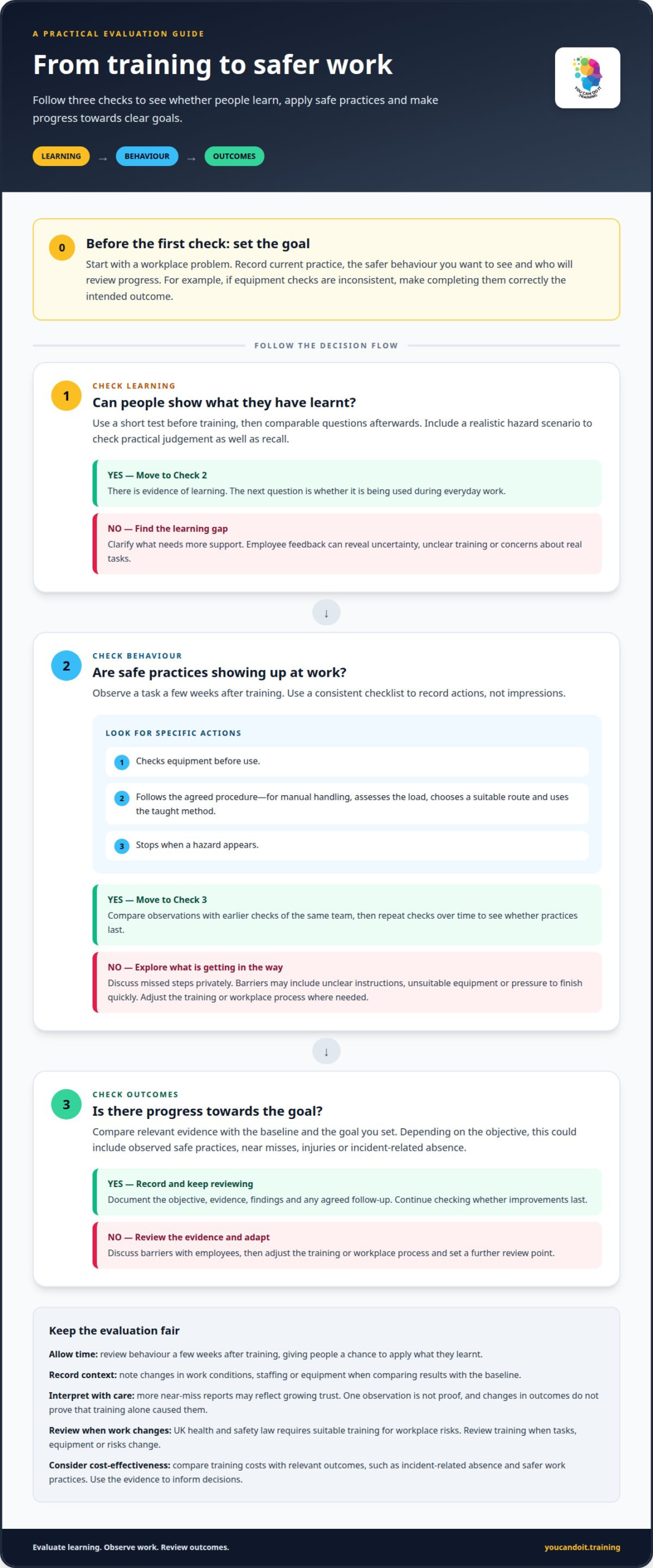
Knowledge and skills matter most when employees use them during everyday work. Observe a task after training and record specific actions, such as checking equipment before use, following the agreed procedure and stopping when a hazard appears. These leading indicators show whether learning is becoming safer workplace behaviour before an incident occurs.
Use a short, consistent checklist so supervisors assess actions rather than rely on general impressions. For a manual handling task, note whether the employee assesses the load, chooses a suitable route and uses the taught method. Record what happened, not assumptions about the person’s attitude or motivation.
Observe work a few weeks after training, once employees have had a chance to apply their learning. Compare results with earlier observations of the same team, then discuss missed steps privately. Ask what made the safe action difficult: unclear instructions, unsuitable equipment or pressure to finish quickly can all affect behaviour.
To assess changes in safety culture, look for patterns across the team. Do employees raise hazards, remind colleagues about safe practices and join safety discussions? Compare these observations with incident and near-miss records, bearing in mind that reporting may increase as trust grows. Repeat checks over time to see whether better practices last; one observation is not proof.
Supervisors can strengthen these skills through role-specific learning. For those overseeing site teams, the CITB Site Supervisor Safety Training Scheme can support practical understanding of safety responsibilities and workplace conduct.
3. Setting measurable safety-training outcomes
Start with a workplace problem the training should address, then define the change you want to see. If a task’s risk assessment identifies inconsistent equipment checks, for example, set an outcome around completing those checks correctly. To understand how to measure the effectiveness of safety training, record current practice, the desired behaviour and who will review progress.
Choose evidence that matches the learning objective. A written test may assess procedural knowledge, while a supervisor’s observation can show whether an employee follows a procedure during a real task. Measure quality as well as completion: it is more useful to know whether checks identified defects and led to appropriate action than simply to record that they took place.
Set a review point that gives employees a fair chance to apply their learning. Compare results with the baseline and record changes in work conditions, staffing or equipment. This context helps managers interpret whether an outcome reflects training, changed exposure or another workplace factor, and supports better decisions in future.
You Can Do It Training: CITB Health and Safety Awareness (HSA)
You Can Do It Training delivers CITB Health and Safety Awareness (HSA) for workers who need to build their health and safety awareness. If your evaluation identifies gaps in foundational knowledge, this course can be a relevant next step. Set a learning goal, then assess how participants apply what they’ve learned.
The CITB Site Supervisor Safety Training Scheme (SSSTS) is designed for site supervisors, while site managers can consider the CITB Site Management Safety Training Scheme (SMSTS). The CITB SSSTS Refresher supports supervisors refreshing their learning. Match the course to the role and training need, then review whether learning transfers to work.
Contact You Can Do It Training or visit youcandoit.training to discuss your training needs.
Turn your findings into safer everyday work
Knowing how to measure the effectiveness of safety training gives you a starting point. Use your findings to address gaps, support safer choices and keep checking whether learning fits the work people actually do. When training goals reflect real roles and risks, evaluation becomes part of improving the workplace, not just a record of completed courses.
You Can Do It Training provides learning for workers, supervisors and managers. If your findings point to a need for role-specific health and safety training, explore suitable courses to support your next steps and build confidence across the team.
Keep listening, learning and making practical improvements. Each thoughtful step can help strengthen a safer workplace culture.
Frequently Asked Questions
Why Is Measuring the Effectiveness of Safety Training Important?
Evaluation shows whether learning is helping employees make safer decisions, rather than simply confirming attendance. It can also reveal gaps between training examples and real working conditions. If a procedure is difficult to follow in a cramped work area, for instance, employee feedback could prompt a review of the task setup, supervision or workplace controls.
How can training transfer to workplace behaviour be measured?
Check whether employees can explain why a safety step matters, as well as carry it out. After training on a site procedure, for example, ask a worker to explain how they would respond if conditions changed. Their answer can show whether they know when to pause, raise a concern or seek guidance, rather than simply repeat a familiar sequence.
How do you measure the impact of safety training on incident and injury rates?
Compare incident and injury records from before and after training, grouping them by task or type to make patterns easier to interpret. Check whether the work or hours of exposure changed between periods. Review near-miss reports alongside injury records, as they can highlight hazards even when nobody has been hurt.
What are the limitations of using accident rates to assess training effectiveness?
Accident rates show recorded outcomes, but cannot explain why an incident happened or whether training caused a change. A quiet period may reflect fewer hazardous tasks, while better reporting may increase recorded incidents. Combine accident data with observations and employee accounts to build a fuller picture and guide practical improvements.









Leave a Reply
Want to join the discussion?Feel free to contribute!